Atoka County fossil region
Southeastern Oklahoma, United States
Antlers Formation
regional marker
Pronunciation: AK-ro-KAN-tho-SORE-us ah-toe-KEN-sis
A giant Early Cretaceous predator from Oklahoma and Texas, distinguished by a deep skull, powerful three-fingered arms and a ridge of tall spines along its neck, back and tail.
Last updated 16 July 2026
Field guide
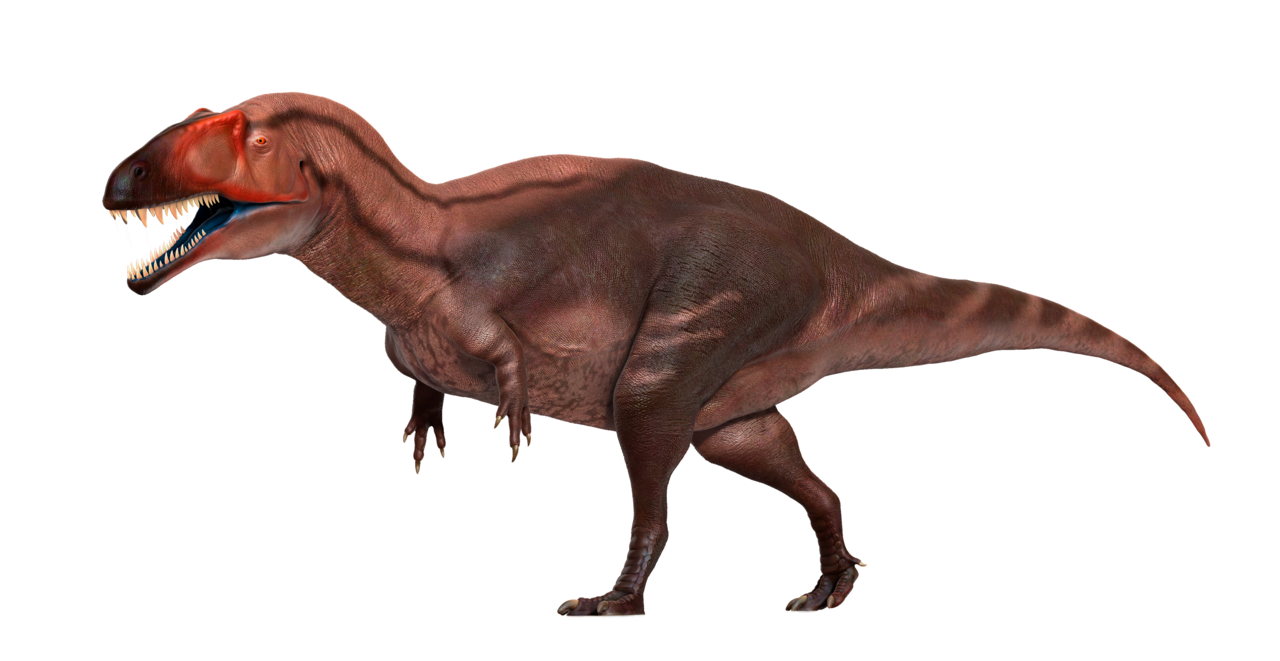
Acrocanthosaurus atokensis was the dominant known giant theropod of parts of Early Cretaceous North America. Its most conspicuous feature is a continuous series of tall neural spines over the neck, trunk, hips and front of the tail. These bones probably anchored substantial muscles and other soft tissues, producing a thick ridge whose precise external shape is unknown. A deep skull with blade-like serrated teeth, robust hind limbs and unusually strong forelimbs made Acrocanthosaurus a formidable macropredator. Anatomical studies place it within Carcharodontosauridae, linking it more closely to giant African and South American allosauroids than to the later tyrannosaurids.
Its fossils occur between approximately 113 and 110 million years ago. Values shown here are approximate and reflect the current curated seed dataset.
Form and function
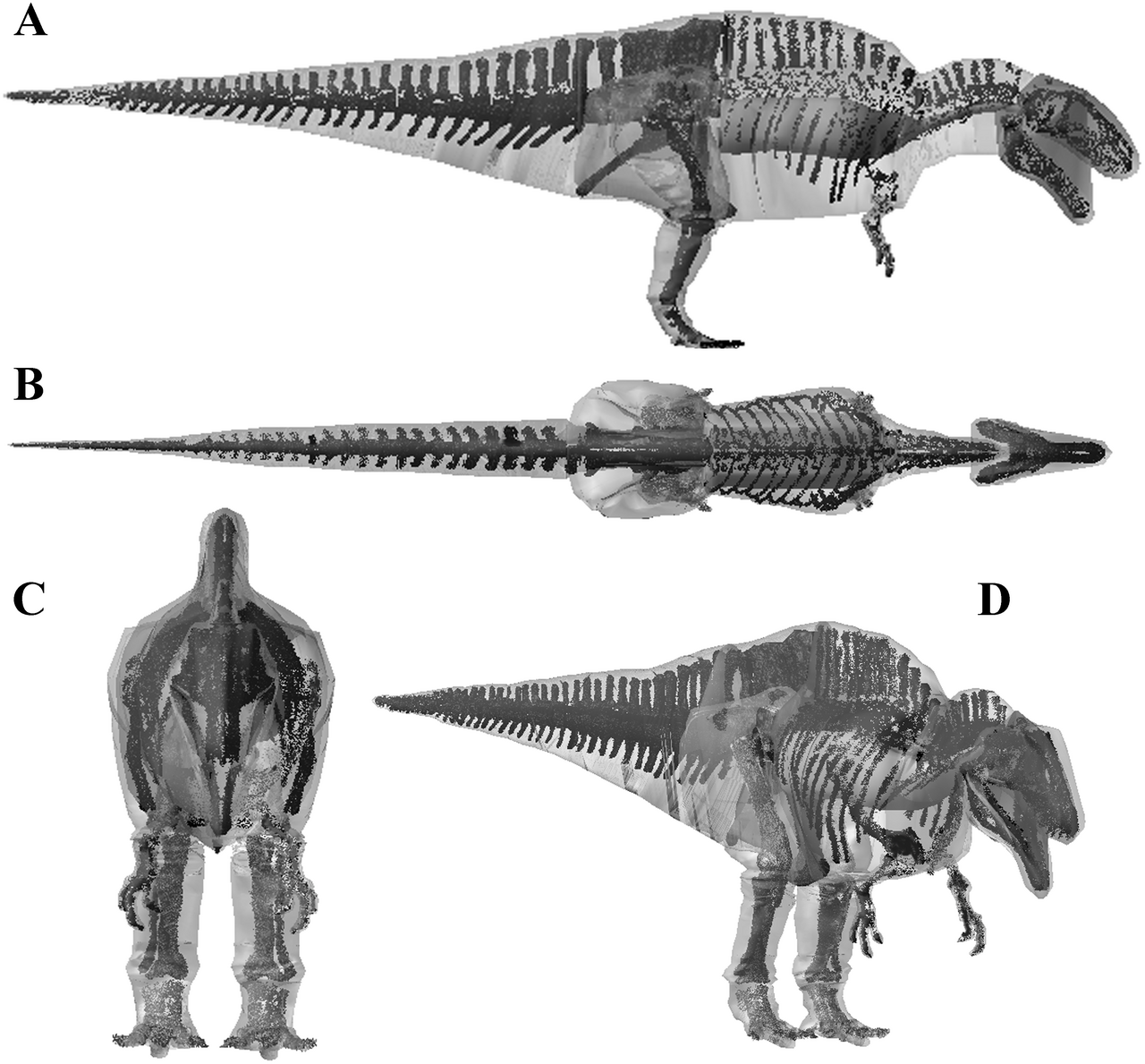
The skull was deep and narrow from above, with large openings and strongly textured bones around the snout and eyes. Laterally compressed teeth carried serrated cutting edges. Each hand retained three clawed fingers, and the muscular forelimb could flex strongly toward the body. Neural spines up to about two and a half times the height of their vertebral centra ran from the neck onto the tail. Their roughened surfaces suggest strong ligament and muscle attachment, favouring a thick muscular ridge over the unsupported thin sail common in older artwork. The body was balanced over powerful hind limbs by a long, deep tail.
Evolutionary position
This simplified classification path shows one placement from Dinosauria to this species. Each step is clickable, and other analyses may support alternative relationships.
Open interactive positionScale
Simplified length comparison using preferred dataset estimates; body shape and posture are not represented.
Scientific record
J. Willis Stovall's University of Oklahoma crews collected two partial skeletons in Atoka County, Oklahoma, during the early 1940s. Stovall and Wann Langston Jr. named Acrocanthosaurus atokensis in 1950, combining the Greek for high, spine and lizard with a reference to Atoka County. The holotype OMNH 10146 includes a partial skull and skeleton; paratype OMNH 10147 preserves complementary anatomy. Later Texas material, especially the much more complete NCSM 14345 nicknamed Fran, shaped modern mounts and body estimates. Fran has historically been referred to this species, but detailed differences from the Oklahoma type make renewed comparison worthwhile.
Discovery credit: University of Oklahoma field crews, J. Willis Stovall.
Naming authors: J. Willis Stovall, Wann Langston Jr..
Palaeoenvironment
The Antlers and Twin Mountains formations record river channels, floodplains, forests and seasonally wet lowlands near the ancient Gulf of Mexico. Acrocanthosaurus lived in ecosystems containing large sauropods, the herbivore Tenontosaurus, smaller theropods, crocodile-line reptiles, turtles and fish. The famous Paluxy trackways come from broadly comparable Texas rocks, but an individual track maker cannot securely be identified as Acrocanthosaurus from footprint shape alone.
Its teeth and reinforced skull identify Acrocanthosaurus as a flesh eater, while the forelimbs were capable of strongly drawing objects toward the chest. Large sauropods and ornithopods were potential prey or carrion sources, but no particular attack sequence is fossilized. The back ridge may have contributed to display, heat exchange, fat storage or mechanical support; the bones alone do not select one function. No nest, bonebed or securely assigned trackway demonstrates pack hunting or other social behaviour.
Worth knowing
Fossil distribution
Southeastern Oklahoma, United States
Antlers Formation
regional marker
North-central Texas, United States
Twin Mountains Formation
regional marker
Markers are deliberately approximate. They identify published fossil areas without exposing sensitive excavation coordinates.
Open interactive mapFossil specimen record
Norman, Oklahoma, United States
Repository of the partial original skull and skeleton that defines Acrocanthosaurus atokensis. Digital Morphology provides CT-derived views of its braincase; continuous public display of the original bones is not confirmed.
A research repository is not necessarily a public exhibit. Loan and display status can change, so check with the institution before visiting.
Media record
Evidence
J. Willis Stovall, Wann Langston Jr. · American Midland Naturalist 43 · 1950
Open sourceDrew R. Eddy, Julia A. Clarke · PLoS ONE 6(3) · 2011
Open sourceDigital Morphology, University of Texas at Austin
Open sourceKarl T. Bates, Peter L. Manning, David Hodgetts, William I. Sellers · PLoS ONE 4(2) · 2009
Open source