Dry Island Albertosaurus bonebed
Dry Island Buffalo Jump, Alberta, Canada
Horseshoe Canyon Formation
regional marker
Pronunciation: al-BER-toh-SORE-us sar-KOFF-ah-gus
A lightly built Canadian tyrannosaur known from skulls, skeletons and a remarkable multi-individual bonebed spanning juvenile to adult growth stages.
Last updated 16 July 2026
Field guide
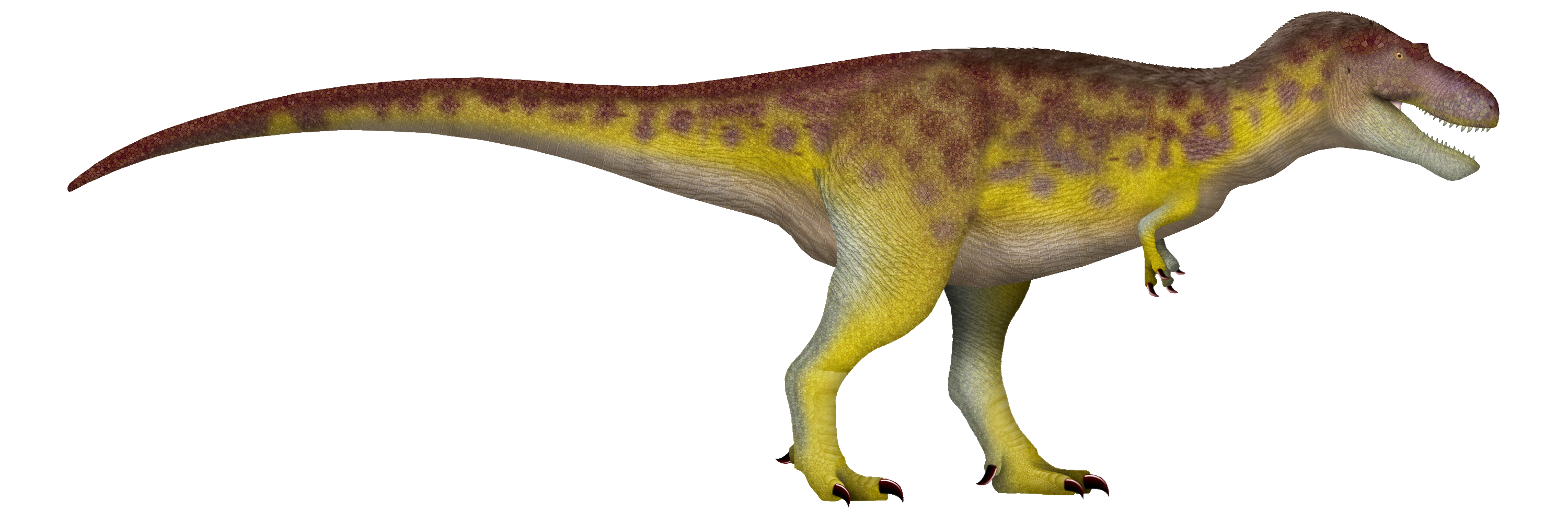
Albertosaurus sarcophagus was a long-legged tyrannosaurid that lived several million years before Tyrannosaurus rex. Its narrow body, proportionally long lower legs and lighter skull distinguish it from the deeper, more massive build of later tyrannosaurines. The species is unusually informative because the Dry Island bonebed preserves at least twelve individuals of different ages in one deposit. That assemblage reveals growth and population structure, but a shared burial site alone cannot establish coordinated pack hunting or a permanent family group.
Its fossils occur between approximately 71.5 and 68.5 million years ago. Values shown here are approximate and reflect the current curated seed dataset.
Form and function
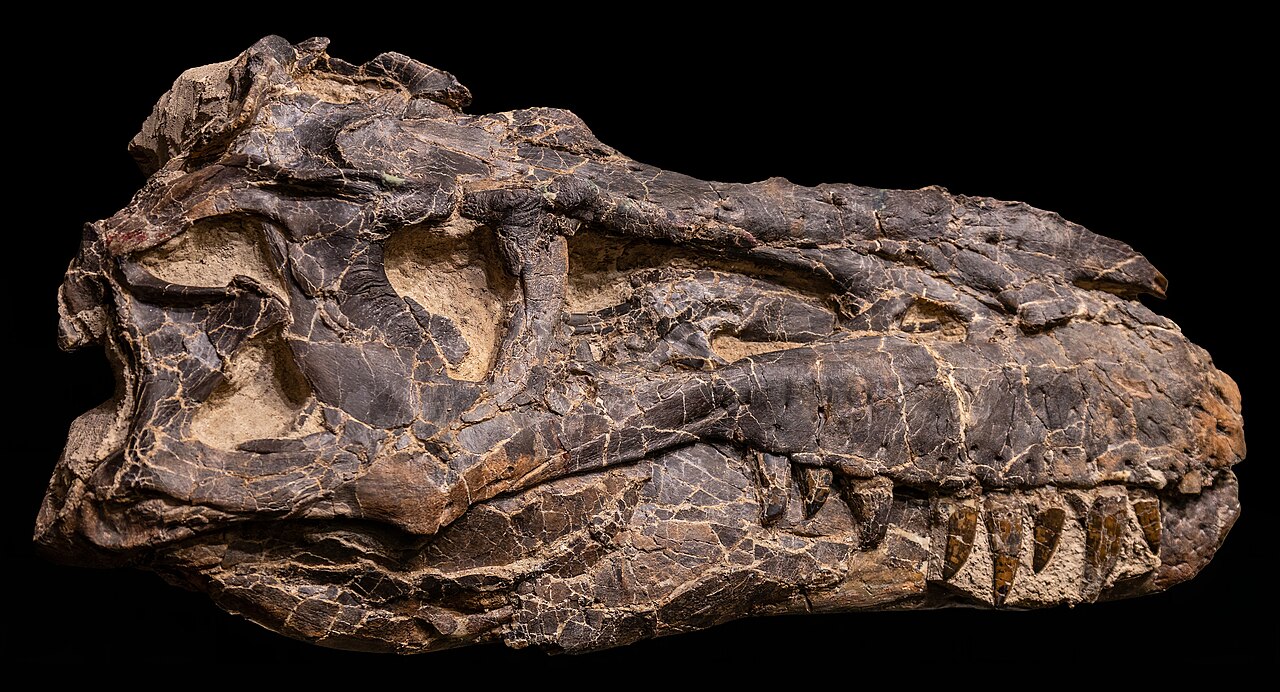
The skull was long and relatively low, with large openings that reduced weight and powerful muscles closing the jaws. Small bony crests rose above the eyes and may have carried keratin or display tissue. Thick, serrated teeth were replaced throughout life. The arms were very short and ended in two functional fingers, while the hind limbs were long and gracile for an animal approaching nine metres. Juveniles had especially slender skulls and legs; the head deepened and the body became more robust as they matured.
Evolutionary position
This simplified classification path shows one placement from Dinosauria to this species. Each step is clickable, and other analyses may support alternative relationships.
Open interactive positionScale
Simplified length comparison using preferred dataset estimates; body shape and posture are not represented.
Scientific record
Geologist Joseph Burr Tyrrell found the incomplete skull CMN 5600 beside Alberta's Red Deer River on 12 August 1884. Thomas Chesmer Weston collected the partial skull and skeleton CMN 5601 in 1889. Henry Fairfield Osborn named Albertosaurus sarcophagus in 1905, the same publication in which he named Tyrannosaurus rex. Barnum Brown found the Dry Island bonebed in 1910, but its position was later lost. Philip Currie relocated it in 1997 and renewed excavation, producing a growth series that helped confirm the bonebed animals belonged to the same species as the damaged type skulls.
Discovery credit: Joseph Burr Tyrrell, Thomas Chesmer Weston.
Naming authors: Henry Fairfield Osborn.
Palaeoenvironment
The Horseshoe Canyon Formation records river channels, floodplains, swamps and coastal lowlands near the retreating Western Interior Seaway. Alberta's climate was cool-temperate by Cretaceous standards and strongly seasonal. Albertosaurus shared the broader formation with hadrosaurs, horned dinosaurs, armoured dinosaurs, smaller theropods, turtles and crocodile-line reptiles, although not every named taxon occupied the exact same horizon.
Albertosaurus was an active carnivore able to bite and tear flesh with reinforced jaws and serrated teeth. Long lower legs suggest efficient terrestrial movement, but maximum running speed remains model-dependent. The Dry Island concentration demonstrates that many individuals died and were buried together. They may have associated before death, or carcasses may have accumulated through local environmental processes; neither explanation proves cooperative hunting. Bite marks on Albertosaurus bones can record feeding or scavenging, not necessarily fatal combat.
Worth knowing
Fossil distribution
Dry Island Buffalo Jump, Alberta, Canada
Horseshoe Canyon Formation
regional marker
Drumheller badlands, Alberta, Canada
Horseshoe Canyon Formation
regional marker
Markers are deliberately approximate. They identify published fossil areas without exposing sensitive excavation coordinates.
Open interactive mapFossil specimen record
Gatineau, Quebec, Canada
Research repository of the damaged original skull that defines the species and the partial skull and skeleton forming its historic type series. The collections facility is not open to the public.
Drumheller, Alberta, Canada
Current environmental reconstruction showing four Albertosaurus figures crossing a dry channel, informed by the museum's Dry Island bonebed research. The family grouping is an interpretive reconstruction, not four articulated skeletons found walking together.
A research repository is not necessarily a public exhibit. Loan and display status can change, so check with the institution before visiting.
Media record
Evidence
Canadian Museum of Nature
Open sourceThomas D. Carr · Canadian Journal of Earth Sciences 47(9) · 2010
Open sourceDavid A. Eberth, Philip J. Currie · Canadian Journal of Earth Sciences 47(9) · 2010
Open sourceRoyal Tyrrell Museum
Open source