Hell Creek fossil region
Eastern Montana, United States
Hell Creek Formation
regional marker
Pronunciation: ANG-kih-loh-SORE-us mag-nih-VEN-tris
A huge, broad-bodied ankylosaurid from the final two million years of the Cretaceous, protected by bony armour and armed with a stiff-handled tail club. Despite its fame, no complete skeleton is known.
Last updated 13 July 2026
Field guide
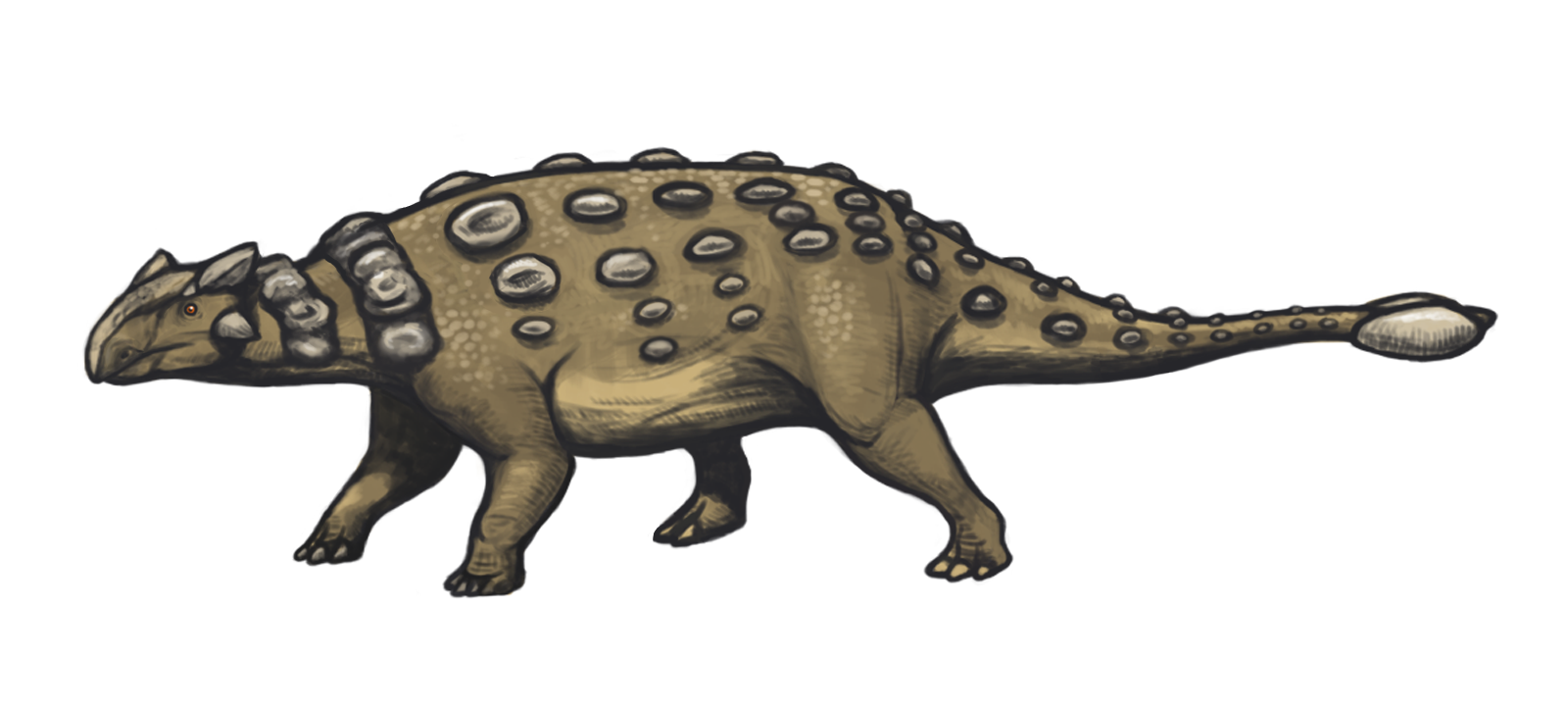
Ankylosaurus magniventris was the largest known ankylosaurid and a rare inhabitant of latest-Cretaceous western North America. It carried tile-like bones over the skull, half-rings around the neck and osteoderms across the body. Referred fossils reveal a stiffened tail ending in a bony club, but the holotype itself has no club. Its exceptionally broad skull, sideways-facing nostrils and proportionally tiny teeth distinguish it from earlier ankylosaurids such as Euoplocephalus.
Its fossils occur between approximately 68 and 66 million years ago. Values shown here are approximate and reflect the current curated seed dataset.
Form and function
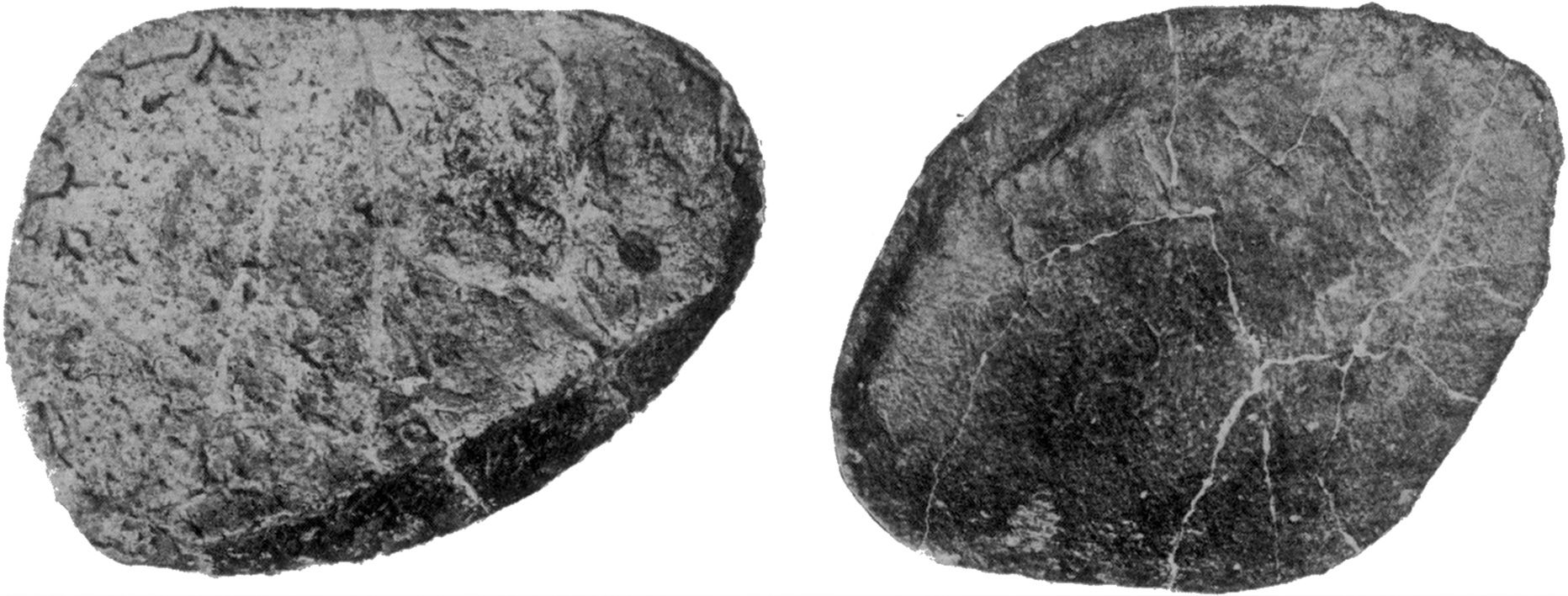
The body was low, wide and supported by four robust limbs. Fused skull bones and polygonal caputegulae formed a heavily reinforced head, while bony cervical half-rings guarded the neck. Numerous osteoderms were embedded in the skin, but no specimen preserves their entire arrangement in life. In the tail, interlocking vertebrae and elongated tendons created a stiff handle for a terminal knob of enlarged osteoderms. The only well-preserved club belongs to referred specimen AMNH 5214, not the holotype AMNH 5895.
Evolutionary position
This simplified classification path shows one placement from Dinosauria to this species. Each step is clickable, and other analyses may support alternative relationships.
Open interactive positionScale
Simplified length comparison using preferred dataset estimates; body shape and posture are not represented.
Scientific record
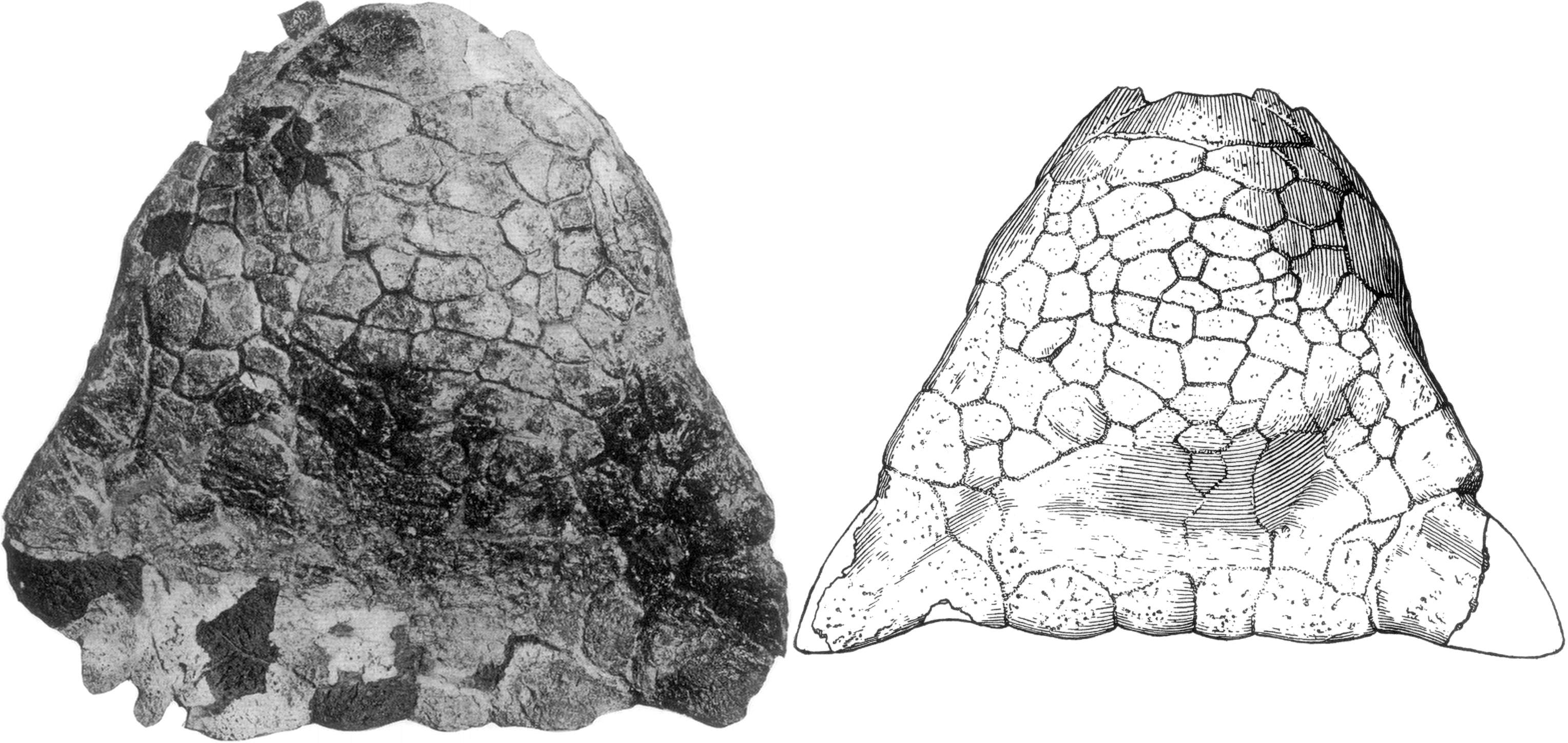
Peter Kaisen found the holotype AMNH 5895 during Barnum Brown's 1906 American Museum expedition near Gilbert Creek, Montana, in the Hell Creek Formation. Brown named Ankylosaurus magniventris in 1908. Ankylosaurus refers to the extensive stiffening and fusion in the skeleton; magniventris means 'great belly' and reflects the animal's remarkable body width. The partial holotype includes a skull roof, teeth, vertebrae, a shoulder element, ribs and armour, but no limbs or tail club. Later specimens from Alberta, Montana and Wyoming supplied the better skull and club familiar from modern reconstructions.
Discovery credit: Peter Kaisen, Barnum Brown.
Naming authors: Barnum Brown.
Palaeoenvironment
A. magniventris inhabited river floodplains, forested lowlands and coastal-plain environments represented by the Hell Creek, Lance, Scollard and Frenchman formations. Flowering plants, conifers, ferns and shrubs formed the vegetation. Triceratops, Edmontosaurus, Thescelosaurus and Tyrannosaurus shared portions of this latest-Maastrichtian landscape. Ankylosaurus fossils are extremely rare within these otherwise well-sampled assemblages.
Its broad muzzle, very small teeth and massive gut region indicate low browsing and fermentation of large amounts of vegetation, although the preferred plants are unknown. Biomechanical work shows that large ankylosaurid clubs could deliver forceful lateral strikes. Defence against predators is plausible, but combat between ankylosaurids is also possible; injuries in the related Zuul strengthen that broader hypothesis without directly documenting it in A. magniventris. The exact arrangement of body armour and any social behaviour remain unknown.
Worth knowing
Fossil distribution
Eastern Montana, United States
Hell Creek Formation
regional marker
Alberta, Canada
Scollard Formation
regional marker
Markers are deliberately approximate. They identify published fossil areas without exposing sensitive excavation coordinates.
Open interactive mapFossil specimen record
New York City, United States
Research repository for original holotype AMNH 5895 and referred specimen AMNH 5214. The holotype is a partial skull and postcranial skeleton; AMNH 5214 supplies the best-preserved skull and the only well-preserved tail club. Public display of these particular originals is not confirmed.
Gatineau, Canada
Research repository for original specimen CMN 8880, the largest known Ankylosaurus skull with a left lower jaw. No postcranial skeleton was found with it, so the animal's full size is estimated by scaling from smaller specimens. Public display is not confirmed.
A research repository is not necessarily a public exhibit. Loan and display status can change, so check with the institution before visiting.
Media record
Evidence
Barnum Brown · Bulletin of the American Museum of Natural History · 1908
Open sourceVictoria M. Arbour, Jordan C. Mallon · FACETS · 2017
Open sourceVictoria M. Arbour · PLOS ONE · 2009
Open sourceVictoria M. Arbour, Philip J. Currie · Journal of Anatomy · 2015
Open sourceNatural History Museum, London Dino Directory
Open sourceAmerican Museum of Natural History
Open sourceCanadian Museum of Nature
Open source