Solnhofen–Eichstätt limestone region
Bavaria, Germany
Altmühltal Formation
regional marker
Pronunciation: ar-kee-OP-ter-iks lith-oh-GRAF-ih-ka
A crow-sized feathered avialan from Bavaria's Late Jurassic lagoon deposits, combining flight feathers and wings with teeth, clawed fingers and a long bony tail. Often called the 'first bird', it is better understood as one of several close relatives near the origin of birds.
Last updated 13 July 2026
Field guide
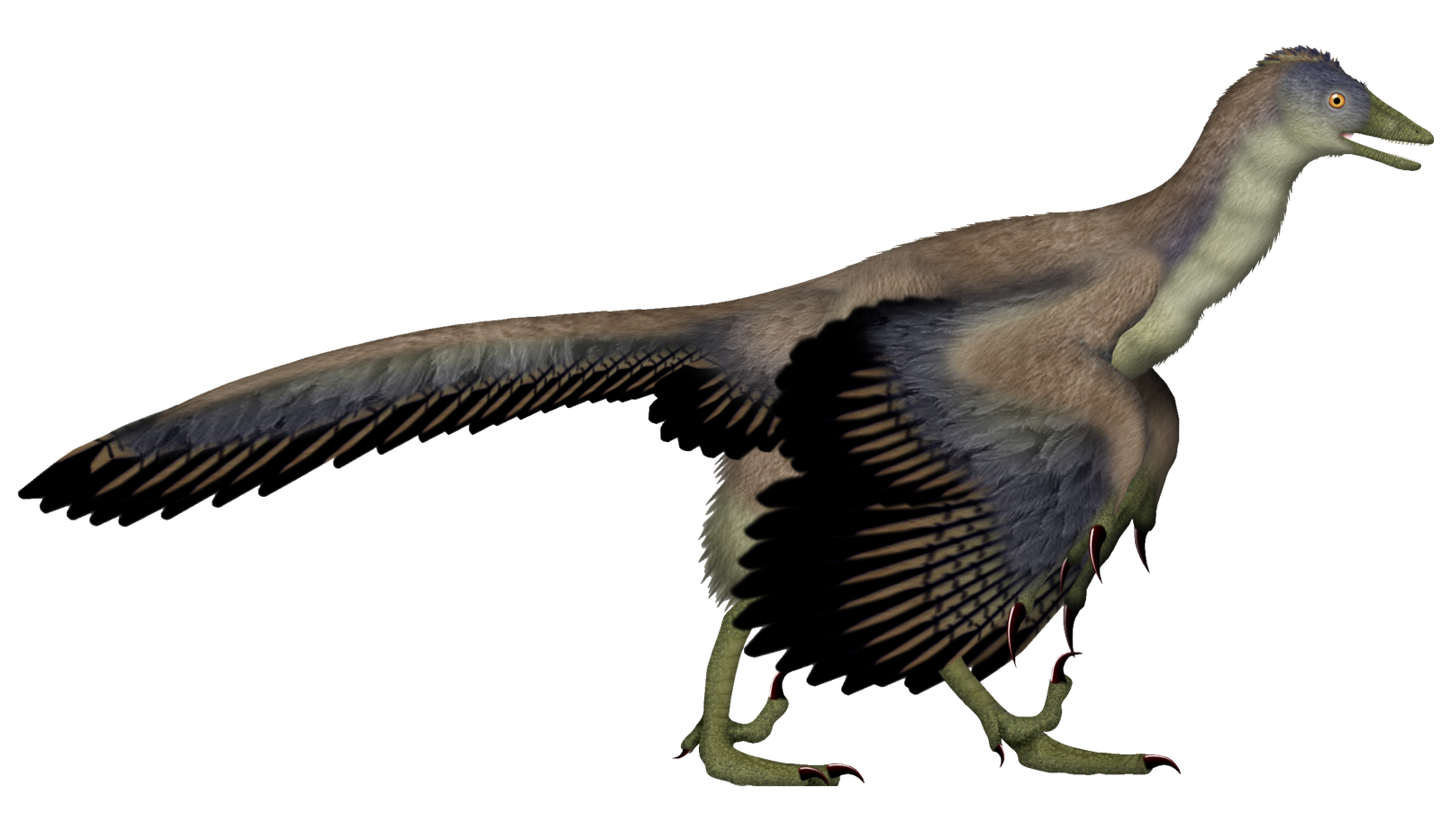
Archaeopteryx lithographica is one of the most informative fossils in the study of the dinosaur–bird transition. Skeletons from the fine-grained Solnhofen limestones preserve asymmetrical wing feathers, tail plumage and, in some specimens, feathers over the body and hind limbs. Beneath that plumage lay a small theropod skeleton with sharp teeth, three clawed fingers, a furcula and a long series of tail vertebrae. Wing-bone geometry supports powered flapping flight, probably in short bursts and with a stroke unlike that of most living birds.
Its fossils occur between approximately 150.8 and 148.5 million years ago. Values shown here are approximate and reflect the current curated seed dataset.
Form and function
The forelimbs formed broad feathered wings with asymmetric primary and secondary feathers. A long bony tail carried paired feathers rather than the short fused pygostyle of modern birds. The jaws retained small teeth, each hand had three separate clawed fingers, and many skeletal elements remained unfused. A furcula and flight-adapted feather arrangement link it with birds, while the long tail, toothed jaws and grasping fingers retain the ancestral theropod condition. Extensive pennaceous feathers on the body and hind limbs show that complex plumage was not limited to the flight surface.
Evolutionary position
This simplified classification path shows one placement from Dinosauria to this species. Each step is clickable, and other analyses may support alternative relationships.
Open interactive positionScale
Simplified length comparison using preferred dataset estimates; body shape and posture are not represented.
Scientific record
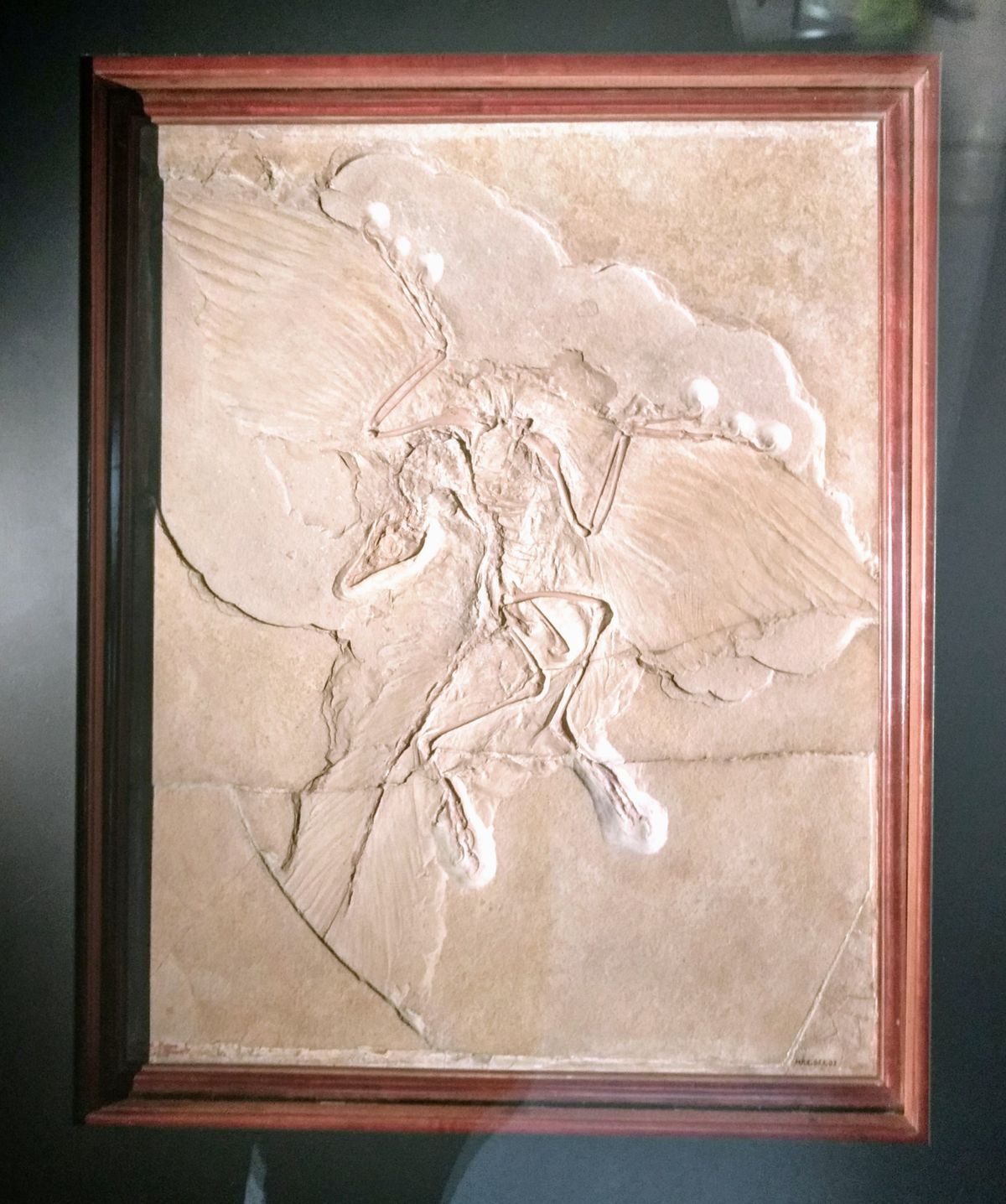
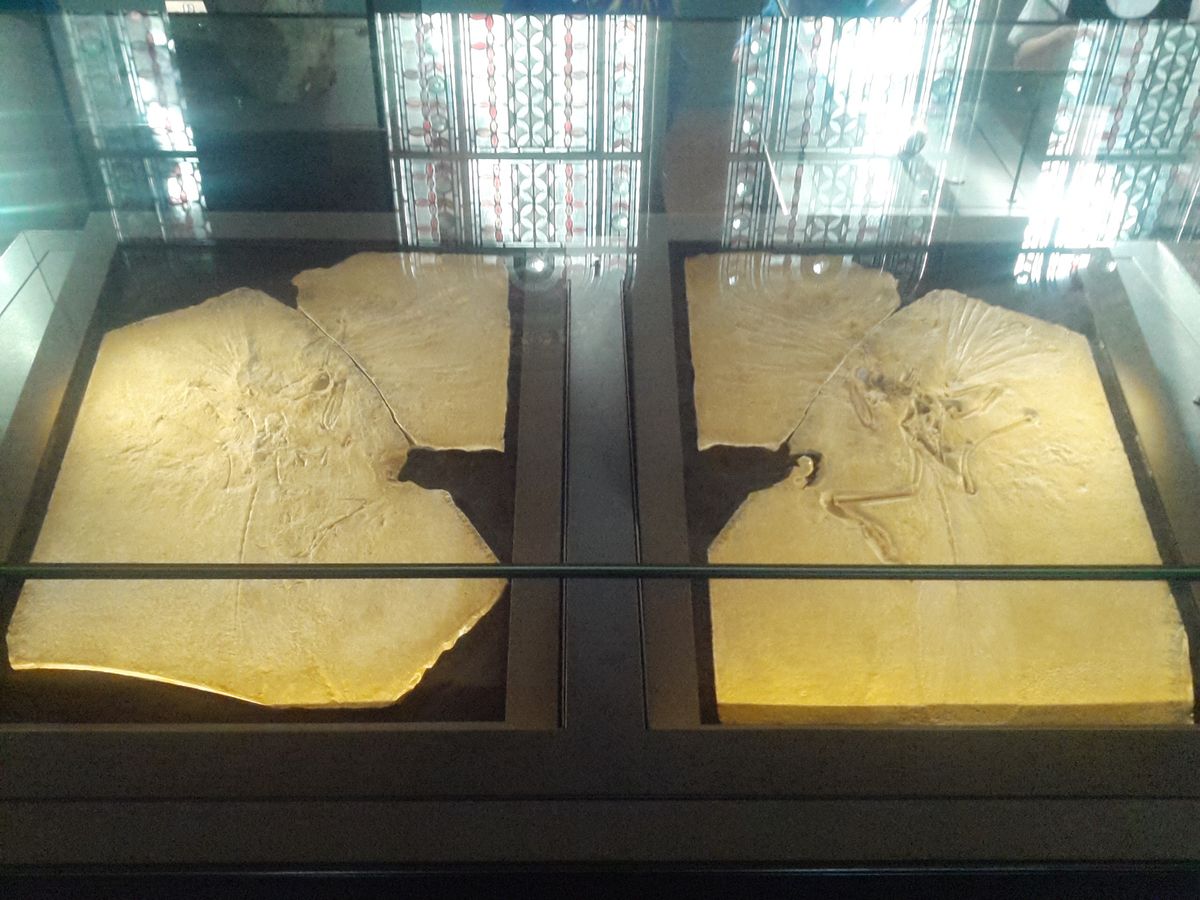
An isolated feather found in the Solnhofen limestone region in 1860 led Hermann von Meyer to name Archaeopteryx lithographica in 1861. Later that year a much more complete feathered skeleton was discovered; the British Museum bought it in 1862, and Richard Owen described it in 1863. A spectacular second skeleton found in the 1870s became the Berlin specimen. Because the isolated feather's identity and diagnostic value remained disputed, the International Commission on Zoological Nomenclature designated the London skeleton NHMUK PV OR 37001 as the neotype in 2011, making it the specimen that now anchors the species name.
Discovery credit: Solnhofen-area quarry workers.
Naming authors: Hermann von Meyer.
Palaeoenvironment
Archaeopteryx lived among low subtropical islands around warm, shallow lagoons in what is now Bavaria. Fine carbonate mud on quiet lagoon floors produced the lithographic limestones that preserve feathers and other delicate structures. The same deposits contain insects, lizards, fish, crustaceans, pterosaurs and the small theropod Compsognathus. The fossils may have been transported from islands or shorelines into hypersaline lagoon waters, so the slabs record burial habitat more directly than everyday living habitat.
Cross-sectional geometry inside the wing bones is consistent with active flapping flight rather than gliding alone, probably in short bursts. Its flight stroke and shoulder were not identical to those of most modern birds, and researchers still debate launch style, endurance and agility. Clawed fingers and curved foot claws could assist climbing or perching, but the degree to which Archaeopteryx lived in trees versus on the ground remains unresolved. It probably ate small animals such as insects and lizards, although its full diet is not preserved as a simple species-wide menu.
Worth knowing
Fossil distribution
Bavaria, Germany
Altmühltal Formation
regional marker
Markers are deliberately approximate. They identify published fossil areas without exposing sensitive excavation coordinates.
Open interactive mapFossil specimen record
London, United Kingdom
Original London specimen NHMUK PV OR 37001, purchased in 1862 and designated the neotype of A. lithographica by the ICZN in 2011. The museum confirms that it is currently on public display.
Berlin, Germany
Original Berlin specimen, an exceptionally complete articulated skeleton with extensive feather impressions. The museum identifies it as part of the current exhibition and widely regarded as the best-preserved Archaeopteryx specimen.
A research repository is not necessarily a public exhibit. Loan and display status can change, so check with the institution before visiting.
Media record
Evidence
Natural History Museum, London
Open sourceMuseum für Naturkunde Berlin
Open sourceInternational Commission on Zoological Nomenclature · Bulletin of Zoological Nomenclature · 2011
Open sourceDennis F. A. E. Voeten, Jorge Cubo, Emmanuel de Margerie and 5 coauthors · Nature Communications · 2018
Open sourceChristian Foth, Helmut Tischlinger, Oliver W. M. Rauhut · Nature · 2014
Open source