Bajo de Santa Rosa fossil region
Río Negro Province, Argentina
Allen Formation
regional marker
Pronunciation: OW-stroh-RAP-tor kah-BAH-zeye
One of the largest known unenlagiine raptors, distinguished by a long, low skull, conical teeth and unusually short forelimbs.
Last updated 23 July 2026
Field guide
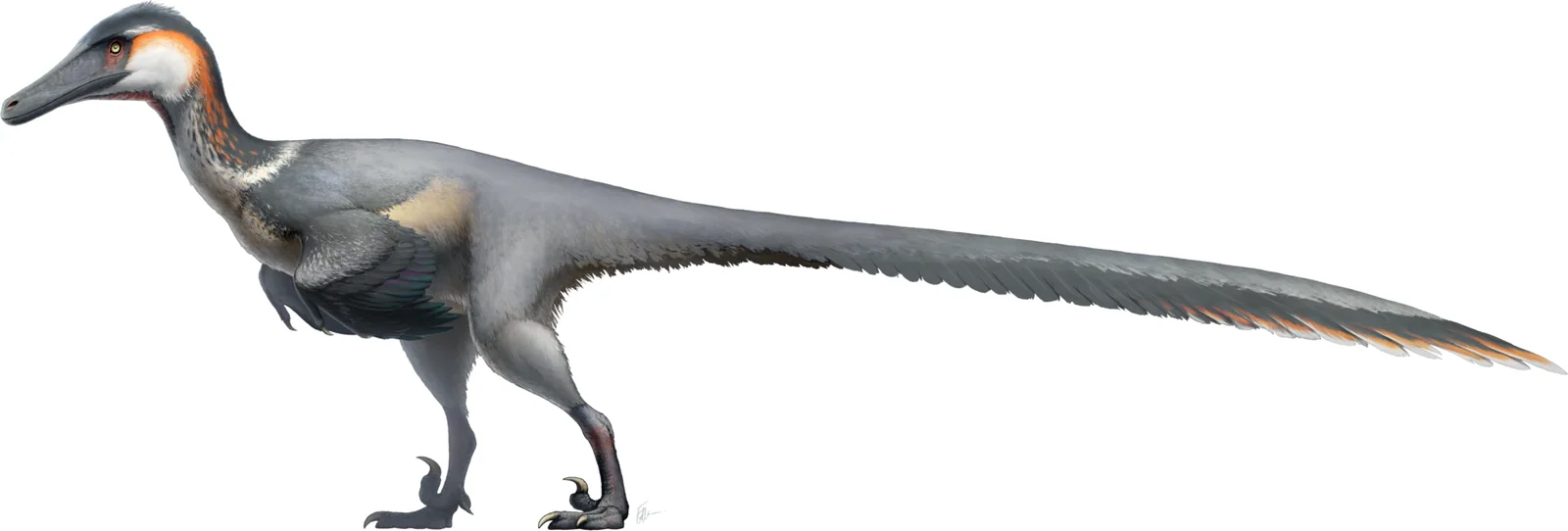
Austroraptor cabazai was a large feathered paravian from the latest Cretaceous Allen Formation of northern Patagonia. At roughly five to six metres long, it was far larger than most close relatives. Its proportions were equally unusual: the skull was elongate and low, the teeth were conical and mostly lacked the coarse serrations common in predatory theropods, and the forelimbs were less than half the length of the femur. Two partial skeletons document complementary parts of the animal. These fossils show that the southern unenlagiine radiation included not only small, lightly built forms but also a distinctive large-bodied predator.
Its fossils occur between approximately 70.1 and 66 million years ago. Values shown here are approximate and reflect the current curated seed dataset.
Form and function
The reconstructed skull approached eighty centimetres in length and had an especially long maxilla. Numerous small, conical teeth occupied the narrow jaws; their form differs from the laterally compressed, strongly serrated teeth of many dromaeosaurids. The humerus was extremely short relative to the femur, and the second specimen added the radius, ulna, parts of the hand and further foot bones. The hind foot retained the specialized second toe associated with paravians, although its claw was less strongly curved than in Velociraptor. Feathers are not preserved with Austroraptor itself but are inferred from extensive evidence across Paraves.
Evolutionary position
This simplified classification path shows one placement from Dinosauria to this species. Each step is clickable, and other analyses may support alternative relationships.
Open interactive positionScale
Simplified length comparison using preferred dataset estimates; body shape and posture are not represented.
Scientific record
Marcelo Isasi discovered the holotype MML-195 at Bajo de Santa Rosa, about ninety kilometres southwest of Lamarque in Río Negro Province. Fernando Novas, Diego Pol, Juan Canale, Juan Porfiri and Jorge Calvo named the species in a paper published in 2009. A second, slightly smaller skeleton, MML-220, was recovered during a 2008 expedition and described by Philip Currie and Ariana Paulina Carabajal in 2012. The genus name combines the Latin auster, south wind, with raptor, thief. The species honours Alberto 'Tito' Cabaza, founder of Lamarque's municipal museum.
Naming authors: Fernando E. Novas, Diego Pol, Juan I. Canale and 2 coauthors.
Palaeoenvironment
The Allen Formation records a low-relief landscape of rivers, shallow lakes, floodplains and coastal-influenced environments near the end of the Cretaceous. Austroraptor shared northern Patagonia with titanosaurs, hadrosaurids, ankylosaurs, abelisaurids, birds, turtles and crocodyliforms. Its narrow snout and tooth form have prompted suggestions of feeding in or around water, but the formation alone does not establish a specialized aquatic lifestyle.
Austroraptor was a bipedal carnivore, yet the exact prey it targeted is unknown. Its long jaws and conical, weakly serrated teeth differ from the slicing dentition of many land predators and may have been useful for gripping small or slippery prey. A fish-rich diet is therefore a testable hypothesis, not a directly preserved fact. The shortened arms make forelimb-assisted prey capture less likely than in some smaller dromaeosaurids. No fossil evidence establishes pack hunting.
Worth knowing
Fossil distribution
Río Negro Province, Argentina
Allen Formation
regional marker
Markers are deliberately approximate. They identify published fossil areas without exposing sensitive excavation coordinates.
Open interactive mapFossil specimen record
Lamarque, Argentina
The municipal collection preserves the holotype MML-195 and referred specimen MML-220 from the Allen Formation.
A research repository is not necessarily a public exhibit. Loan and display status can change, so check with the institution before visiting.
Media record
Evidence
Fernando E. Novas, Diego Pol, Juan I. Canale and 2 coauthors · Proceedings of the Royal Society B 276(1659), 1101–1107 · 2009
Open sourcePhilip J. Currie, Ariana Paulina Carabajal · Ameghiniana 49(4), 662–667 · 2012
Open sourceMatías J. Motta, Fernando E. Novas · Historical Biology 38(6) · 2025
Open source