Smokejacks Brickworks
Surrey, United Kingdom
Weald Clay Formation
approximate site marker
Pronunciation: BAIR-ee-ON-iks WALK-er-eye
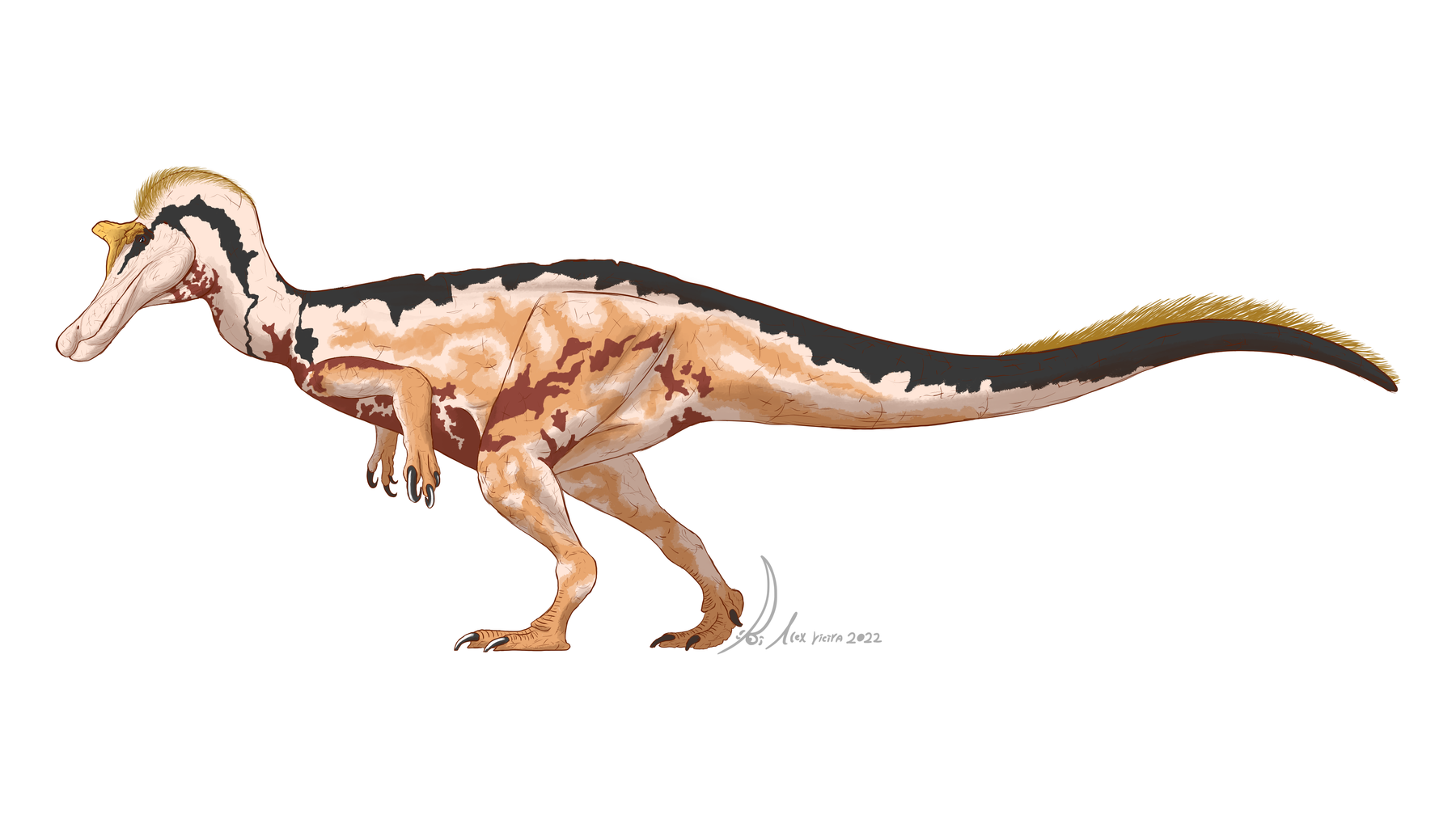
An Early Cretaceous spinosaurid from southern England with a long, low snout, conical teeth and an enormous thumb claw. Its partial skeleton preserves rare direct evidence of a mixed diet that included fish and an iguanodontian dinosaur.
Last updated 13 July 2026
Field guide
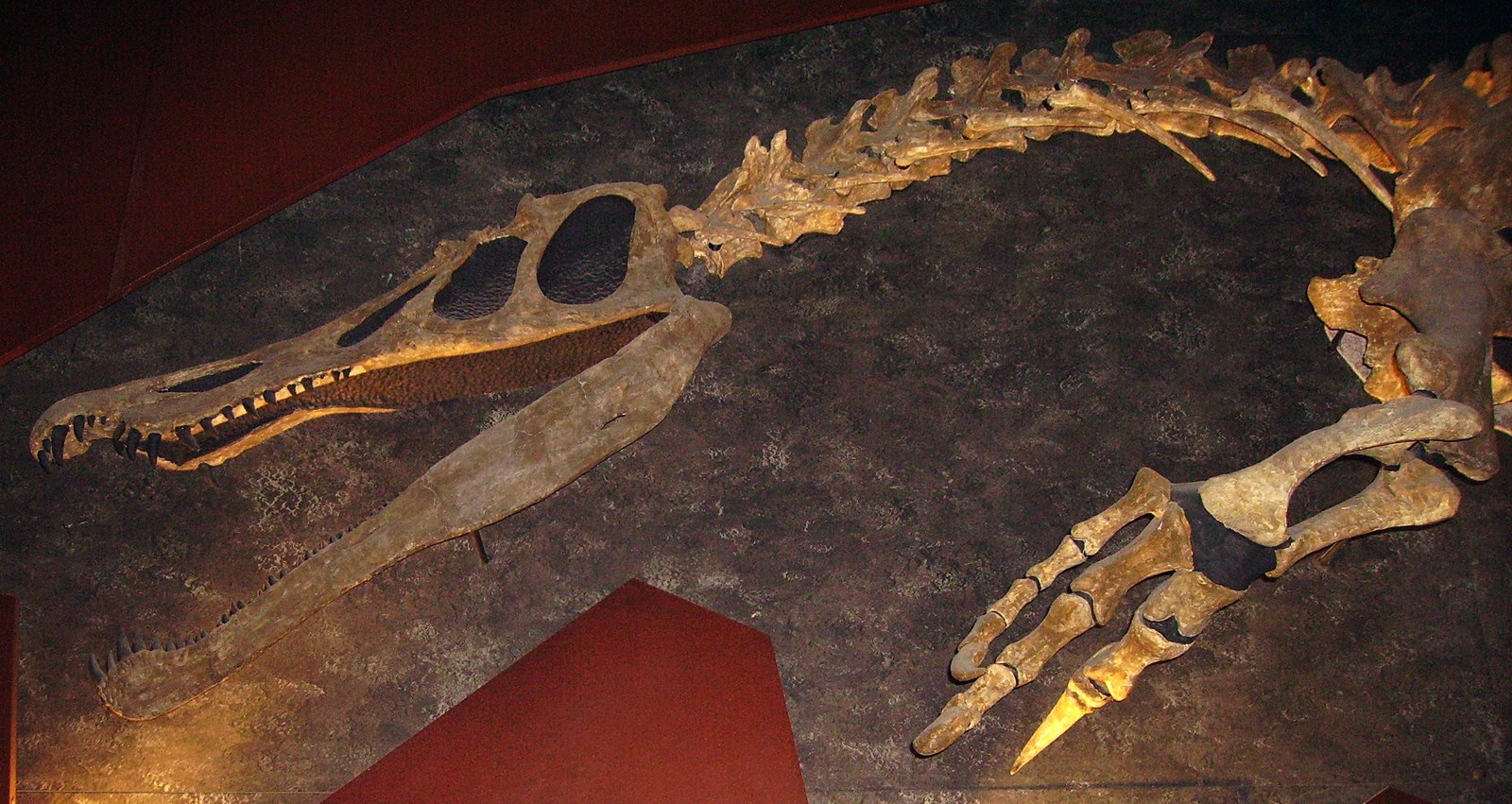
Baryonyx walkeri transformed scientific understanding of spinosaurids because its holotype preserved much more of the skull and body than the fragmentary Spinosaurus material known at the time. The animal had a long, narrow snout expanded into a terminal rosette, many lightly serrated conical teeth, strong forelimbs and a very large claw on the first finger. Fish remains and juvenile iguanodontian bones found in the body cavity show that it was an opportunistic carnivore rather than a fish-only specialist. Its exact relationship with water remains debated: shoreline or shallow-water foraging is plausible, but the skeleton does not by itself demonstrate a highly aquatic lifestyle.
Its fossils occur between approximately 130 and 125 million years ago. Values shown here are approximate and reflect the current curated seed dataset.
Form and function
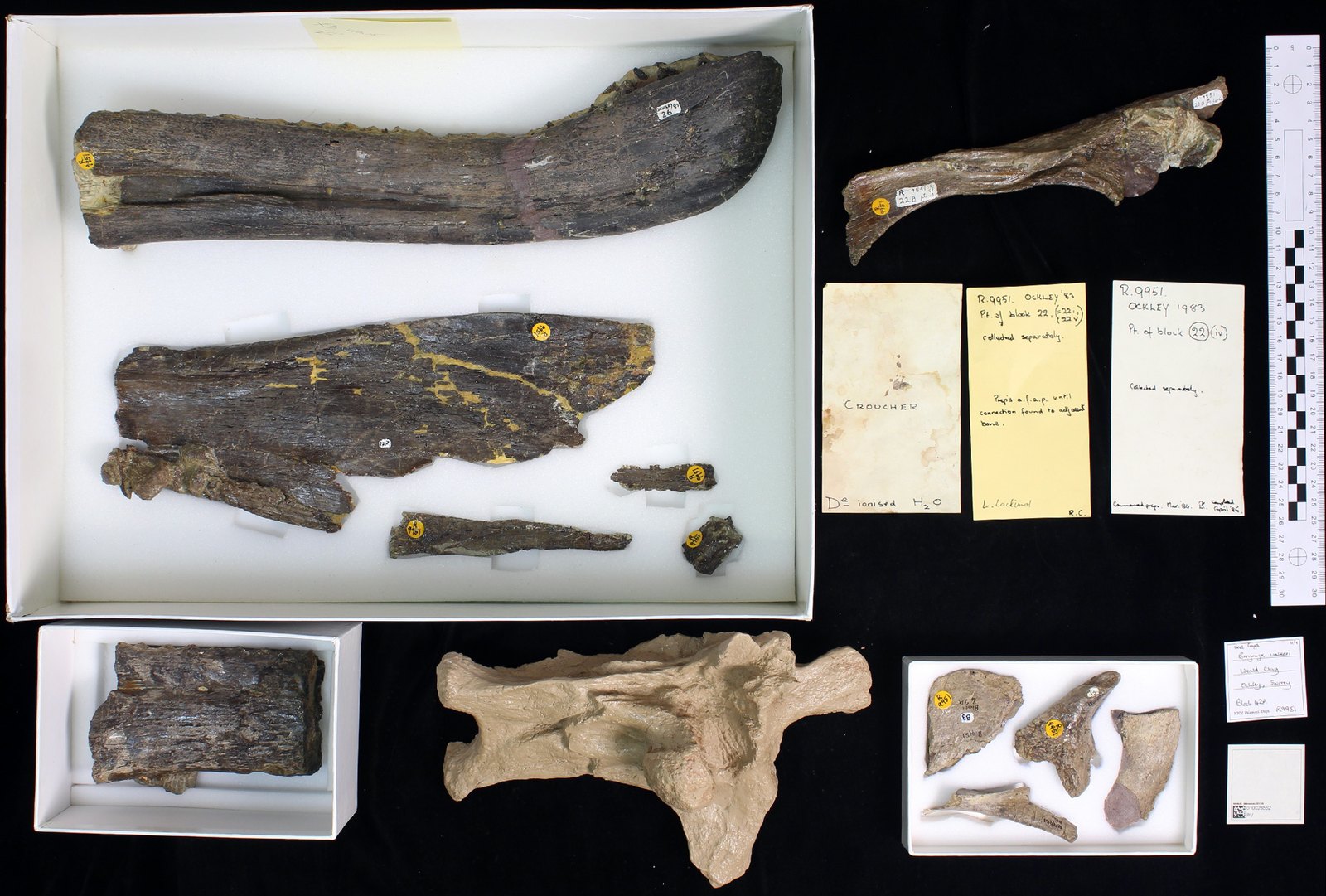
Holotype NHMUK PV R 9951 preserves much of the skull, jaws, neck and trunk, both shoulder girdles and upper arms, parts of the forelimbs, pelvis, hind limbs and feet. The snout's expanded tip and recessed notch interlocked with the lower jaw, while numerous subcircular teeth were suited to gripping. The famous first-finger ungual measures about 31 centimetres around its outer curve before adding the keratin sheath present in life.
Evolutionary position
This simplified classification path shows one placement from Dinosauria to this species. Each step is clickable, and other analyses may support alternative relationships.
Open interactive positionScale
Simplified length comparison using preferred dataset estimates; body shape and posture are not represented.
Scientific record
Amateur fossil collector William J. Walker noticed the tip of a large claw in Smokejacks brickworks clay pit near Ockley, Surrey, in January 1983. He brought the pieces to the Natural History Museum, whose team excavated the rest of the partial skeleton in May and June. Alan Charig and Angela Milner named Baryonyx walkeri in Nature in 1986; the genus means 'heavy claw' and the species honours Walker. Their detailed 1997 monograph documented the skeleton and the stomach-region remains that established fish consumption.
Discovery credit: William J. Walker, Natural History Museum field team.
Naming authors: Alan J. Charig, Angela C. Milner.
Palaeoenvironment
The Weald Clay Formation records a low-lying floodplain crossed by rivers and dotted with lakes, marshes and vegetated wetlands. Baryonyx lived alongside fish, turtles, crocodilians, pterosaurs and dinosaurs including iguanodontians and armoured forms. The Smokejacks deposit accumulated in and around a freshwater setting, but a wet habitat alone does not prove that Baryonyx spent most of its life in water.
Fish scales and teeth in the body cavity provide direct evidence that Baryonyx ate fish, while etched bones from a juvenile iguanodontian show consumption of terrestrial dinosaur tissue. Whether that animal was hunted or scavenged cannot be determined. The narrow jaws, conical teeth and strong forelimbs are consistent with grabbing slippery prey, but the exact use of the thumb claw is unknown. Claims of underwater pursuit, quadrupedal walking or specialised diving exceed what the holotype directly demonstrates.
Worth knowing
Fossil distribution
Surrey, United Kingdom
Weald Clay Formation
approximate site marker
Markers are deliberately approximate. They identify published fossil areas without exposing sensitive excavation coordinates.
Open interactive mapFossil specimen record
London, United Kingdom
Research repository for holotype NHMUK PV R 9951, the partial original skeleton excavated at Smokejacks in 1983. The institution verifies custody of the type specimen; its reconstructed mount has historically been displayed, but current public display of the original bones is not guaranteed.
A research repository is not necessarily a public exhibit. Loan and display status can change, so check with the institution before visiting.
Media record
Evidence
Alan J. Charig, Angela C. Milner · Nature · 1986
Open sourceAlan J. Charig, Angela C. Milner · Bulletin of the Natural History Museum, Geology Series · 1997
Open sourceNatural History Museum, London
Open sourceNatural History Museum, London
Open source