Suncor Millennium Mine fossil region
Northern Alberta, Canada
Clearwater Formation
regional marker
Pronunciation: bor-ee-AL-oh-PEL-tah mark-mih-CHELL-eye
The best-preserved armored dinosaur known, retaining its body outline, skin, armor, horn sheaths, stomach contents and evidence of colour.
Last updated 26 July 2026
Field guide
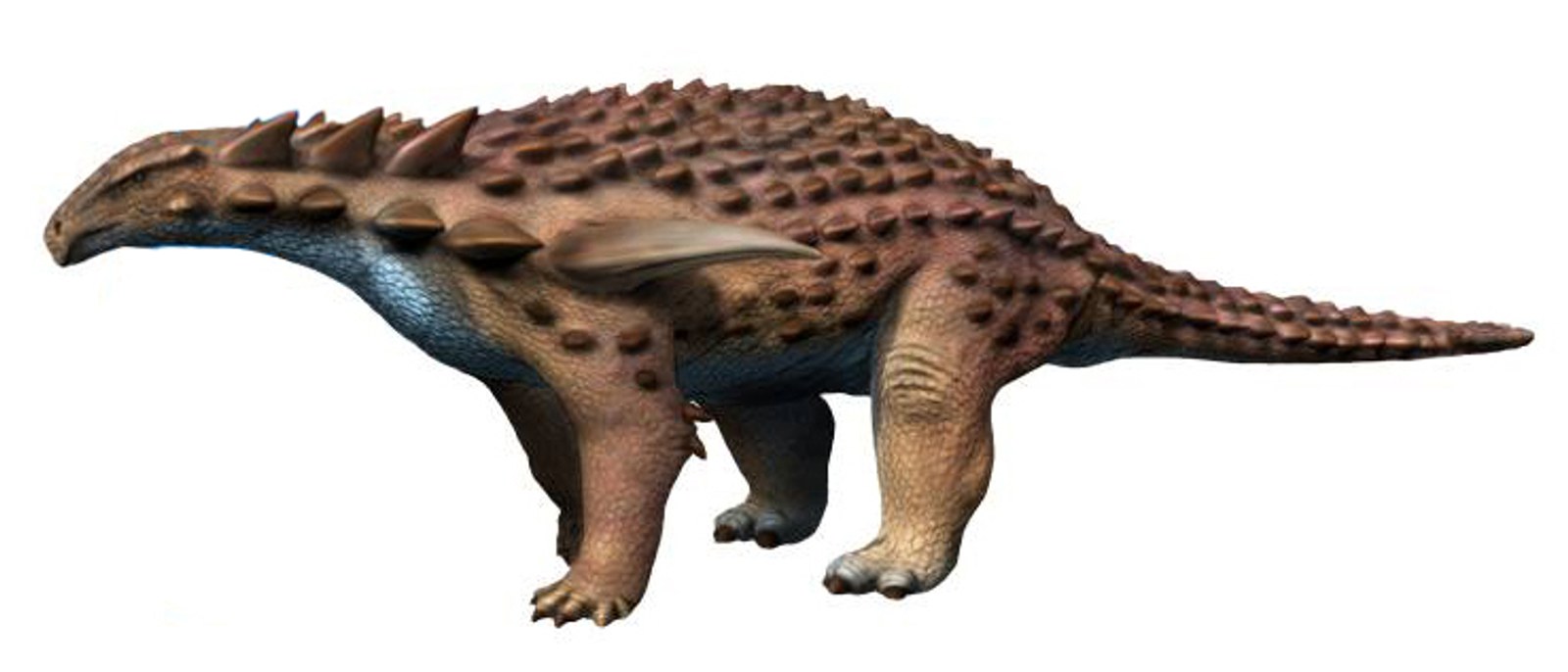
Borealopelta markmitchelli was a nodosaurid ankylosaur entombed in marine sediments after its carcass drifted away from the Early Cretaceous Alberta coast. The front half of the body survives as a three-dimensional block with armor and skin close to their life positions. Chemical evidence indicates reddish-brown pigmentation and countershading, while preserved stomach contents reveal a last meal dominated by ferns. This extraordinary specimen provides a rare evidence-based view of the external appearance and diet of a large dinosaur.
Its fossils occur between approximately 112.6 and 110.5 million years ago. Values shown here are approximate and reflect the current curated seed dataset.
Form and function
Borealopelta had a broad, low body protected by tightly arranged osteoderms and keratin-covered spikes. Large paired spines projected from the shoulders, with smaller armor along the neck and back. Preserved soft tissues show the real contours around the neck and torso rather than only the underlying skeleton. Its broad beak and small teeth cropped low vegetation.
Evolutionary position
This simplified classification path shows one placement from Dinosauria to this species. Each step is clickable, and other analyses may support alternative relationships.
Open interactive positionScale
Simplified length comparison using preferred dataset estimates; body shape and posture are not represented.
Scientific record
Heavy-equipment operator Shawn Funk exposed the specimen at Suncor's Millennium Mine north of Fort McMurray on 21 March 2011. Royal Tyrrell Museum crews recovered the block from the Clearwater Formation. Technician Mark Mitchell spent more than five years and roughly 7,000 hours preparing it. Caleb Brown and colleagues named Borealopelta markmitchelli in 2017, honouring Mitchell's work.
Discovery credit: Shawn Funk, Suncor Millennium Mine workers.
Naming authors: Caleb M. Brown, Donald M. Henderson, Jakob Vinther.
Palaeoenvironment
Borealopelta lived on humid coastal lowlands in northern Alberta. After death, the carcass entered the Western Interior Seaway, floated offshore, sank and was rapidly buried in oxygen-poor marine mud of the Clearwater Formation.
Its stomach contents show selective feeding on ferns shortly before death and include charcoal, perhaps swallowed while browsing recently burned vegetation. Countershading suggests that camouflage remained useful despite heavy armor. Social behaviour, mating displays and parental care are unknown.
Worth knowing
Fossil distribution
Northern Alberta, Canada
Clearwater Formation
regional marker
Markers are deliberately approximate. They identify published fossil areas without exposing sensitive excavation coordinates.
Open interactive mapFossil specimen record
Drumheller, Canada
Holotype TMP 2011.033.0001 is displayed with its three-dimensional skin, armor and soft-tissue outline exposed.
A research repository is not necessarily a public exhibit. Loan and display status can change, so check with the institution before visiting.
Media record
Evidence
Caleb M. Brown, Donald M. Henderson, Jakob Vinther and 4 coauthors · Current Biology 27(16), 2514–2521.e3 · 2017
Open sourceRoyal Tyrrell Museum of Palaeontology
Open source