Como Bluff Quarry 13 fossil region
Albany County, Wyoming, United States
Morrison Formation
regional marker
Pronunciation: CAMP-toe-SORE-us DIS-par
A robust Late Jurassic plant-eater from the Morrison Formation, built for powerful hind-limb movement and efficient cropping with a deep beak and ridged cheek teeth.
Last updated 2 August 2026
Field guide
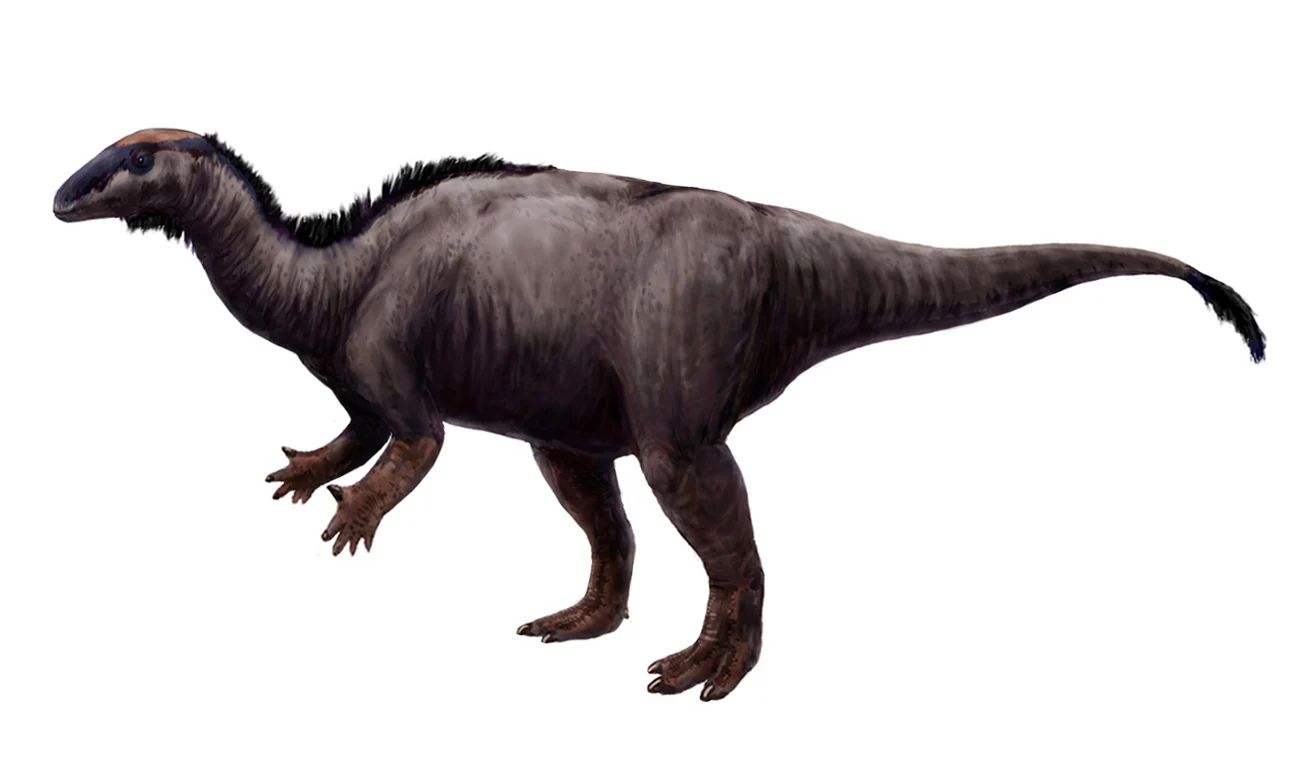
Camptosaurus dispar was a medium-sized iguanodontian that lived across the floodplains of western North America during the Late Jurassic. Its deep skull, keratin-covered beak and closely packed ridged cheek teeth formed an effective plant-processing system, although it lacked the highly specialized dental batteries of later hadrosaurs. The forelimbs were shorter than the hind limbs but strongly built, so adults could probably move and feed on all fours while retaining the ability to rise or travel bipedally. Several partial skeletons and skulls make C. dispar anatomically well known, but the genus also has a complicated history: fossils once combined in museum mounts came from different individuals, and a skull long used in reconstructions was later recognized as the separate dinosaur Theiophytalia.
Its fossils occur between approximately 157 and 145 million years ago. Values shown here are approximate and reflect the current curated seed dataset.
Form and function
The skull was relatively low and deep, with a toothless beak at the front and rows of ridged cheek teeth behind it. Its torso was broad, the pelvis and hind limbs were robust, and a long heavy tail balanced the body. Shorter but sturdy forelimbs could support weight, while the hands retained separate fingers rather than the compact hoof-like structure of later hadrosaurs. The animal's habitual posture remains debated, but its skeleton is compatible with both bipedal and quadrupedal movement rather than a permanently upright kangaroo-like stance.
Evolutionary position
This simplified classification path shows one placement from Dinosauria to this species. Each step is clickable, and other analyses may support alternative relationships.
Open interactive positionScale
Simplified length comparison using preferred dataset estimates; body shape and posture are not represented.
Scientific record
William Harlow Reed found the first material at Quarry 13 near Como Bluff, Wyoming, in 1879 while collecting for Othniel Charles Marsh. Marsh named it Camptonotus dispar that year, then replaced the genus name with Camptosaurus in 1885 because Camptonotus had already been used for an insect. Additional Quarry 13 fossils were collected in the following years. After Marsh's death, important material passed to the Smithsonian, where Charles W. Gilmore prepared a detailed osteological revision and a composite mount in the early twentieth century. Gilmore's work remains a major historical record, although modern studies have separated several species and specimens once placed in Camptosaurus.
Discovery credit: William Harlow Reed.
Naming authors: Othniel Charles Marsh.
Palaeoenvironment
Camptosaurus lived on the river-fed floodplains and seasonally dry landscapes recorded by the Morrison Formation. Ferns, cycads, conifers and other plants formed a varied herbivore food supply. It shared these environments with sauropods such as Diplodocus, Apatosaurus and Brachiosaurus, armored dinosaurs including Stegosaurus, and predators such as Allosaurus and Ceratosaurus. The map marker represents the broad Como Bluff fossil region rather than the precise historic quarry face.
Its beak cropped plants and the cheek teeth sliced and crushed food before swallowing. Limb proportions suggest that it could feed or walk on four limbs and also move on the hind limbs, but the frequency and speed of each gait are not directly preserved. The tail was a counterbalance rather than a ground-dragging prop. No secure nest, herd structure or display behaviour is known specifically for C. dispar.
Worth knowing
Fossil distribution
Albany County, Wyoming, United States
Morrison Formation
regional marker
Markers are deliberately approximate. They identify published fossil areas without exposing sensitive excavation coordinates.
Open interactive mapFossil specimen record
Washington, D.C., United States
The Smithsonian catalogues original C. dispar material collected by William H. Reed in Wyoming, including skull, vertebral and limb elements. Its historic composite mount was assembled from Como Bluff material for research and public interpretation.
A research repository is not necessarily a public exhibit. Loan and display status can change, so check with the institution before visiting.
Media record
Evidence
Charles W. Gilmore · Proceedings of the United States National Museum 36(1666), 197-332 · 1909
Open sourceSmithsonian National Museum of Natural History
Open sourceSmithsonian Institution Archives
Open source