Gara Sbaa and Kem Kem fossil region
Errachidia Province, Morocco
Kem Kem Group, Douira Formation
regional marker
Pronunciation: kar-KAR-oh-DON-toh-SORE-us sah-HAH-ri-kus
A giant North African predator defined chiefly by lost Algerian teeth and a huge partial Moroccan skull, with blade-like serrated teeth and a complicated taxonomic history.
Last updated 16 July 2026
Field guide
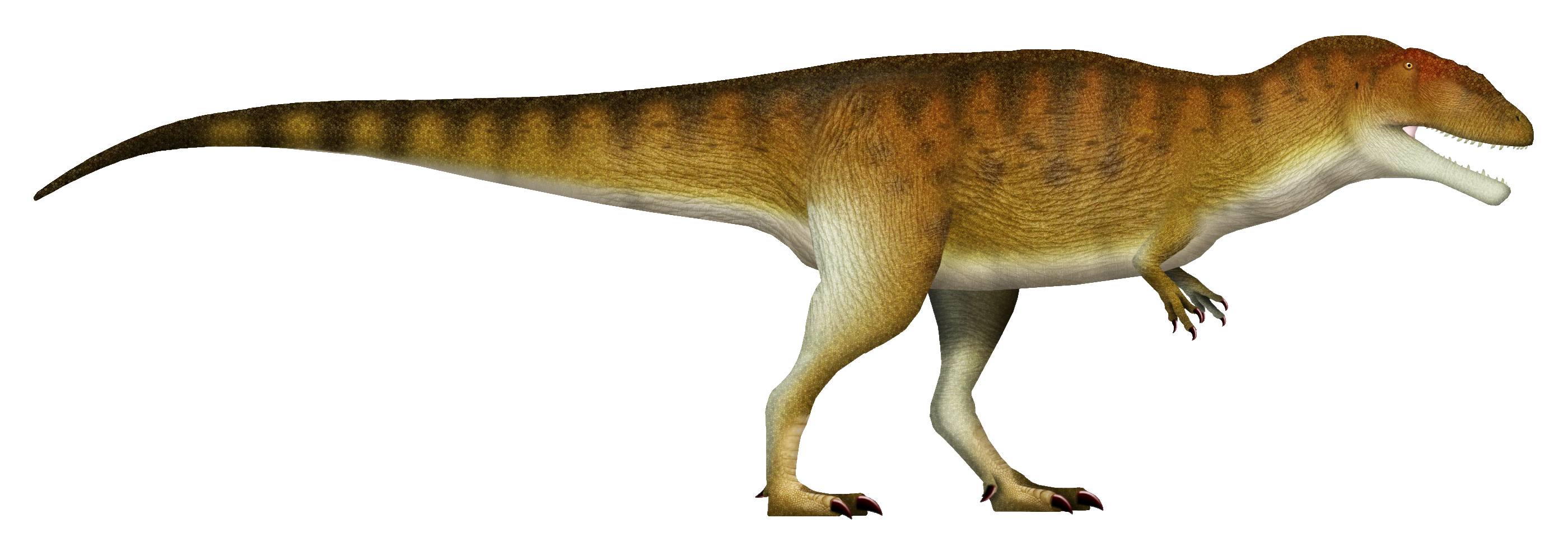
Carcharodontosaurus saharicus was one of the giant carcharodontosaurid predators of mid-Cretaceous North Africa. The Moroccan neotype is a partial skull about 1.6 metres long, but secure postcranial material is sparse, so whole-body dimensions rely heavily on comparison with close relatives. The animal's name refers to the resemblance between its thin, serrated teeth and those of the shark genus Carcharodon. A famous partial skeleton from Egypt shaped reconstructions for almost a century, but a 2025 re-evaluation found enough differences to name that animal Tameryraptor markgrafi. It should no longer be used as direct evidence for the body of C. saharicus.
Its fossils occur between approximately 100.5 and 93.9 million years ago. Values shown here are approximate and reflect the current curated seed dataset.
Form and function
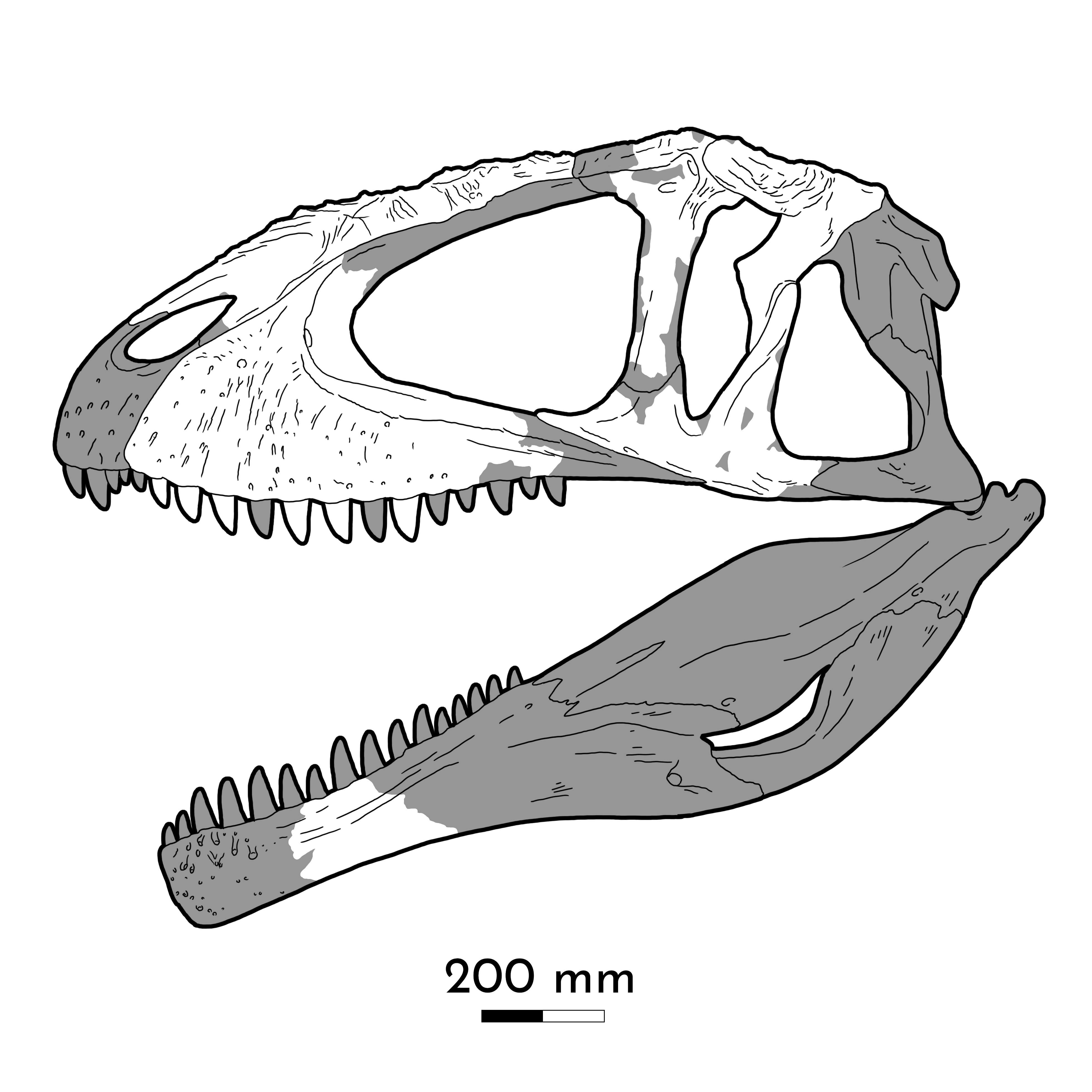
Neotype SGM-Din 1 preserves much of a very large, long and laterally narrow cranium, although the snout tip, rear corners, quadrates and much of the palate are missing. The maxilla has deeply grooved external sculpturing and held long, compressed teeth with curved enamel wrinkles beside the serrations. Large skull openings reduced weight, and the braincase shows extensive pneumatic spaces. The skull alone securely documents the head; the neck, arms, pelvis and legs shown in restorations are mostly reconstructed from related carcharodontosaurids rather than from one associated C. saharicus skeleton.
Evolutionary position
This simplified classification path shows one placement from Dinosauria to this species. Each step is clickable, and other analyses may support alternative relationships.
Open interactive positionScale
Simplified length comparison using preferred dataset estimates; body shape and posture are not represented.
Scientific record
Two large theropod teeth were collected in 1924 from separate foggara water-channel cuttings near Timimoun, Algeria. Charles Depéret and Justin Savornin named them Megalosaurus saharicus in 1925, and Ernst Stromer created Carcharodontosaurus for the species in 1931. The original teeth are now lost. Paul Sereno and colleagues found a huge partial skull in Morocco's Kem Kem region in 1995 and described it in 1996; Brusatte and Sereno designated it neotype SGM-Din 1 in 2007. Stromer's Egyptian skull and partial skeleton, destroyed in Munich in 1944, were historically referred to C. saharicus but were redescribed as Tameryraptor markgrafi in 2025.
Discovery credit: Workers near Timimoun, Captain Burté, Paul Sereno.
Naming authors: Charles Depéret, Justin Savornin.
Palaeoenvironment
The Kem Kem Group records river channels, floodplains and deltaic settings along the northern margin of Africa during the Cenomanian. Fish, crocodyliforms, turtles, pterosaurs and several large predatory dinosaurs occur in the regional assemblage, including Spinosaurus and Deltadromeus. The original Algerian teeth came from broadly coeval continental deposits near Timimoun, but fossils separated by hundreds of kilometres and long intervals of deposition did not necessarily form one local community.
The thin, deeply serrated teeth were effective cutting tools, supporting a role as a large-bodied carnivore. Exactly how Carcharodontosaurus killed prey, what it preferred to hunt and whether it scavenged regularly cannot be read directly from the partial skull. There is no secure evidence for cooperative packs. Comparisons with related allosauroids suggest powerful neck-driven feeding, but bite-force and speed estimates depend on reconstructed muscles and an incompletely known body.
Worth knowing
Fossil distribution
Errachidia Province, Morocco
Kem Kem Group, Douira Formation
regional marker
Adrar Province, Algeria
Continental intercalaire
regional marker
Markers are deliberately approximate. They identify published fossil areas without exposing sensitive excavation coordinates.
Open interactive mapFossil specimen record
Rabat, Morocco
Repository associated with the original partial cranium designated as the neotype of Carcharodontosaurus saharicus. The scientific papers document its Rabat repository; this entry does not claim that the specimen is currently on public display.
A research repository is not necessarily a public exhibit. Loan and display status can change, so check with the institution before visiting.
Media record
Evidence
Charles Depéret, Justin Savornin · Comptes Rendus de l'Académie des Sciences 181 · 1925
Paul C. Sereno, Didier B. Dutheil, M. Iarochene and 6 coauthors · Science 272(5264) · 1996
Open sourceStephen L. Brusatte, Paul C. Sereno · Journal of Vertebrate Paleontology 27(4) · 2007
Open sourceMaximilian Kellermann, Elena Cuesta, Oliver W. M. Rauhut · PLoS ONE 20(1) · 2025
Open sourceMinistry of Energy Transition and Sustainable Development, Morocco
Open source