Bajada Moreno fossil area
Chubut Province, Argentina
La Colonia Formation
approximate site marker
Pronunciation: car-no-TORE-us SAS-tray-eye
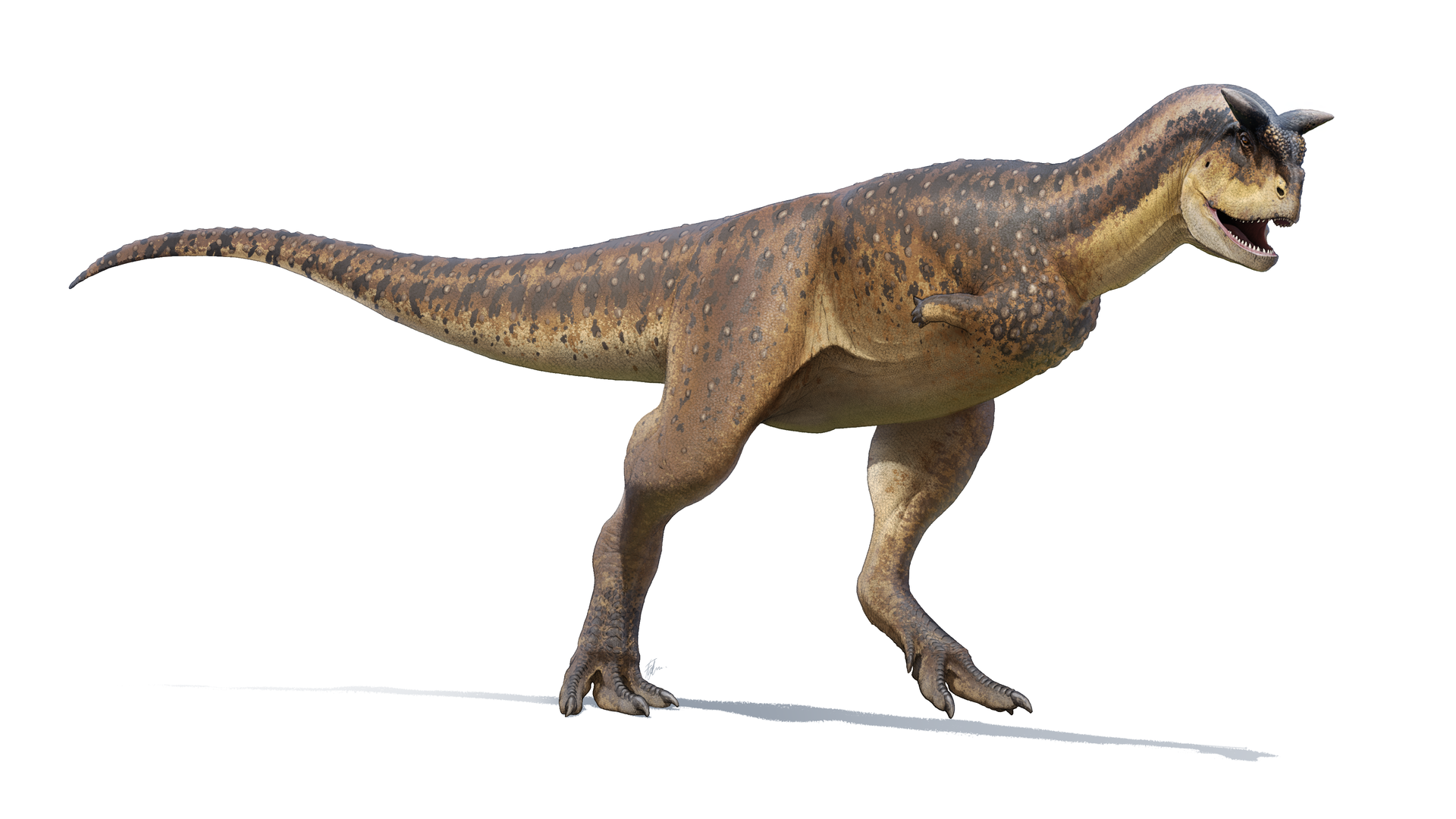
A short-skulled Patagonian abelisaurid with thick brow horns, extremely reduced arms and exceptionally preserved scaly skin. Nearly everything known comes from one remarkable skeleton.
Last updated 13 July 2026
Field guide
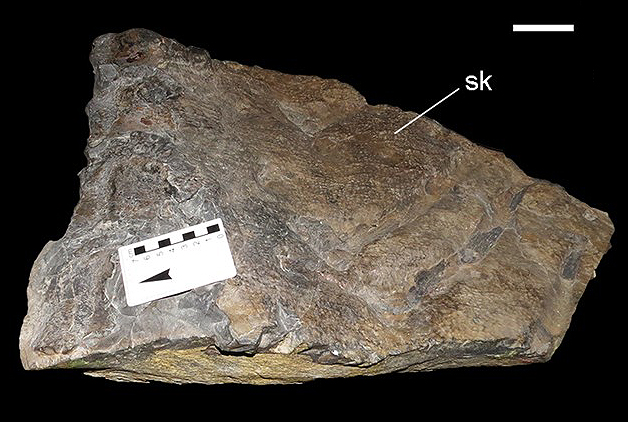
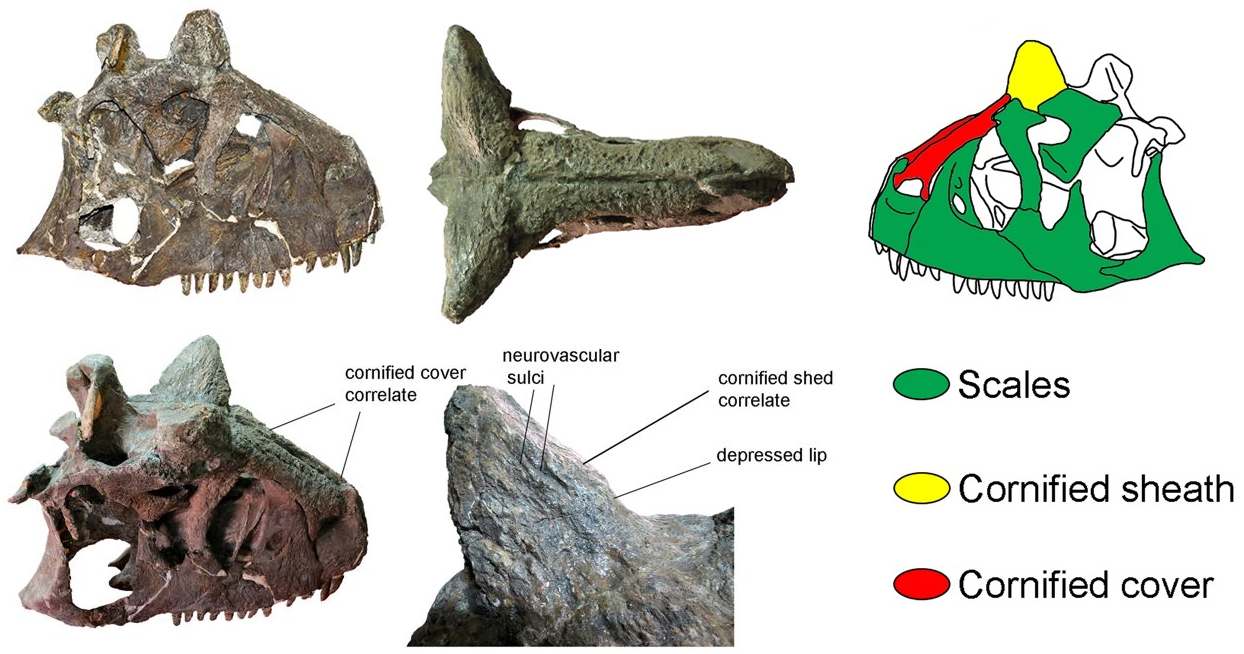
Carnotaurus sastrei was a specialised large predator from latest Cretaceous Patagonia. Its deep, short skull carried a stout horn core above each eye, while the forelimbs were reduced even beyond the condition in tyrannosaurids. The only known skeleton, MACN-PV-CH 894, is substantially complete and preserves skin impressions from several regions of the body. That combination makes Carnotaurus one of the best documented southern-hemisphere theropods, while also imposing a major limitation: variation, growth and differences between sexes cannot be tested from a sample of one.
Its fossils occur between approximately 72 and 69 million years ago. Values shown here are approximate and reflect the current curated seed dataset.
Form and function
The holotype preserves most of the skull and skeleton, both forelimbs and extensive patches of integument. Crushing and sideways deformation altered parts of the skull, so modern studies separate original anatomy from distortion. The horns were bony cores that probably carried keratin in life, but their external shape and use cannot be reconstructed exactly.
Evolutionary position
This simplified classification path shows one placement from Dinosauria to this species. Each step is clickable, and other analyses may support alternative relationships.
Open interactive positionScale
Simplified length comparison using preferred dataset estimates; body shape and posture are not represented.
Scientific record
Members of the Sastre family guided José Bonaparte's eighth Patagonian expedition to the fossil site near Bajada Moreno, Chubut Province, in 1984. The nearly articulated skeleton was enclosed in an exceptionally hard hematite concretion, making preparation slow. Bonaparte named Carnotaurus sastrei in 1985; Carnotaurus means 'meat-eating bull' and sastrei honours Ángel Sastre. Bonaparte, Fernando Novas and Rodolfo Coria published the full skeletal description in 1990.
Discovery credit: Sastre family, José Bonaparte-led Patagonian expedition.
Naming authors: José F. Bonaparte.
Palaeoenvironment
The La Colonia Formation records low-relief coastal plains with rivers, ponds, estuaries and marine influence. Carnotaurus shared this landscape with turtles, crocodyliforms, snakes, mammals and herbivorous dinosaurs. Exact dates within the formation continue to be refined, so the displayed range is approximate.
Carnotaurus was a terrestrial carnivore, but preferred prey and hunting technique are unknown. Its long hind limbs and expanded tail musculature suggest strong forward locomotion, not a measured top speed. The horns may have had display or combat roles, and the skull and neck could resist some loading, but head-butting scenarios remain hypotheses. The preserved skin confirms scales; it does not establish colour or the absence of every filament on unpreserved body regions.
Worth knowing
Fossil distribution
Chubut Province, Argentina
La Colonia Formation
approximate site marker
Markers are deliberately approximate. They identify published fossil areas without exposing sensitive excavation coordinates.
Open interactive mapFossil specimen record
Buenos Aires, Argentina
Repository of the original and only known skeleton, MACN-PV-CH 894, including the skull and associated skin impressions. The museum identifies Carnotaurus as a permanent public exhibit, but individual original bones may rotate for conservation.
Blanding, United States
Displays casts and moulds made from original Carnotaurus skin material. The original fossils remain in the MACN collection in Argentina.
A research repository is not necessarily a public exhibit. Loan and display status can change, so check with the institution before visiting.
Media record
Evidence
José F. Bonaparte · National Geographic Research · 1985
José F. Bonaparte, Fernando E. Novas, Rodolfo A. Coria · Contributions in Science · 1990
Open sourceJavier Ruiz, Angélica Torices, Humberto Serrano, Valentín López · Palaeontology · 2011
Open sourceW. Scott Persons, Philip J. Currie · PLOS ONE · 2011
Open sourceMauricio A. Cerroni, Juan I. Canale, Fernando E. Novas · Historical Biology · 2020
Open sourceChristophe Hendrickx, Phil R. Bell · Cretaceous Research · 2021
Open sourceMuseo Argentino de Ciencias Naturales Bernardino Rivadavia
Open source