Sihetun fossil region
Liaoning Province, China
Yixian Formation
regional marker
Pronunciation: KAW-dip-TER-iks ZOH-eye
A small, flightless oviraptorosaur whose exquisite Liaoning fossils preserve downy body covering and symmetrical wing and tail feathers.
Last updated 26 July 2026
Field guide
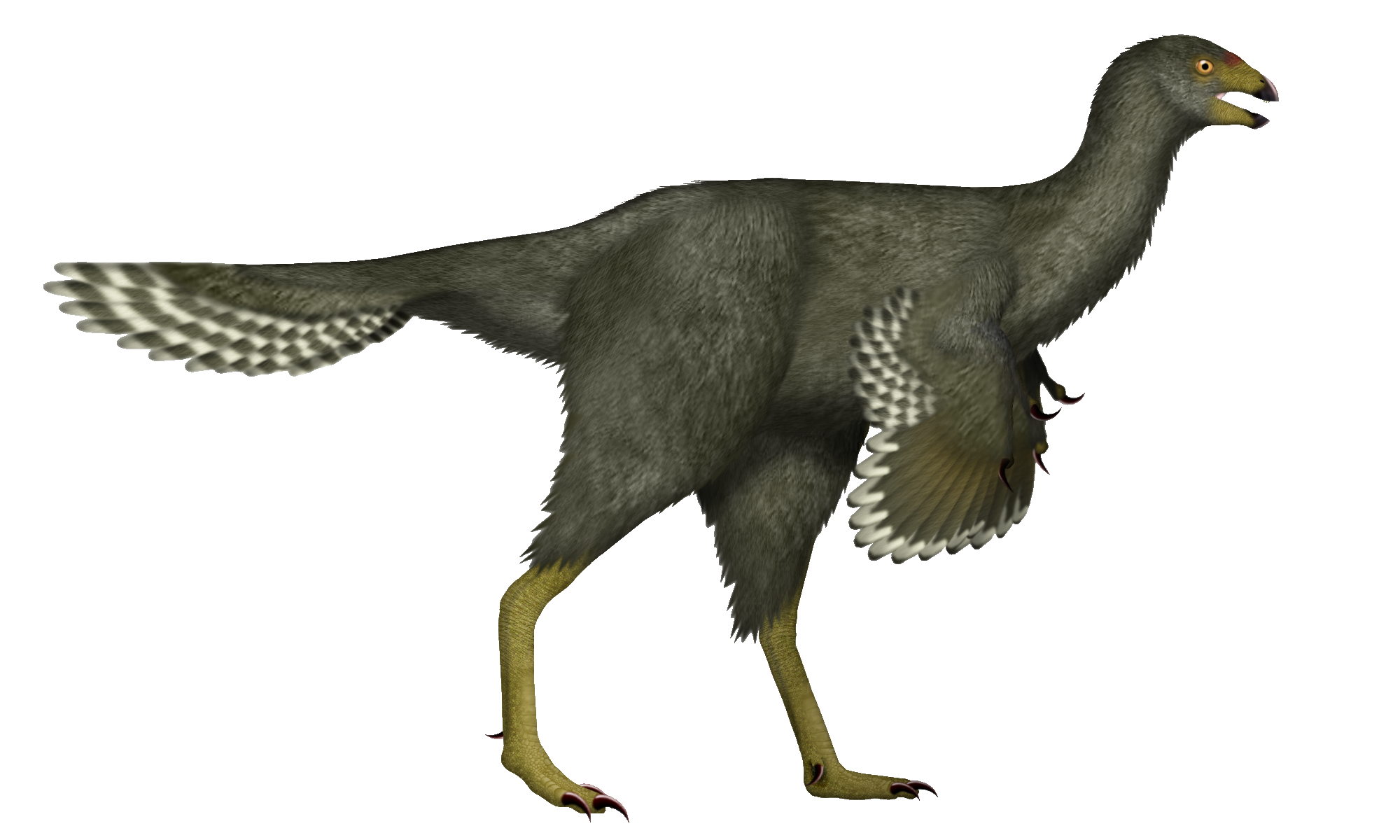
Caudipteryx zoui was a turkey-sized, feathered oviraptorosaur from the Yixian Formation of northeastern China. Nearly complete articulated fossils preserve short down over the body and long, vaned feathers on the hands and tail. Those feathers were symmetrical and too short for powered flight, providing striking evidence that complex plumage evolved in non-avian dinosaurs for functions other than flying.
Its fossils occur between approximately 125 and 122 million years ago. Values shown here are approximate and reflect the current curated seed dataset.
Form and function
Caudipteryx had a short, beak-like skull with only a few small teeth at the front of the upper jaw. Its torso was compact, the legs long, and the tail unusually short for a non-avian theropod. Pennaceous feathers formed small hand wings and a terminal tail fan, while simpler feathers covered the body. Polished stones preserved in the abdomen are interpreted as gastroliths.
Evolutionary position
This simplified classification path shows one placement from Dinosauria to this species. Each step is clickable, and other analyses may support alternative relationships.
Open interactive positionScale
Simplified length comparison using preferred dataset estimates; body shape and posture are not represented.
Scientific record
Fossil collectors recovered the first specimens from the Sihetun area of Liaoning in 1997. Qiang Ji, Philip Currie, Mark Norell and Shu-An Ji named Caudipteryx zoui in Nature in 1998 from holotype NGMC 97-4-A and a paratype. The genus means tail feather, and the species honours Chinese science supporter Zou Jiahua.
Discovery credit: Local fossil collectors in Liaoning Province.
Naming authors: Qiang Ji, Philip J. Currie, Mark A. Norell, Shu-An Ji.
Palaeoenvironment
The Yixian Formation records lakes, forests, volcanic deposits and more open ground within the Jehol Biota. Caudipteryx lived alongside feathered dinosaurs, early birds, mammals, lizards and pterosaurs.
Caudipteryx could not fly. Its long legs suit terrestrial movement, while the hand and tail feathers may have been used in display, brooding or balance. Gastroliths, a beak and reduced teeth support a varied diet, probably dominated by plants but potentially including small animals.
Worth knowing
Fossil distribution
Liaoning Province, China
Yixian Formation
regional marker
Markers are deliberately approximate. They identify published fossil areas without exposing sensitive excavation coordinates.
Open interactive mapFossil specimen record
Beijing, China
Holotype NGMC 97-4-A preserves an articulated skeleton, feather impressions and abdominal gastroliths.
A research repository is not necessarily a public exhibit. Loan and display status can change, so check with the institution before visiting.
Media record
Evidence
Qiang Ji, Philip J. Currie, Mark A. Norell, Shu-An Ji · Nature 393, 753–761 · 1998
Open sourceNatural History Museum, London
Open source