Garden Park Fossil Area
Colorado, United States
Morrison Formation
approximate site marker
Pronunciation: seh-RAT-oh-SORE-us NAY-zih-COR-nis
A medium-sized Morrison Formation predator with a blade-like nasal horn, raised brow bones, unusually deep jaws, four-fingered hands and a row of small bony osteoderms along the body midline.
Last updated 13 July 2026
Field guide
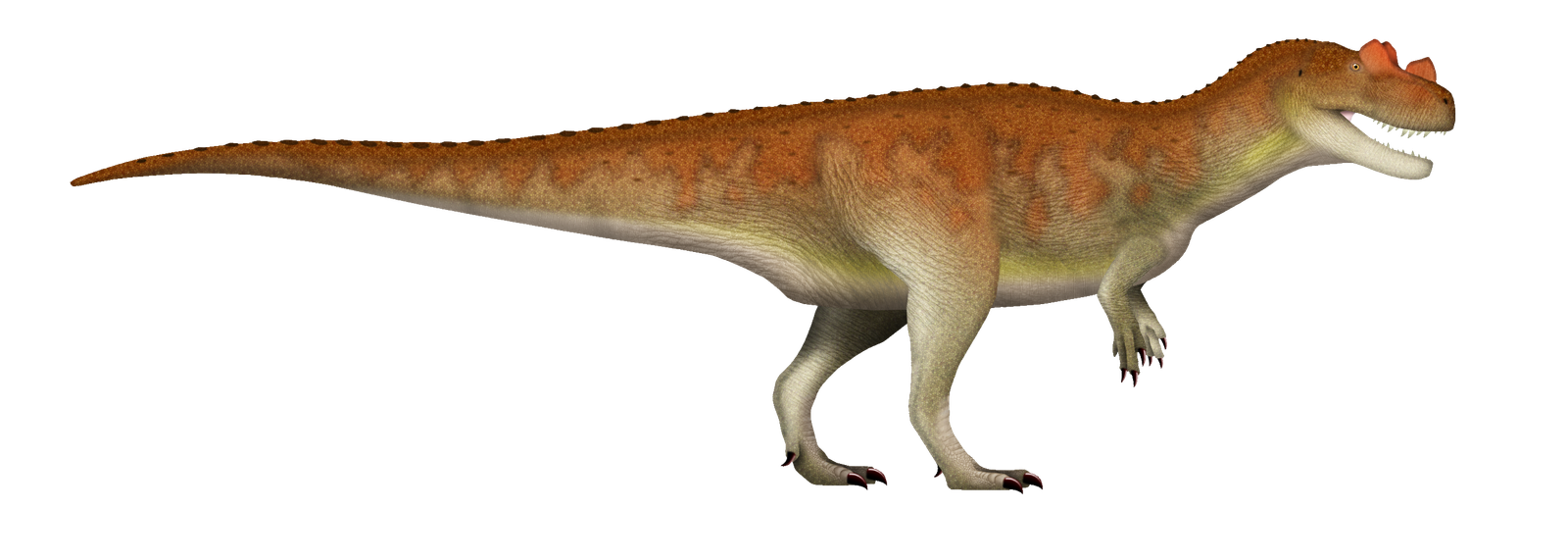
Ceratosaurus nasicornis was a distinctive large theropod of Late Jurassic western North America. It was smaller and less heavily built than the largest contemporary Allosaurus, but carried a proportionally deep skull with long blade-like teeth, a prominent bony horn core above the nose and elevated ornament over both eyes. The nearly complete Garden Park holotype makes its skeleton unusually informative. Ceratosaurus also preserves postcranial osteoderms—small bones formed in the skin—an exceptional feature among known theropods.
Its fossils occur between approximately 154 and 148 million years ago. Values shown here are approximate and reflect the current curated seed dataset.
Form and function
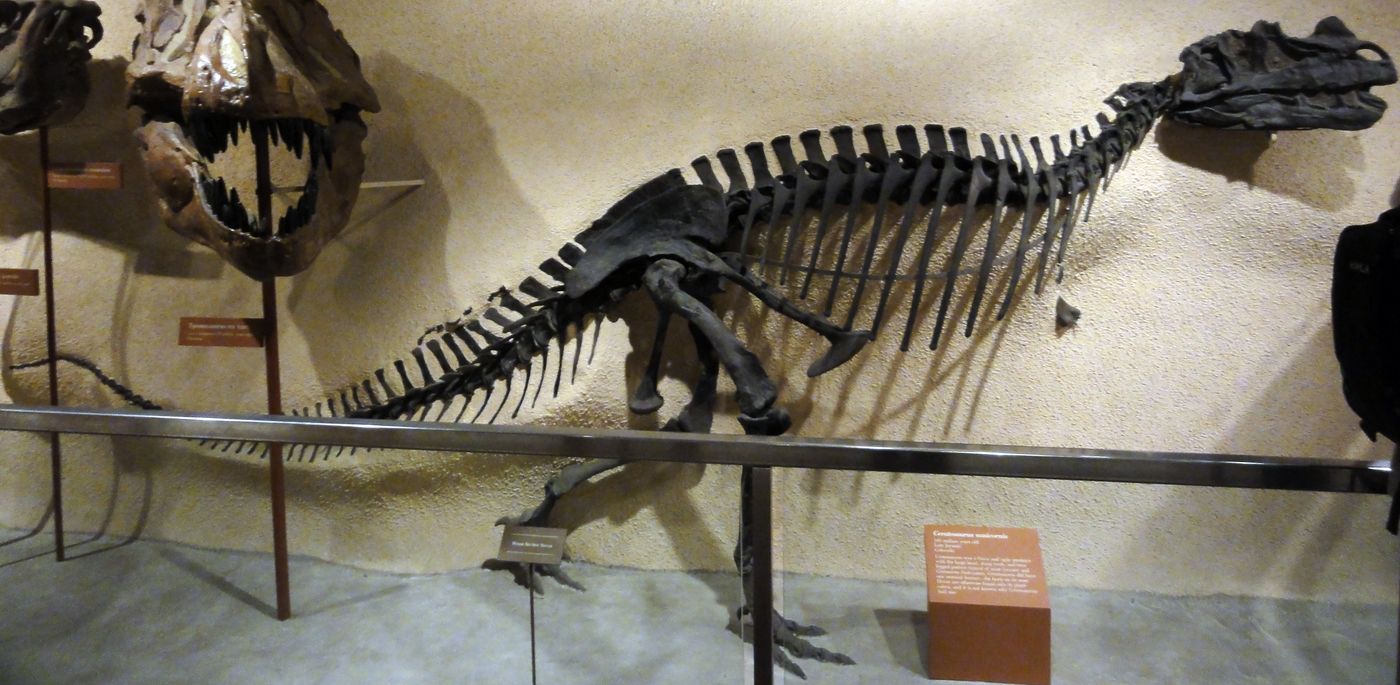
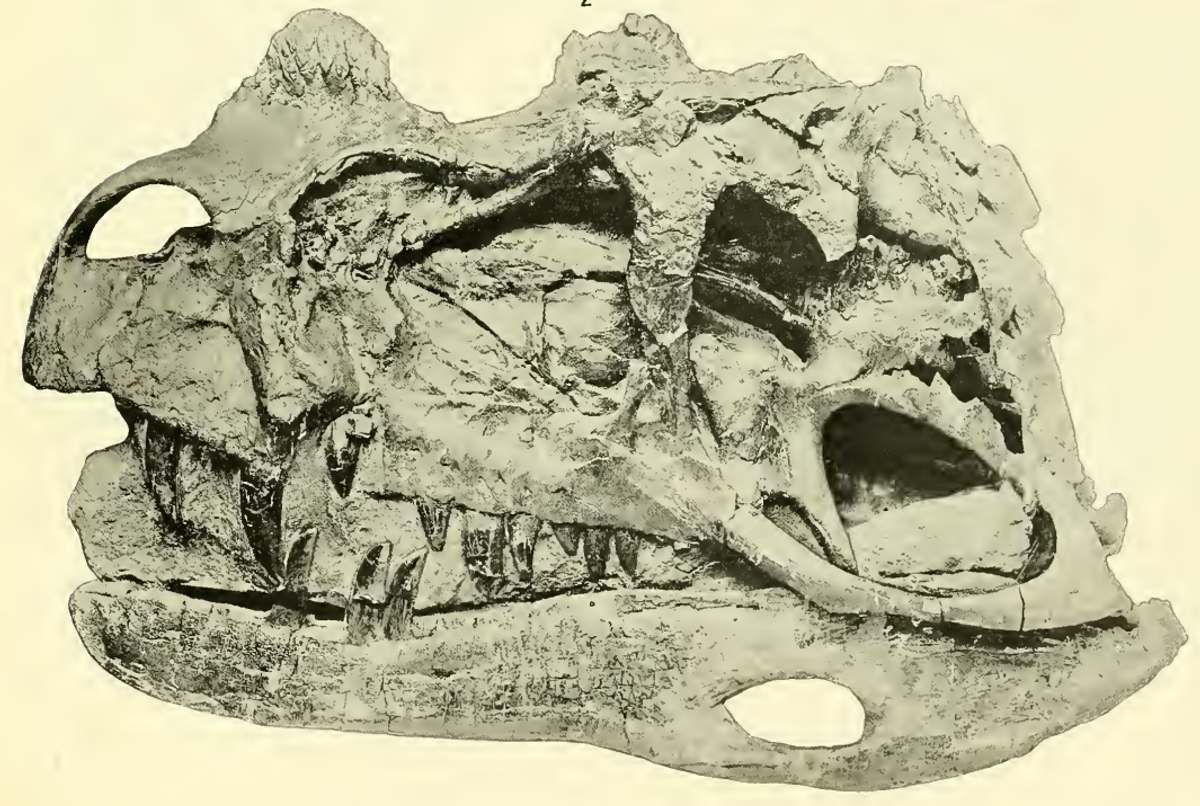
The skull was deep and narrow in front view, with a fused nasal structure rising into the famous midline horn core. Paired lacrimal prominences formed lower ornaments above the eyes. The jaws carried large, laterally compressed and serrated teeth, including unusually long upper teeth. The arms were short but retained four digits; modern re-examination identified reduced metacarpals and phalanges that early preparations had misunderstood. Strong hind limbs supported a bipedal body, while tall tail vertebral spines and chevrons produced a comparatively deep tail.
Evolutionary position
This simplified classification path shows one placement from Dinosauria to this species. Each step is clickable, and other analyses may support alternative relationships.
Open interactive positionScale
Simplified length comparison using preferred dataset estimates; body shape and posture are not represented.
Scientific record
Marshall P. Felch collected the holotype USNM 4735 at Felch-Marsh Quarry in Garden Park, Colorado, in 1883. Othniel Charles Marsh named Ceratosaurus nasicornis in 1884 and emphasized its horn, fused pelvic bones and unusual metatarsus. The specimen later passed from Yale to the Smithsonian. Charles W. Gilmore prepared, mounted and comprehensively described it in 1920. A revised osteology in 2000 incorporated additional Ceratosaurus skeletons, while a 2016 study corrected important details of the holotype forearm and hand.
Discovery credit: Marshall P. Felch.
Naming authors: Othniel Charles Marsh.
Palaeoenvironment
Ceratosaurus lived on the seasonally dry floodplains represented by the Morrison Formation. Braided rivers, ponds and wooded corridors interrupted broad fern- and cycad-rich open areas. The fauna included enormous sauropods, stegosaurs and ornithopods together with other large predators such as Allosaurus and Torvosaurus. The type specimen came from the same Garden Park fossil region that produced important Allosaurus material.
Ceratosaurus was an active carnivore capable of cutting flesh with its deep jaws and long teeth, but no fossil fixes a narrow prey preference or hunting technique. Its horn core and brow ornaments were probably covered by keratin and may have served visual display, species recognition or physical interaction; their exact role cannot be tested directly. Bone histology published in 2025 indicates exceptionally rapid growth compared with later ceratosaur lineages. Claims that its deep tail made it a specialized swimmer remain speculative.
Worth knowing
Fossil distribution
Colorado, United States
Morrison Formation
approximate site marker
Markers are deliberately approximate. They identify published fossil areas without exposing sensitive excavation coordinates.
Open interactive mapFossil specimen record
Washington, D.C., United States
The Smithsonian houses original holotype USNM 4735 in its national collection. The current gallery presents a modern research-based mount created from a digital model, keeping the exhibit reconstruction distinct from the original fossil bones.
A research repository is not necessarily a public exhibit. Loan and display status can change, so check with the institution before visiting.
Media record
Evidence
Charles W. Gilmore · Bulletin of the United States National Museum · 1920
Open sourceOthniel Charles Marsh · Geological Magazine · 1884
Open sourceJames H. Madsen Jr., Samuel P. Welles · Utah Geological Survey Miscellaneous Publication 00-2 · 2000
Open sourceMatthew T. Carrano, Jonah Choiniere · Journal of Vertebrate Paleontology · 2016
Open sourceRiley Sombathy, Patrick M. O'Connor, Michael D. D'Emic · Journal of Anatomy · 2025
Open sourceSmithsonian National Museum of Natural History
Open sourceSmithsonian Libraries and Archives · 2019
Open source