Lamadong fossil area
Jianchang County, western Liaoning, China
Jiufotang Formation
regional marker
Pronunciation: CHANG-joh-SORE-us sy-NEN-sis
A tiny, nearly complete feathered pennaraptoran from Early Cretaceous China, preserving enormous wings, feathered feet and a fan of about 16 exceptionally long tail feathers.
Last updated 16 July 2026
Field guide
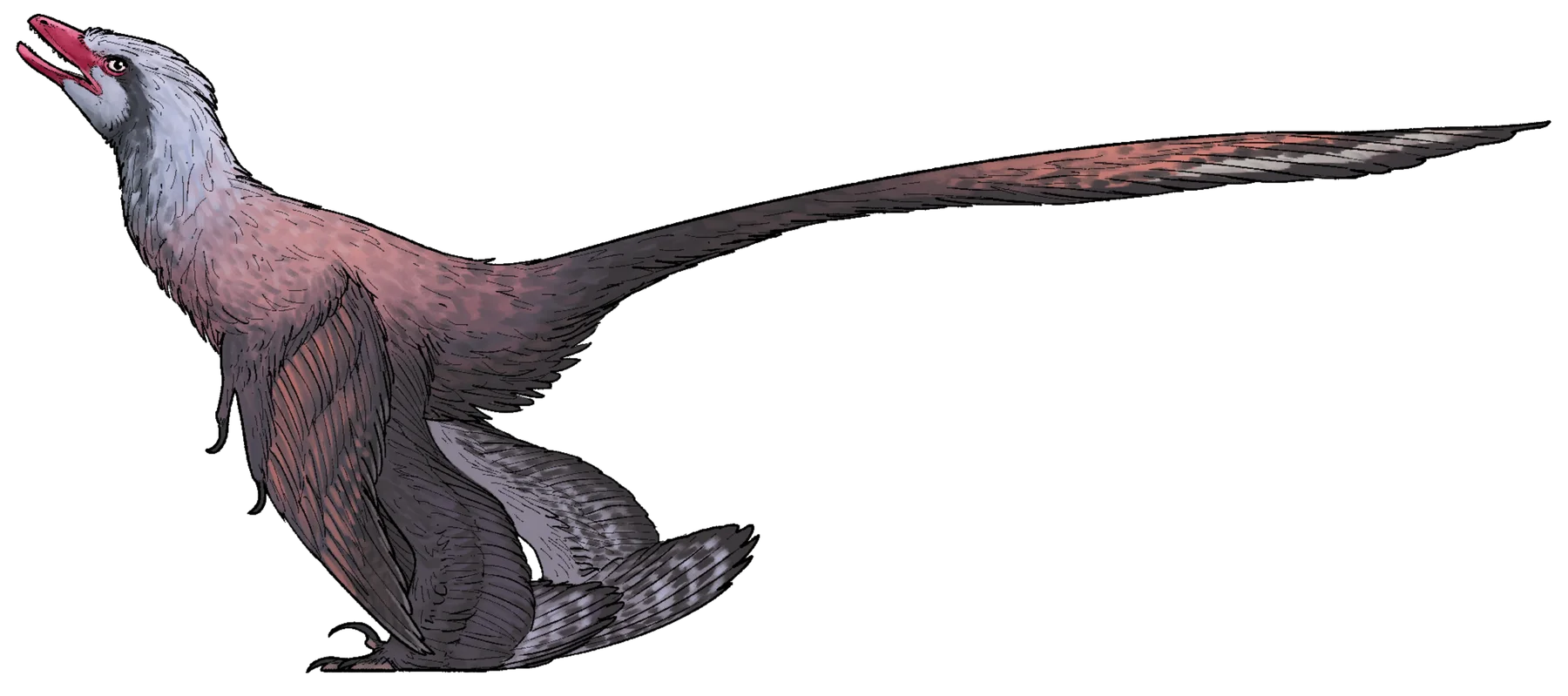
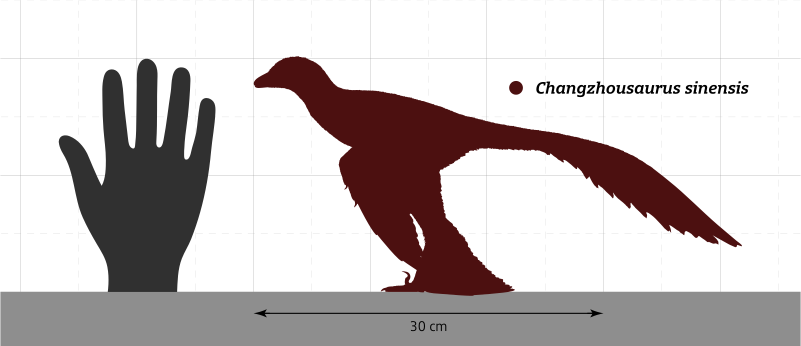
Changzhousaurus sinensis is known from a single slab-and-counterslab skeleton with much of its plumage preserved. At only about 34 centimetres in skeletal body length, it nevertheless carried proportionally immense feathered wings, large feathers on its feet and a striking tail fan whose longest feathers were roughly four times the length of the femur. Xing Xu's 2026 analysis most often recovered it as an early-diverging deinonychosaur, close to the lineage containing dromaeosaurids and troodontids, but alternative placements among anchiornithines or early avialans could not be excluded. It therefore records a mosaic of aerial and terrestrial adaptations rather than a simple intermediate on a straight path to birds.
Its fossils occur between approximately 120.3 and 119 million years ago. Values shown here are approximate and reflect the current curated seed dataset.
Form and function
The skeleton combines a short, deep skull and compact bony forelimbs with remarkably extensive flight feathers. Both forelimbs supported large pennaceous wings, and the hind limbs bore long pedal feathers. Approximately 16 ribbon-like or pennaceous feathers formed an elongated tail fan. The shoulder, hand and tail include character combinations not seen together in other known pennaraptorans. The holotype is nearly complete and preserves soft-tissue outlines, but compression on the slab and the animal's probable subadult age limit some measurements.
Evolutionary position
This simplified classification path shows one placement from Dinosauria to this species. Each step is clickable, and other analyses may support alternative relationships.
Open interactive positionScale
Simplified length comparison using preferred dataset estimates; body shape and posture are not represented.
Scientific record
The holotype, LDNHMF 2026A/B, came from the Aptian Jiufotang Formation at Lamadong in Jianchang County, western Liaoning. It is preserved as matching slab and counterslab and is housed at the Lande Museum of Natural History in Tangshan; casts IVPP FV2204A/B are held by the Institute of Vertebrate Paleontology and Paleoanthropology in Beijing. Xing Xu named and described the species in 2026. The genus acknowledges support from the Changzhou municipal government, while sinensis means Chinese or from China.
Naming authors: Xing Xu.
Palaeoenvironment
Changzhousaurus lived in the Jehol Biota around lakes and forested volcanic landscapes in what is now western Liaoning. Fine sediments of the Jiufotang Formation buried small animals rapidly enough to preserve delicate feathers. The exact microhabitat occupied by this individual cannot be determined from its skeleton alone.
Its extensive asymmetric-looking feather surfaces are consistent with an aerial role, but the paper does not establish whether Changzhousaurus launched from the ground, climbed, glided or used powered flight. Large pedal feathers may retain an ancestral four-winged condition even if some terrestrial ability had been regained. Colour, display behaviour, nesting and sociality remain unknown.
Worth knowing
Fossil distribution
Jianchang County, western Liaoning, China
Jiufotang Formation
regional marker
Markers are deliberately approximate. They identify published fossil areas without exposing sensitive excavation coordinates.
Open interactive mapFossil specimen record
Tangshan, China
Repository of the original feathered slab and counterslab. The scientific paper documents the repository but does not confirm that the specimen is continuously on public display.
Beijing, China
Repository of research casts of both parts of the holotype; these are replicas, not original fossil material. Public display is not confirmed.
A research repository is not necessarily a public exhibit. Loan and display status can change, so check with the institution before visiting.
Media record
Evidence
Xing Xu · Vertebrata PalAsiatica · 2026
Open sourceChinese Academy of Sciences · 2026
Open source