Ghost Ranch
New Mexico, United States
Chinle Formation
approximate site marker
Pronunciation: SEE-loh-FYE-sis BOW-rye
A lightly built Late Triassic predator known from hundreds of skeletons at Ghost Ranch. Its famous fossils stabilized a difficult species name—and disproved a textbook story about dinosaur cannibalism.
Last updated 13 July 2026
Field guide
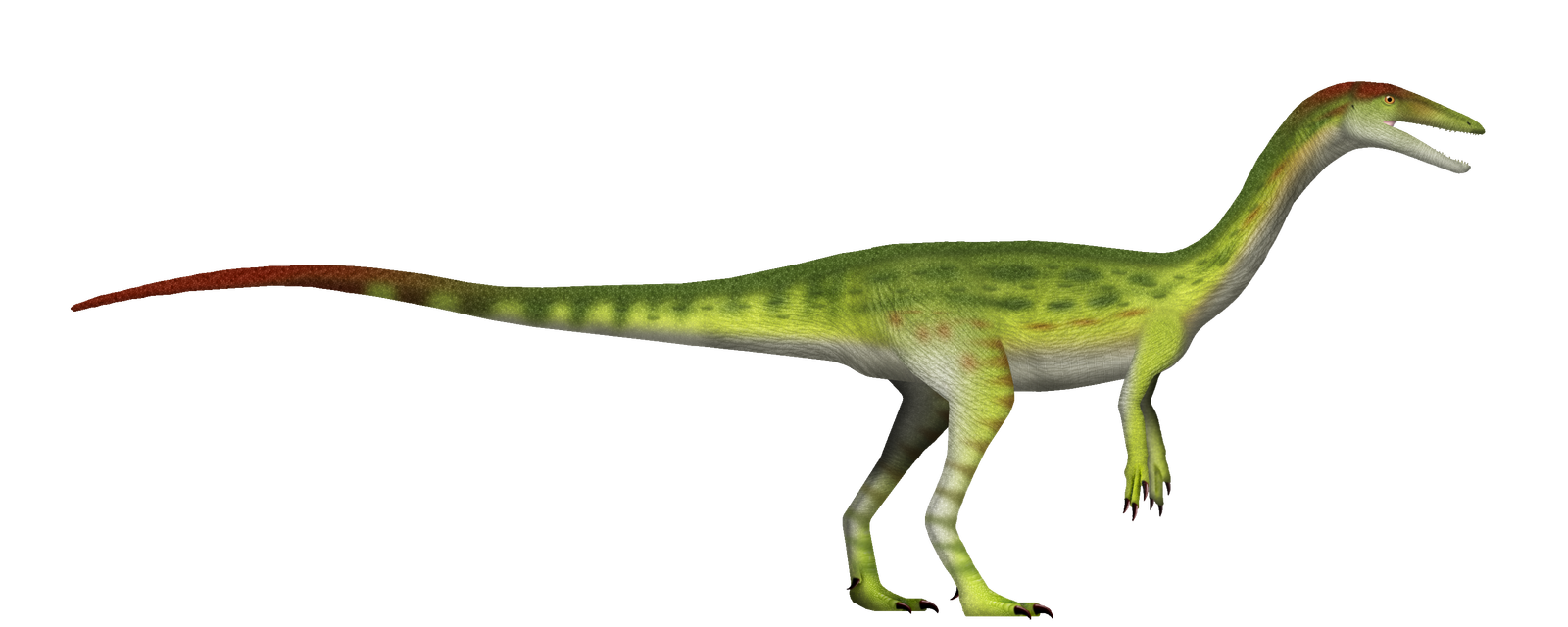
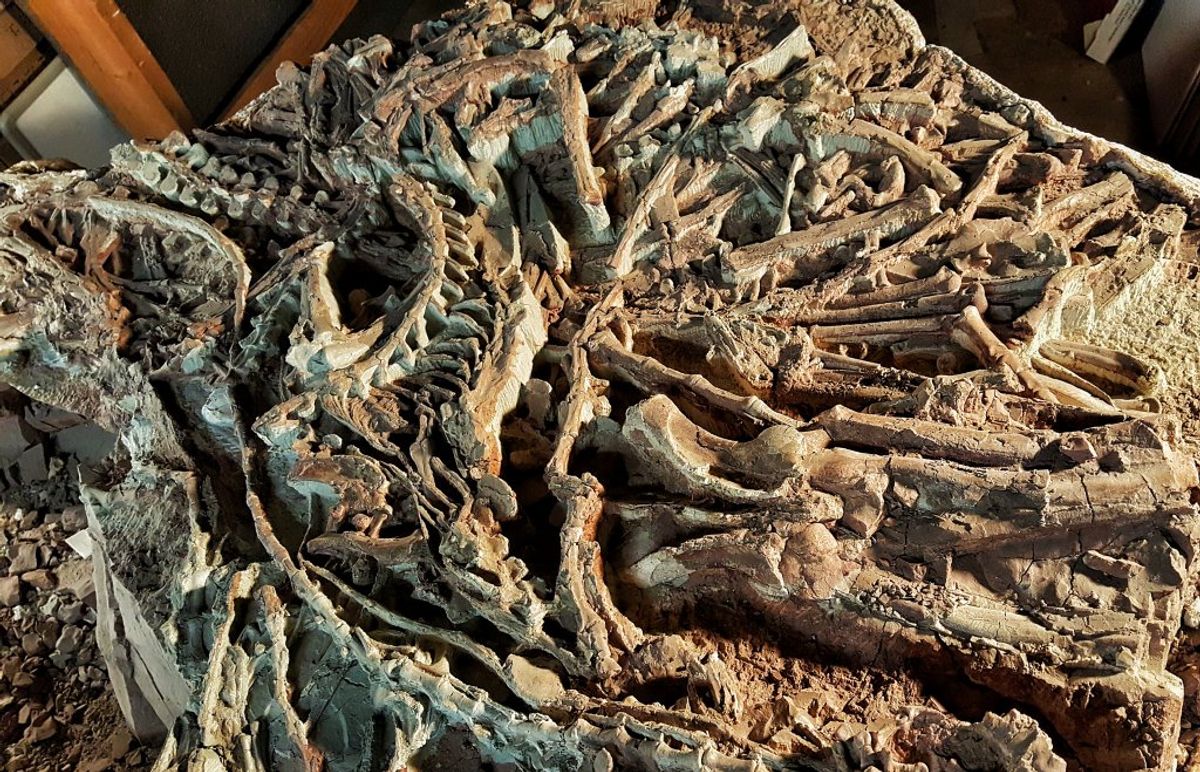
Coelophysis bauri was a small, slender theropod that lived in what is now the south-western United States late in the Triassic. A long narrow head, recurved serrated teeth, flexible neck, lightweight trunk, long hind limbs and an equally long balancing tail made it an agile bipedal predator. Its anatomy is exceptionally well known because the Whitaker Quarry at Ghost Ranch preserves hundreds of individuals, many articulated and representing several growth stages. Those skeletons are scientifically important, but their concentration does not by itself prove that Coelophysis hunted in coordinated packs or even lived in permanent groups.
Its fossils occur between approximately 212 and 205 million years ago. Values shown here are approximate and reflect the current curated seed dataset.
Form and function
The skull was low and narrow, with a kink between the tooth-bearing premaxilla and maxilla and many small cutting teeth. The neck and tail were long, the vertebrae and limb bones were lightly constructed, and the hind limbs were proportionally elongated. Each hand carried three substantial clawed fingers and a much smaller fourth digit. The Ghost Ranch sample includes differently sized and differently proportioned skeletons, but proposed divisions into male and female body forms have not been demonstrated securely.
Evolutionary position
This simplified classification path shows one placement from Dinosauria to this species. Each step is clickable, and other analyses may support alternative relationships.
Open interactive positionScale
Simplified length comparison using preferred dataset estimates; body shape and posture are not represented.
Scientific record
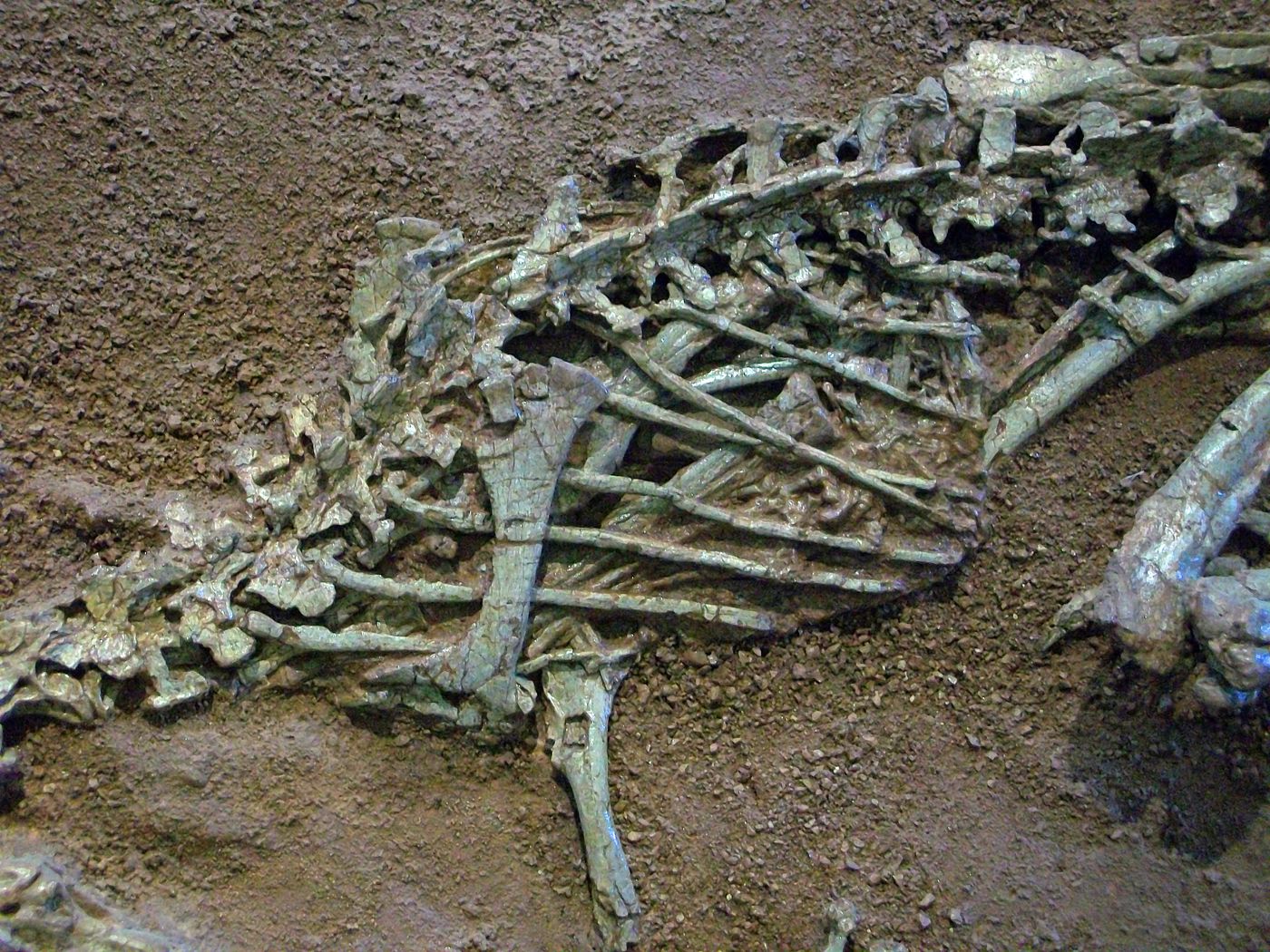
David Baldwin collected the fragmentary original fossils in northern New Mexico in 1881. Edward Drinker Cope named them Coelurus bauri in 1887 and created the genus Coelophysis in 1889. The fossils were too incomplete to connect confidently with the spectacular skeletons discovered after crew member George Whitaker located the dense Ghost Ranch bonebed during Edwin H. Colbert’s 1947 American Museum expedition. After years of competing names, the International Commission on Zoological Nomenclature stabilized usage in 1996 by replacing the old lectotype with articulated Ghost Ranch skeleton AMNH FR 7224 as the neotype of C. bauri.
Discovery credit: David Baldwin, George Whitaker, Edwin H. Colbert.
Naming authors: Edward Drinker Cope.
Palaeoenvironment
Ghost Ranch lay within a broad low-latitude river system on western Pangaea. Seasonal channels crossed wooded floodplains under a strongly seasonal climate. Coelophysis shared this landscape with phytosaurs, aetosaurs, crocodylomorph relatives and many smaller reptiles rather than living in a dinosaur-dominated fauna.
Coelophysis probably caught small vertebrates and other manageable prey with its jaws and grasping hands. A 2006 re-examination showed that bones associated with the abdomen of the neotype belonged to a small crocodylomorph, not a juvenile Coelophysis, while the second supposed case did not preserve diagnostic gut contents. Cannibalism is therefore not supported by these famous specimens. The cause of the Ghost Ranch mass accumulation remains uncertain; flooding, drought mortality, transport and concentration in a channel may all have contributed.
Worth knowing
Fossil distribution
New Mexico, United States
Chinle Formation
approximate site marker
Markers are deliberately approximate. They identify published fossil areas without exposing sensitive excavation coordinates.
Open interactive mapFossil specimen record
New York, United States
Original, nearly complete Ghost Ranch Coelophysis specimens are permanently displayed. The museum also houses neotype AMNH FR 7224, the skeleton that formally anchors the species name.
Cleveland, United States
Original Ghost Ranch bone block CMNH 10971, formerly AMNH Block XII. A museum volunteer spent about eight years exposing its tightly packed skeletons.
A research repository is not necessarily a public exhibit. Loan and display status can change, so check with the institution before visiting.
Media record
Evidence
International Commission on Zoological Nomenclature · Bulletin of Zoological Nomenclature · 1996
Open sourceSterling J. Nesbitt, Alan H. Turner, Gregory M. Erickson, Mark A. Norell · Biology Letters · 2006
Open sourceAmerican Museum of Natural History
Open sourceNew Mexico Bureau of Geology & Mineral Resources
Open sourceAmerican Museum of Natural History · 2006
Open sourceCleveland Museum of Natural History
Open source