Kelheim–Solnhofen limestone region
Bavaria, Germany
Altmühltal Formation
regional marker
Pronunciation: KOMP-sog-NATH-us LON-jih-peez
A small Late Jurassic theropod known from just two exceptionally complete European skeletons—one from Bavaria and a larger individual from Canjuers, France—both preserving evidence central to its anatomy and diet.
Last updated 14 July 2026
Field guide
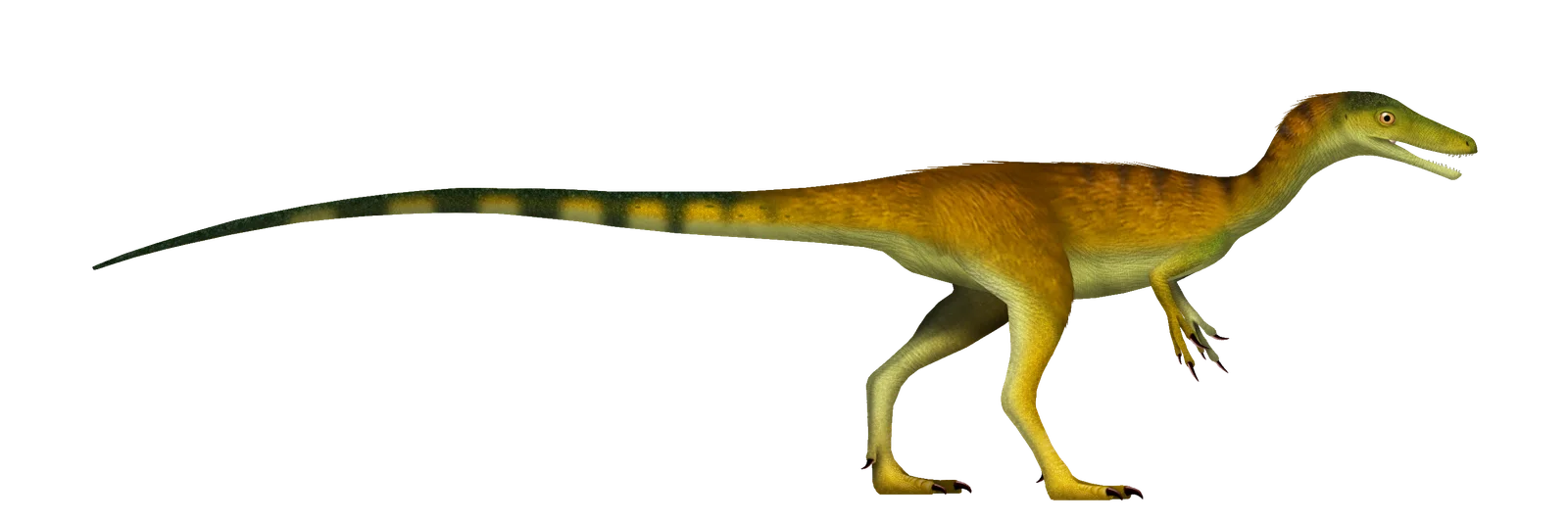
Compsognathus longipes is one of the historically most important small dinosaurs. Its nearly complete Bavarian skeleton was described as early as 1859, just before Archaeopteryx helped bring bird-like dinosaurs into evolutionary debate. A second, roughly twice-as-large skeleton from Canjuers, France, was named Compsognathus corallestris in 1972 and later referred to the same species. Together, only these two individuals underpin nearly everything known about the animal. They show a lightly built, long-tailed biped with a small narrow head and three-fingered hands. Both also preserve direct feeding evidence: a small lizard inside the German specimen and remains interpreted as rhynchocephalians within the French one. Its familiar downy covering is plausible but unpreserved, and a major 2024 analysis challenged whether the traditional family Compsognathidae is a natural group at all.
Its fossils occur between approximately 150.5 and 148 million years ago. Values shown here are approximate and reflect the current curated seed dataset.
Form and function
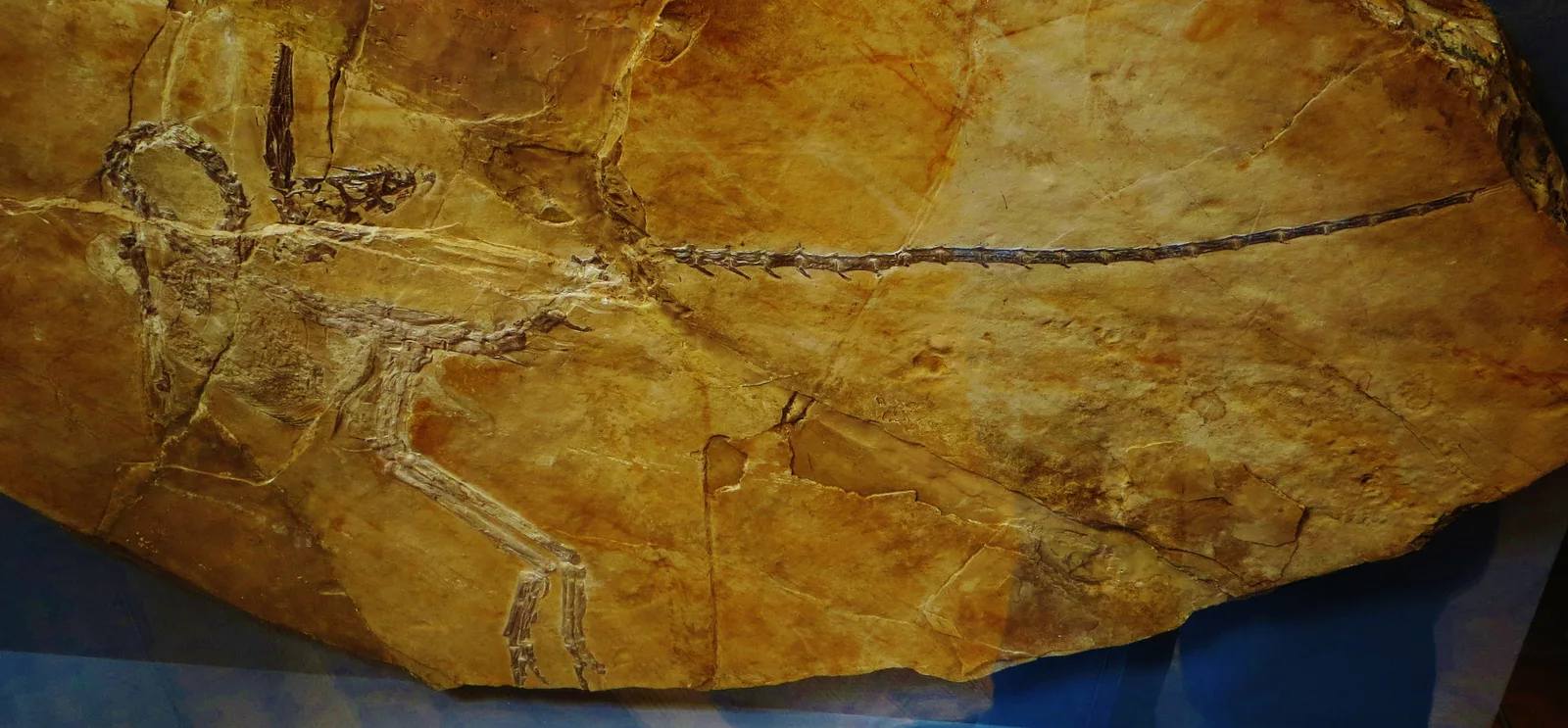
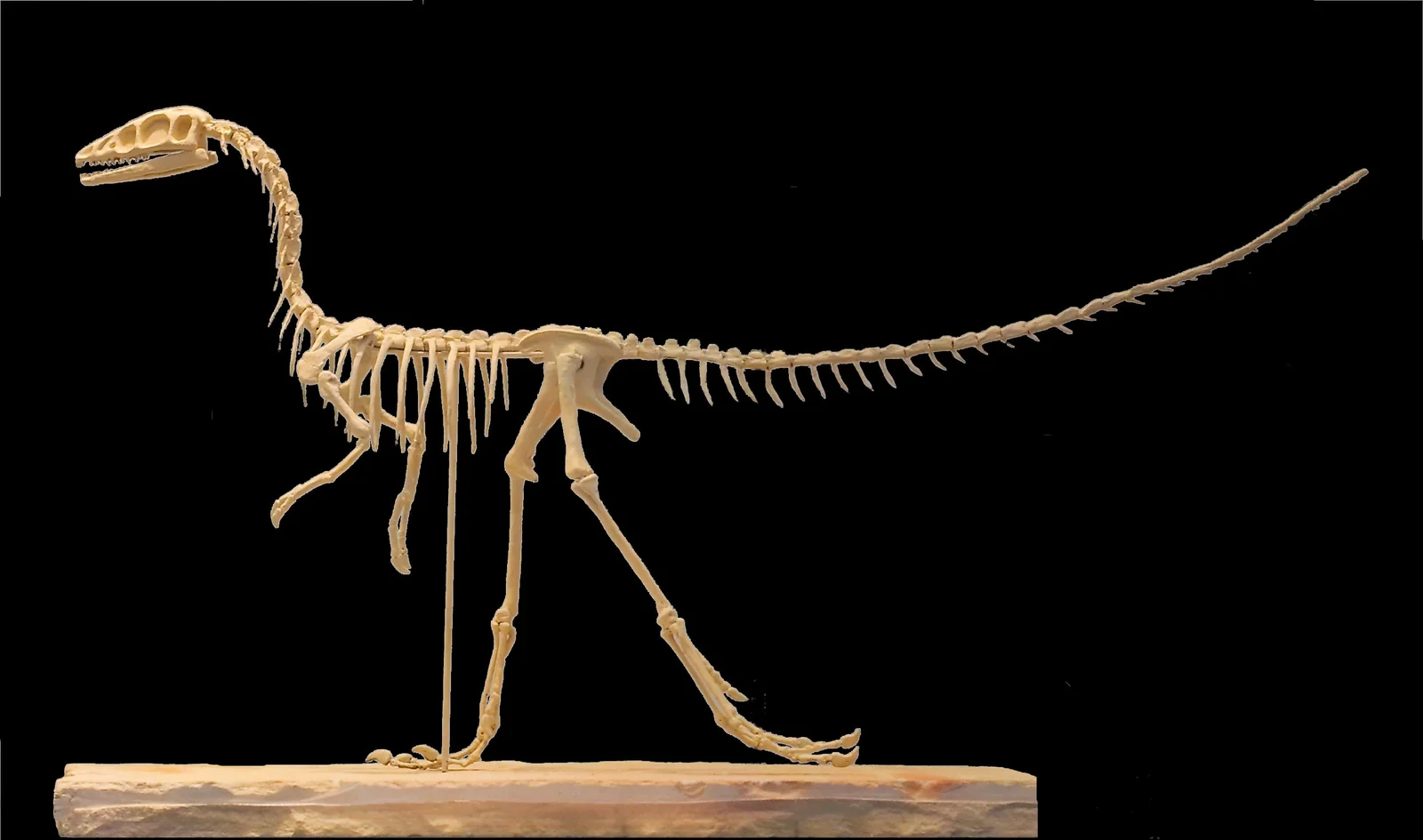
The German holotype SNSB-BSPG AS I 563 is about 70–90 centimetres long depending on how missing tail segments are restored; the French specimen MNHN CNJ 79 reaches roughly 1.25–1.5 metres. Both have a low, lightly constructed skull, slender jaws with recurved teeth, a flexible neck, long hind limbs and a very long balancing tail. Peyer’s re-study established at least three functional fingers, overturning older two-fingered reconstructions. The French specimen also showed that broad structures once interpreted as swimming paddles were sedimentary features rather than anatomy. Fine impressions beside its tail have been described as skin, but neither specimen preserves unequivocal feathers. Their substantial size difference probably includes an ontogenetic component, although published assessments disagree over which growth stage each animal represents.
Evolutionary position
This simplified classification path shows one placement from Dinosauria to this species. Each step is clickable, and other analyses may support alternative relationships.
Open interactive positionScale
Simplified length comparison using preferred dataset estimates; body shape and posture are not represented.
Scientific record
The exact quarry and finder of the Bavarian specimen are undocumented. Physician and fossil collector Joseph Oberndorfer owned it by the late 1850s and lent it to Johann Andreas Wagner, who briefly named Compsognathus longipes in 1859 and described it more fully in 1861. The Bavarian state collection acquired Oberndorfer’s fossils in 1866; the holotype is now SNSB-BSPG AS I 563. Quarrying at Canjuers in southeastern France produced the second skeleton in the early 1970s. Alain Bidar and colleagues named it C. corallestris, interpreting its forelimbs as aquatic adaptations. Later work rejected that interpretation, and Karin Peyer’s 2006 redescription treated the French form as a subjective junior synonym of C. longipes. The specimen, MNHN CNJ 79, is now displayed in Paris.
Discovery credit: Unknown Bavarian quarry worker; specimen collected by Joseph Oberndorfer, Canjuers quarry workers.
Naming authors: Johann Andreas Wagner.
Palaeoenvironment
Both skeletons entered quiet carbonate lagoons around the northern Tethys, but they represent separate island systems. The Bavarian animal came from the Solnhofen Plattenkalk region, an archipelago of low islands, reef barriers and restricted lagoons whose oxygen-poor bottoms discouraged scavengers. The exact holotype quarry is uncertain, with historical labels pointing broadly to the Altmühl valley near Kelheim and later to Jachenhausen. Canjuers was another shallow lagoon bordered by emergent reef areas in what is now Provence. Sedimentology indicates that storms carried many land and reef organisms into the basin. Compsognathus lived on nearby dry land; its preservation in marine limestone does not make it an aquatic dinosaur.
Compsognathus was an active terrestrial carnivore, and its meals provide unusually direct evidence. Ostrom identified the articulated animal inside the German ribcage as the lizard Bavarisaurus rather than an embryo, disproving an old cannibalism story. The French specimen preserves two small reptile remains identified by the MNHN as rhynchocephalians. These fossils show ingestion of small vertebrates but do not reveal whether prey was chased, ambushed or scavenged. Long legs suggest capable terrestrial movement, yet no trackway supplies a measured speed. There is no nest, group accumulation or injury pattern demonstrating social behaviour, parental care or combat.
Worth knowing
Fossil distribution
Bavaria, Germany
Altmühltal Formation
regional marker
Var, Provence-Alpes-Côte d’Azur, France
Canjuers lithographic limestone
regional marker
Markers are deliberately approximate. They identify published fossil areas without exposing sensitive excavation coordinates.
Open interactive mapFossil specimen record
Munich, Germany
Permanent research repository of original Bavarian holotype SNSB-BSPG AS I 563. The institution identifies Compsognathus among the particularly important fossils in this collection, but its public page does not promise that the delicate slab is continuously exhibited.
Paris, France
The museum’s current object page identifies original Canjuers skeleton MNHN CNJ 79 as the most complete dinosaur known from France and confirms that it is displayed in the Galerie de Paléontologie. It is the larger of the two known Compsognathus individuals.
Paris, France
The scientific collection catalogue records an exhibited mould of Bavarian holotype SNSB-BSPG AS I 563. The database labels the determination as holotype because the cast represents that specimen; the object in Paris is explicitly a moulage, not the original fossil.
A research repository is not necessarily a public exhibit. Loan and display status can change, so check with the institution before visiting.
Media record
Evidence
Johann Andreas Wagner · Sitzungsberichte der Bayerischen Akademie der Wissenschaften 49 · 1859
Open sourceJohn H. Ostrom · Zitteliana 4 · 1978
Open sourceKarin Peyer · Journal of Vertebrate Paleontology 26(4) · 2006
Open sourceKarin Peyer, Sylvain Charbonnier, Ronan Allain and 2 coauthors · Comptes Rendus Palevol 13(5) · 2014
Open sourceAndrea Cau · Bollettino della Società Paleontologica Italiana 63(1) · 2024
Open sourceMuséum national d’Histoire naturelle
Open sourceMuséum national d’Histoire naturelle scientific collections
Open sourceNatural History Museum, London
Open sourceBayerische Staatssammlung für Paläontologie und Geologie
Open source