Las Hoyas fossil site
La Cierva, Cuenca Province, Spain
La Huérguina Formation
approximate site marker
Pronunciation: kon-KAH-veh-NAY-tor kor-koh-VAH-tus
A nearly completely known Early Cretaceous predator from Spain with a short, tall-backed crest immediately in front of its hips.
Last updated 23 July 2026
Field guide
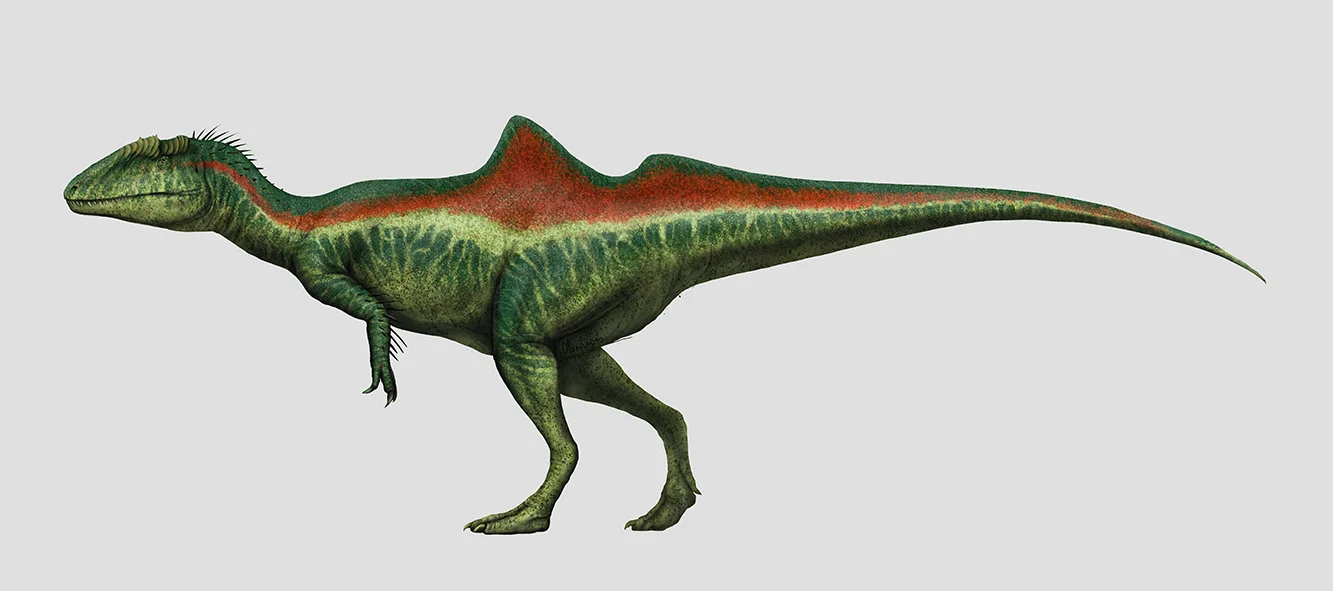
Concavenator corcovatus was an early carcharodontosaurian theropod from the Las Hoyas wetland in central Spain. The sole known skeleton, MCCM-LH 6666, is articulated and approximately 95 percent complete, preserving not only most bones but also patches of scales and other soft-tissue traces. Two exceptionally tall vertebral spines form its famous short hump or sail. A row of bumps on the ulna was originally interpreted as attachment points for simple feather-like structures, but subsequent anatomical work has kept muscular and other explanations in play.
Its fossils occur between approximately 129.4 and 125 million years ago. Values shown here are approximate and reflect the current curated seed dataset.
Form and function
Concavenator had a low, narrow skull with blade-like, serrated teeth and relatively short forelimbs. The neural spines of the final two back vertebrae were dramatically elongated, creating a steep triangular profile in front of the hips; lower but enlarged spines continued onto the front of the tail. The right ulna bears a series of regularly spaced bumps. Their placement is unusual for bird-like quill knobs, so they should not be treated as proof of wing feathers. Scale impressions around the feet and tail provide rare direct evidence of its external covering.
Evolutionary position
This simplified classification path shows one placement from Dinosauria to this species. Each step is clickable, and other analyses may support alternative relationships.
Open interactive positionScale
Simplified length comparison using preferred dataset estimates; body shape and posture are not represented.
Scientific record
Researchers excavated MCCM-LH 6666 at the Las Hoyas fossil site in 2003. Francisco Ortega, Fernando Escaso and José Luis Sanz named the dinosaur in Nature in 2010. Conca refers to Cuenca, venator means hunter, and corcovatus means hump-backed. The specimen is popularly nicknamed Pepito and is conserved and displayed at the Museo Paleontológico de Castilla-La Mancha in Cuenca.
Naming authors: Francisco Ortega, Fernando Escaso, José Luis Sanz.
Palaeoenvironment
Las Hoyas preserves a subtropical freshwater wetland with shallow lakes, carbonate muds and microbial mats. Fish, amphibians, turtles, crocodile-line reptiles, small mammals, insects, plants and early birds are preserved in exceptional detail. The fine sediment and rapid burial that protected this community also account for the articulation and soft-tissue traces around Concavenator.
Its teeth and theropod build identify Concavenator as a predator, but the fossil does not reveal preferred prey, pack hunting or social behaviour. The tall back crest may have contributed to display, species recognition, fat storage or thermoregulation; none of those functions has been demonstrated. The ulna bumps likewise do not securely establish feathered arms.
Worth knowing
Fossil distribution
La Cierva, Cuenca Province, Spain
La Huérguina Formation
approximate site marker
Markers are deliberately approximate. They identify published fossil areas without exposing sensitive excavation coordinates.
Open interactive mapFossil specimen record
Cuenca, Spain
The museum conserves and publicly exhibits the holotype MCCM-LH 6666 from Las Hoyas, one of its signature fossils.
A research repository is not necessarily a public exhibit. Loan and display status can change, so check with the institution before visiting.
Media record
Evidence
Francisco Ortega, Fernando Escaso, José Luis Sanz · Nature 467, 203–206 · 2010
Open sourceElena Cuesta, Francisco Ortega, José Luis Sanz, Philip J. Currie · Cretaceous Research 95, 106–120 · 2019
Open sourceMUPA
Open source