Dinosaur Provincial Park region
Alberta, Canada
Dinosaur Park Formation
regional marker
Pronunciation: koh-RITH-oh-SORE-us cass-you-AIR-ee-us
A large Canadian duck-billed dinosaur whose hollow, helmet-shaped crest enclosed long looping nasal passages and whose holotype preserves skin impressions.
Last updated 16 July 2026
Field guide
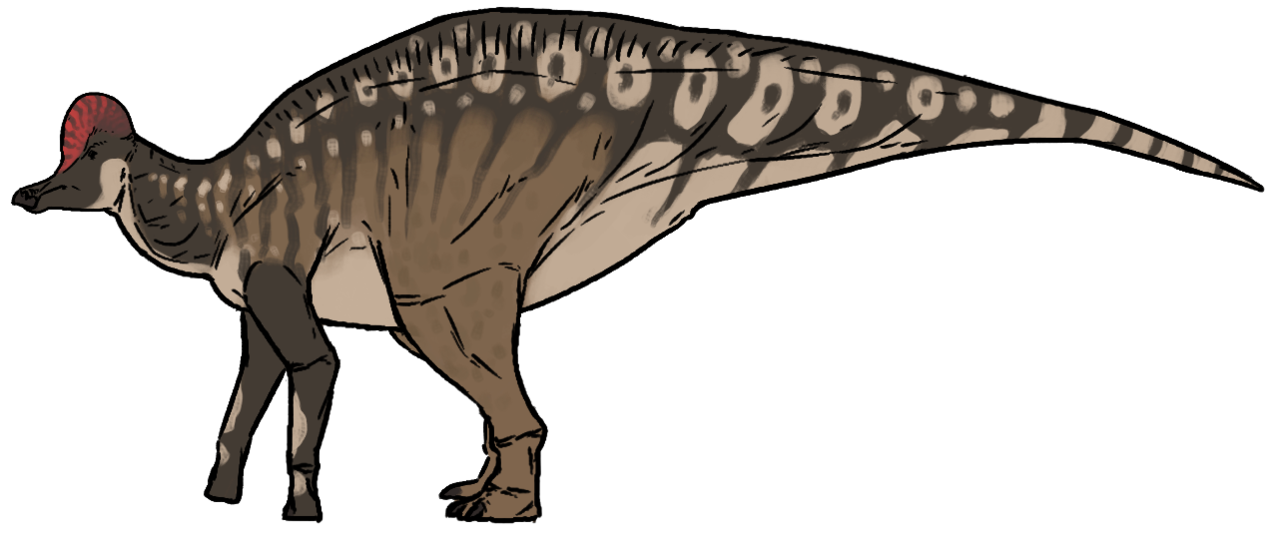
Corythosaurus casuarius is a lambeosaurine hadrosaur from Alberta's Dinosaur Park Formation. Its tall semicircular crest contains paired nasal passages that loop through the crest before entering the airway, making it both a visual structure and a plausible acoustic resonator. Numerous skulls and skeletons reveal how the crest changed as animals grew. The celebrated holotype is an articulated skeleton with skin impressions and calcified tendons, providing unusually direct evidence for body outline as well as bone anatomy.
Its fossils occur between approximately 76.6 and 75.5 million years ago. Values shown here are approximate and reflect the current curated seed dataset.
Form and function
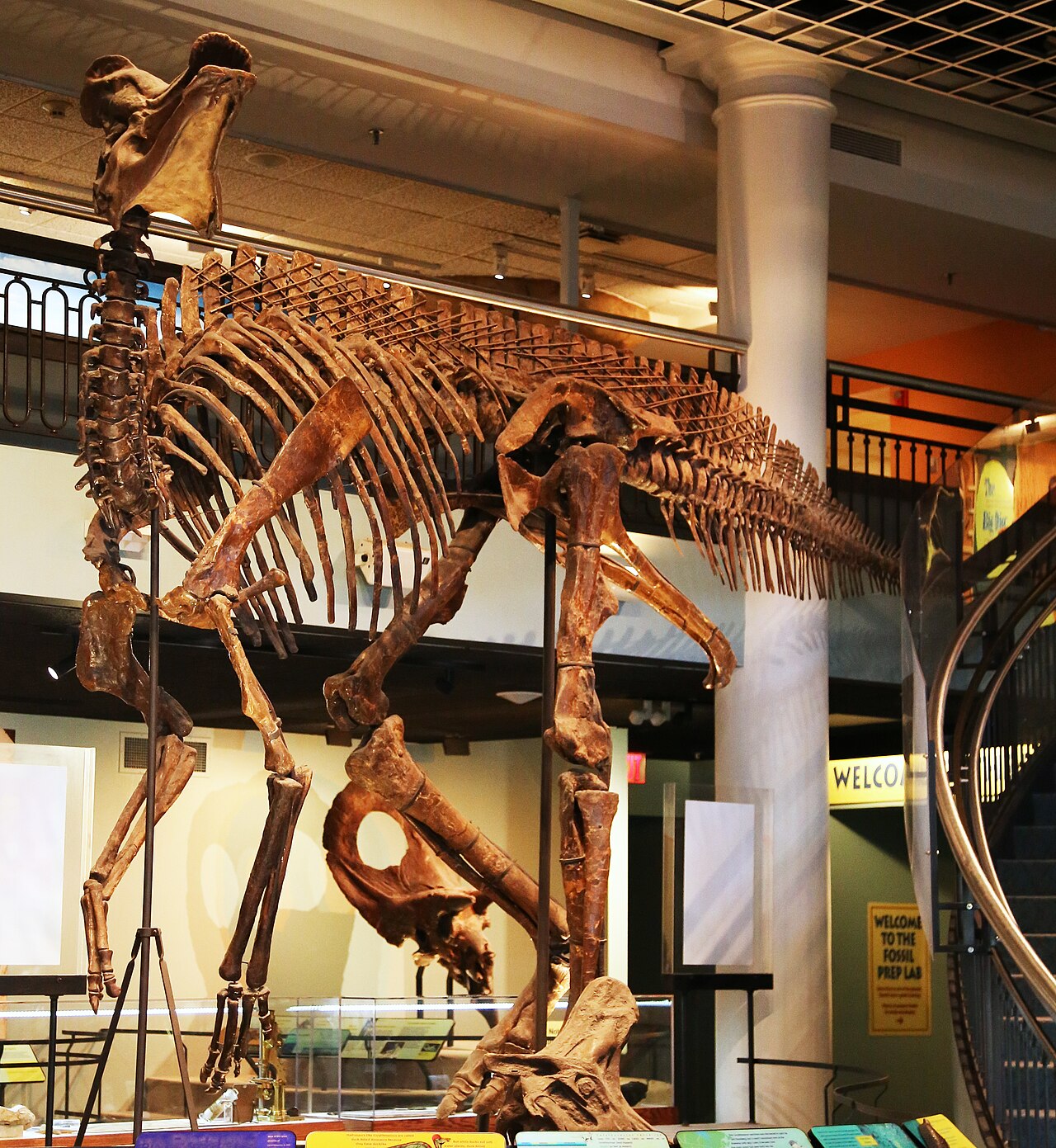
AMNH 5240 preserves an articulated skeleton, skin impressions and a meshwork of calcified tendons that stiffened the back and tail. The hollow crest is formed chiefly by the nasal and premaxillary bones and houses elongated airways. Hundreds of tightly packed teeth formed dental batteries that replaced worn teeth continuously. Robust forelimbs and hoof-like finger bones supported quadrupedal walking, while longer hind limbs also permitted bipedal movement, especially during faster travel.
Evolutionary position
This simplified classification path shows one placement from Dinosauria to this species. Each step is clickable, and other analyses may support alternative relationships.
Open interactive positionScale
Simplified length comparison using preferred dataset estimates; body shape and posture are not represented.
Scientific record
Barnum Brown and his American Museum field team collected the holotype beside Alberta's Red Deer River in 1912. Brown named Corythosaurus casuarius in 1914. Corythosaurus combines Greek korythos, helmet, with sauros, lizard; casuarius compares the crest with that of a cassowary. The original skeleton remains a prominent specimen in the American Museum of Natural History's Hall of Ornithischian Dinosaurs in New York.
Discovery credit: Barnum Brown, American Museum of Natural History field team.
Naming authors: Barnum Brown.
Palaeoenvironment
The Dinosaur Park Formation records river channels, coastal-plain floodplains, ponds and forested lowlands near the western shore of the Western Interior Seaway. Conifers, flowering plants, ferns and horsetails supplied diverse browse. Other hadrosaurs, horned dinosaurs, armoured dinosaurs and tyrannosaurids occur in the formation, but its fossil record spans many habitats and hundreds of thousands of years.
Dental batteries and a broad beak identify Corythosaurus as a plant eater able to crop and grind vegetation. The crest's internal passages could alter vocal resonance, and its conspicuous external shape likely also carried visual information. Models support acoustic potential but do not reveal a specific call. Differences among crest shapes once attributed to sex are now known to be strongly affected by growth and species identity.
Worth knowing
Fossil distribution
Alberta, Canada
Dinosaur Park Formation
regional marker
Markers are deliberately approximate. They identify published fossil areas without exposing sensitive excavation coordinates.
Open interactive mapFossil specimen record
New York, United States
Original articulated skeleton with skin impressions and calcified tendons, on public display in the Hall of Ornithischian Dinosaurs on Floor 4.
A research repository is not necessarily a public exhibit. Loan and display status can change, so check with the institution before visiting.
Media record
Evidence
Barnum Brown · Bulletin of the American Museum of Natural History 33 · 1914
Open sourceAmerican Museum of Natural History
Open source