Mount Kirkpatrick dinosaur site
Queen Alexandra Range, Transantarctic Mountains, Antarctica
Hanson Formation
regional marker
Pronunciation: cry-oh-LOAF-oh-SORE-us ell-ee-OT-eye
A large Early Jurassic Antarctic predator with a spectacular sideways-curving crest and one of the continent's most informative dinosaur skeletons.
Last updated 16 July 2026
Field guide
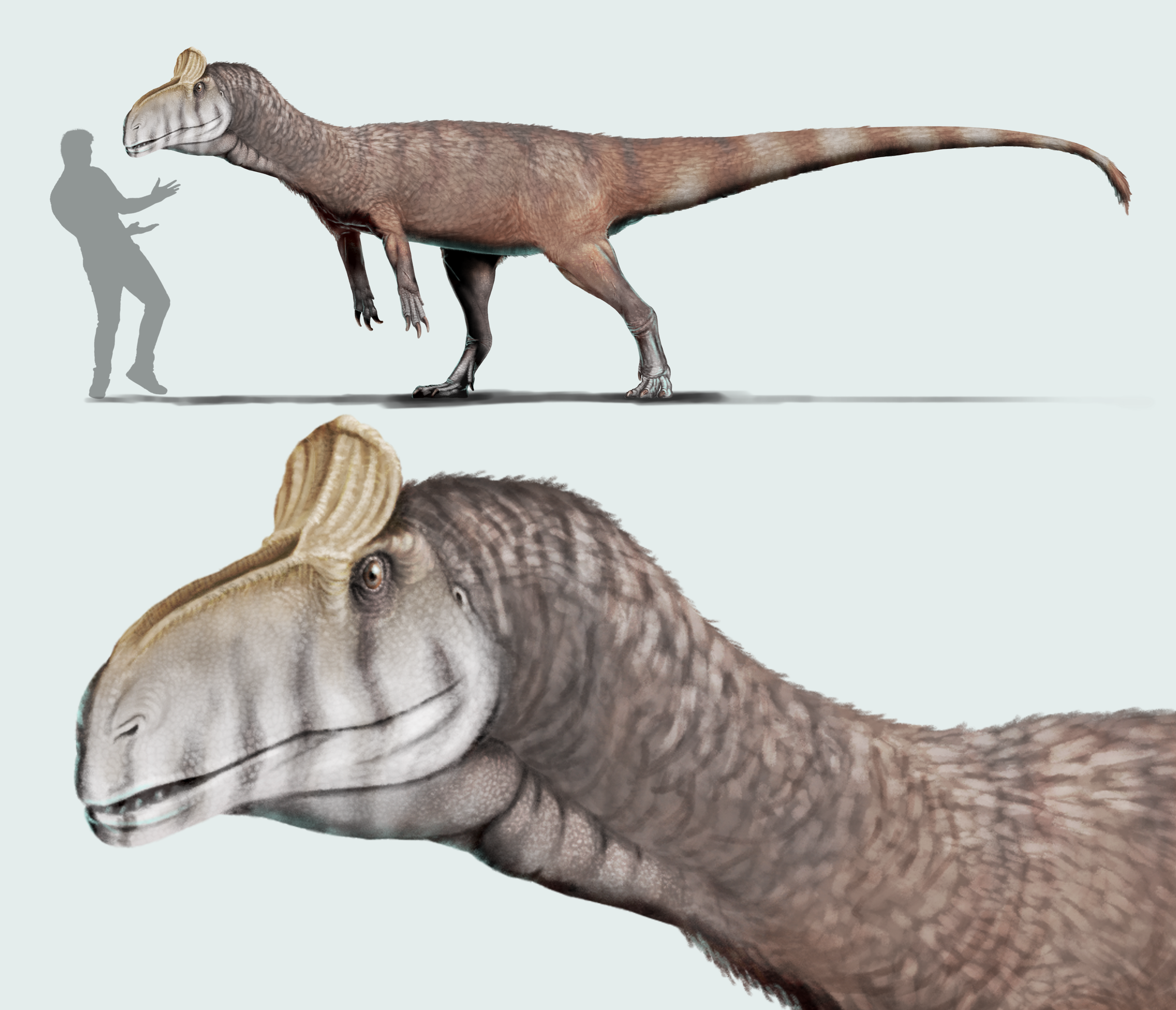
Cryolophosaurus ellioti was a large early theropod from the Hanson Formation of Antarctica. It is instantly recognisable from the thin, fluted crest that crosses the top of its skull instead of running lengthwise along the snout. The partial skeleton was collected only about 640 kilometres from the South Pole at more than 4,000 metres elevation. Antarctica itself was milder and forested in the Early Jurassic because it occupied a different global climate and was joined to the rest of Gondwana. Cryolophosaurus is unquestionably a theropod, but analyses have placed it in several different positions near the early radiation of large-bodied predatory dinosaurs.
Its fossils occur between approximately 194 and 188 million years ago. Values shown here are approximate and reflect the current curated seed dataset.
Form and function
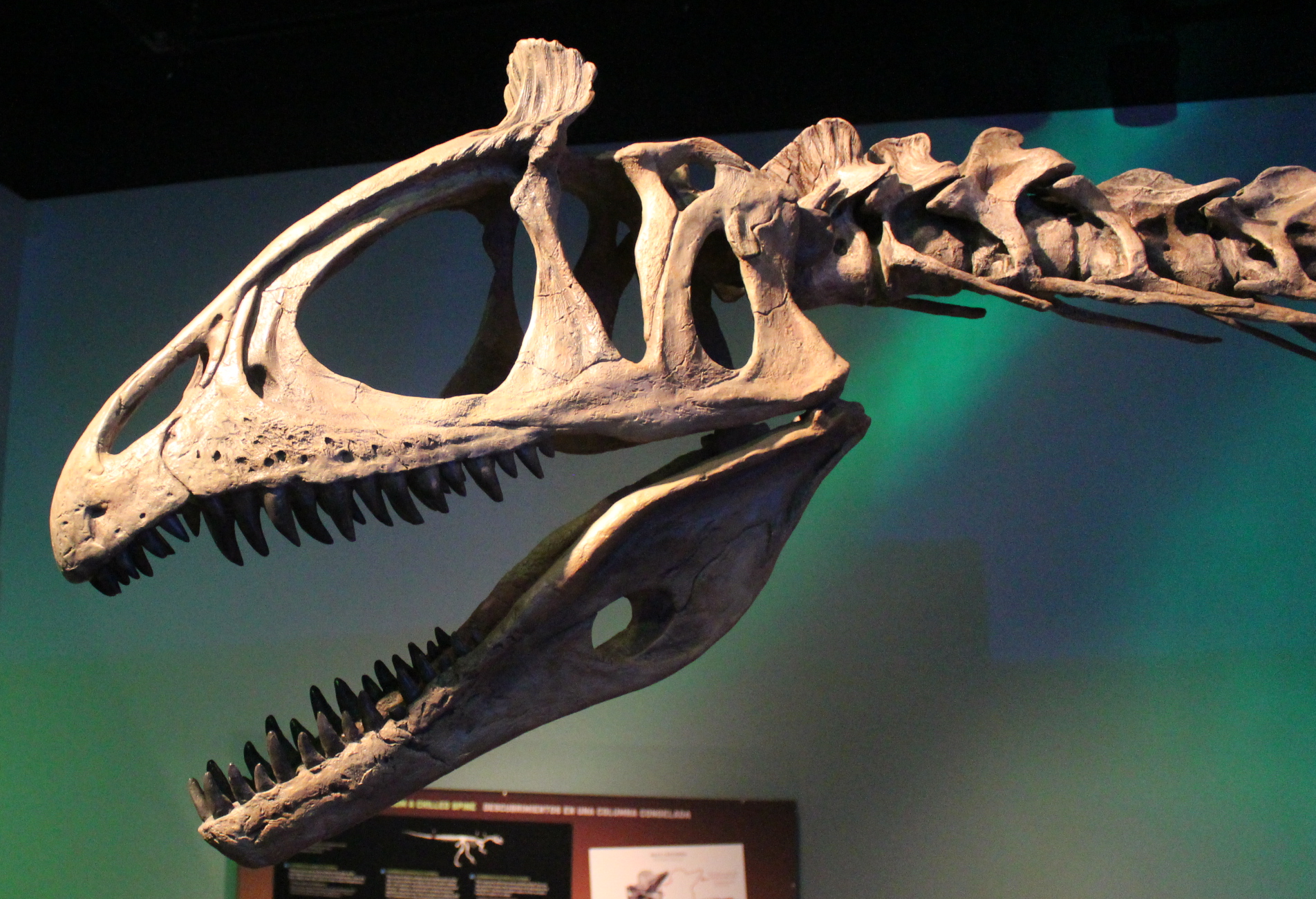
The rear and upper portions of the skull preserve a distinctive transverse crest formed largely by the lacrimal bones, with fluted outer surfaces and swept projections. The front of the mounted skull is reconstructed because erosion removed much of the snout. Known postcranial material includes cervical, dorsal, sacral and caudal vertebrae, ribs, parts of the shoulder and pelvis, and hind-limb bones including a femur. The skeleton combines primitive theropod features with traits compared to later tetanurans. Its three-fingered hands, exact body covering and full tail proportions are reconstructed from close relatives.
Evolutionary position
This simplified classification path shows one placement from Dinosauria to this species. Each step is clickable, and other analyses may support alternative relationships.
Open interactive positionScale
Simplified length comparison using preferred dataset estimates; body shape and posture are not represented.
Scientific record
Geologist David Elliot noticed fossil bone on Mount Kirkpatrick in 1991 while working near William Hammer's palaeontology camp. Excavation from frozen, high-altitude rock recovered the partial skull and skeleton now catalogued as FMNH PR 1821. William Hammer and William Hickerson named Cryolophosaurus ellioti in 1994, honouring Elliot. The crest's resemblance to a stylised pompadour led to the informal nickname Elvisaurus. Additional preparation and fieldwork exposed more of the original specimen, allowing Nathan Smith and colleagues to publish a substantially expanded osteological description in 2007.
Discovery credit: David Elliot, William R. Hammer field team.
Naming authors: William R. Hammer, William J. Hickerson.
Palaeoenvironment
The Hanson Formation records rivers and floodplains within an Early Jurassic high-latitude forest. Fossil wood and associated vertebrates show that the region was not a modern ice desert, although winters still brought long darkness and strong seasonality. Cryolophosaurus lived alongside the sauropodomorph Glacialisaurus and other fragmentary vertebrates. The bones were later uplifted with the Transantarctic Mountains to their present extreme elevation.
Serrated teeth and a large theropod build identify Cryolophosaurus as a predator or scavenger. Its thin crest would have been poorly suited to forceful head-butting and is commonly interpreted as a visual display structure, but sex, colour and signalling behaviour cannot be read from a single skeleton. Bones of a sauropodomorph found close to the mouth were once described as possible gut contents or a choking event; the association is intriguing but does not establish the animal's final meal with certainty.
Worth knowing
Fossil distribution
Queen Alexandra Range, Transantarctic Mountains, Antarctica
Hanson Formation
regional marker
Markers are deliberately approximate. They identify published fossil areas without exposing sensitive excavation coordinates.
Open interactive mapFossil specimen record
Chicago, Illinois, United States
Repository of the original partial skull and skeleton collected on Mount Kirkpatrick. The museum's collection page identifies PR 1821 as type material and provides a digital skull model; this entry does not promise that the original is always on public display.
A research repository is not necessarily a public exhibit. Loan and display status can change, so check with the institution before visiting.
Media record
Evidence
William R. Hammer, William J. Hickerson · Science 264(5160) · 1994
Open sourceNathan D. Smith, Peter J. Makovicky, William R. Hammer, Philip J. Currie · Zoological Journal of the Linnean Society 151(2) · 2007
Open sourceField Museum of Natural History
Open source