Swindon Great Quarry fossil region
Old Swindon Hill, Wiltshire, United Kingdom
Kimmeridge Clay Formation
regional marker
Pronunciation: dah-sen-TROO-rus ar-MAH-tus
A heavily built European stegosaur with a long neck, broad back plates and formidable tail spikes, known from a historic English skeleton and newer Iberian fossils.
Last updated 2 August 2026
Field guide
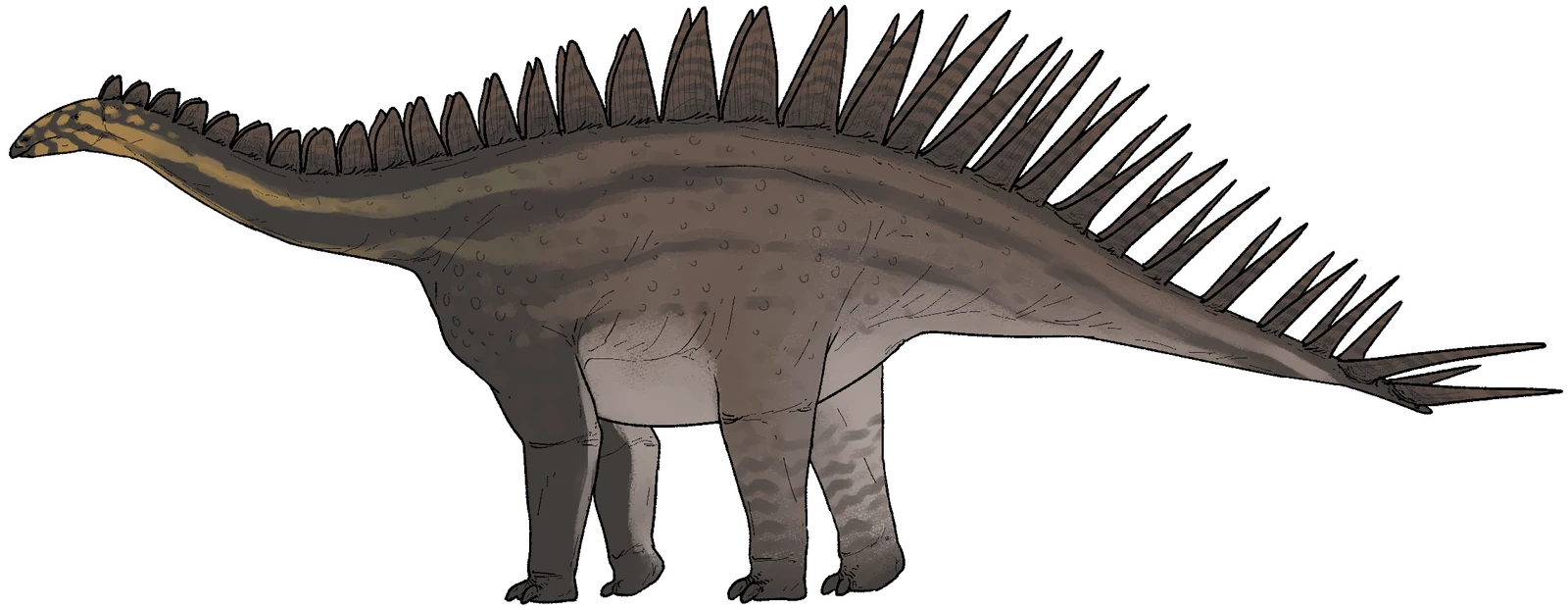
Dacentrurus armatus was a large, robust stegosaur that lived in western Europe during the Late Jurassic. Its skeleton carried paired bony plates along the neck and back and long spikes toward the tail, although the exact arrangement cannot be reconstructed from the incomplete English holotype alone. The pelvis, limbs and vertebrae show a heavy animal with a relatively long neck and broad torso. Material from France, Portugal and Spain has greatly expanded the anatomical picture. A detailed 2024 study of a relatively complete Spanish skeleton argued that the long-necked Portuguese dinosaur Miragaia belongs to D. armatus, but this proposed synonymy remains a taxonomic interpretation rather than universal agreement.
Its fossils occur between approximately 154 and 150 million years ago. Values shown here are approximate and reflect the current curated seed dataset.
Form and function
Dacentrurus had a small head, a comparatively long neck, a deep barrel-shaped trunk and stout columnar limbs. Bony plates protected and displayed along the neck and back, transitioning into elongated spines over the rear body and tail. The muscular tail ended in paired defensive spikes. Its teeth and beak were suited to cropping vegetation, but the skull remains much less completely known than the postcranial skeleton, so head shape and plate arrangement rely partly on referred material and comparison with related stegosaurs.
Evolutionary position
This simplified classification path shows one placement from Dinosauria to this species. Each step is clickable, and other analyses may support alternative relationships.
Open interactive positionScale
Simplified length comparison using preferred dataset estimates; body shape and posture are not represented.
Scientific record
In 1874, James Shopland reported a partial skeleton uncovered in the Swindon Great Quarry in Wiltshire. Richard Owen arranged for William Davies to recover the heavy clay-encased specimen and described it in 1875 as Omosaurus armatus. Because Omosaurus had already been used for another reptile, Frederic A. Lucas supplied the replacement genus name Dacentrurus in 1902. The holotype remains at London's Natural History Museum, with part displayed in the Fossil Marine Reptiles gallery. Later fossils from continental Europe have changed reconstructions of the animal and continue to reshape its species boundaries.
Discovery credit: James Shopland, Swindon Great Quarry workers.
Naming authors: Richard Owen, Frederic A. Lucas.
Palaeoenvironment
The fossils attributed to Dacentrurus come from several Late Jurassic coastal-plain and floodplain environments across western Europe. The English holotype was preserved in the marine-influenced Kimmeridge Clay after the carcass or bones reached a coastal setting, while Iberian specimens come from terrestrial river and floodplain deposits. The map marker shows the historic Swindon discovery region rather than the quarry's exact former face.
Dacentrurus was a four-legged herbivore that browsed low-to-middle vegetation with a small beak and simple teeth. Its tail spikes offered a plausible active defence against large theropods, but no healed combat injury or trackway demonstrates a specific fighting technique. Plates may also have served in display or species recognition. Direct evidence for herd structure, nesting or parental care is absent.
Worth knowing
Fossil distribution
Old Swindon Hill, Wiltshire, United Kingdom
Kimmeridge Clay Formation
regional marker
Markers are deliberately approximate. They identify published fossil areas without exposing sensitive excavation coordinates.
Open interactive mapFossil specimen record
London, United Kingdom
The museum holds the original partial skeleton found at Swindon in 1874. Part of this historically important holotype is displayed in the Fossil Marine Reptiles gallery and the remainder is cared for in the research collection.
A research repository is not necessarily a public exhibit. Loan and display status can change, so check with the institution before visiting.
Media record
Evidence
Natural History Museum, London
Open sourceNatural History Museum, London
Open sourceSergio Sanchez-Fenollosa, Fernando Escaso, Alberto Cobos · Zoological Journal of the Linnean Society · 2024
Open source