Dinosaur Provincial Park fossil region
Alberta, Canada
Oldman Formation
regional marker
Pronunciation: das-PLEE-toh-SORE-us toh-ROH-sus
A robust tyrannosaurid from Late Cretaceous Alberta, known from an unusually complete skull and skeleton collected by Charles M. Sternberg.
Last updated 26 July 2026
Field guide
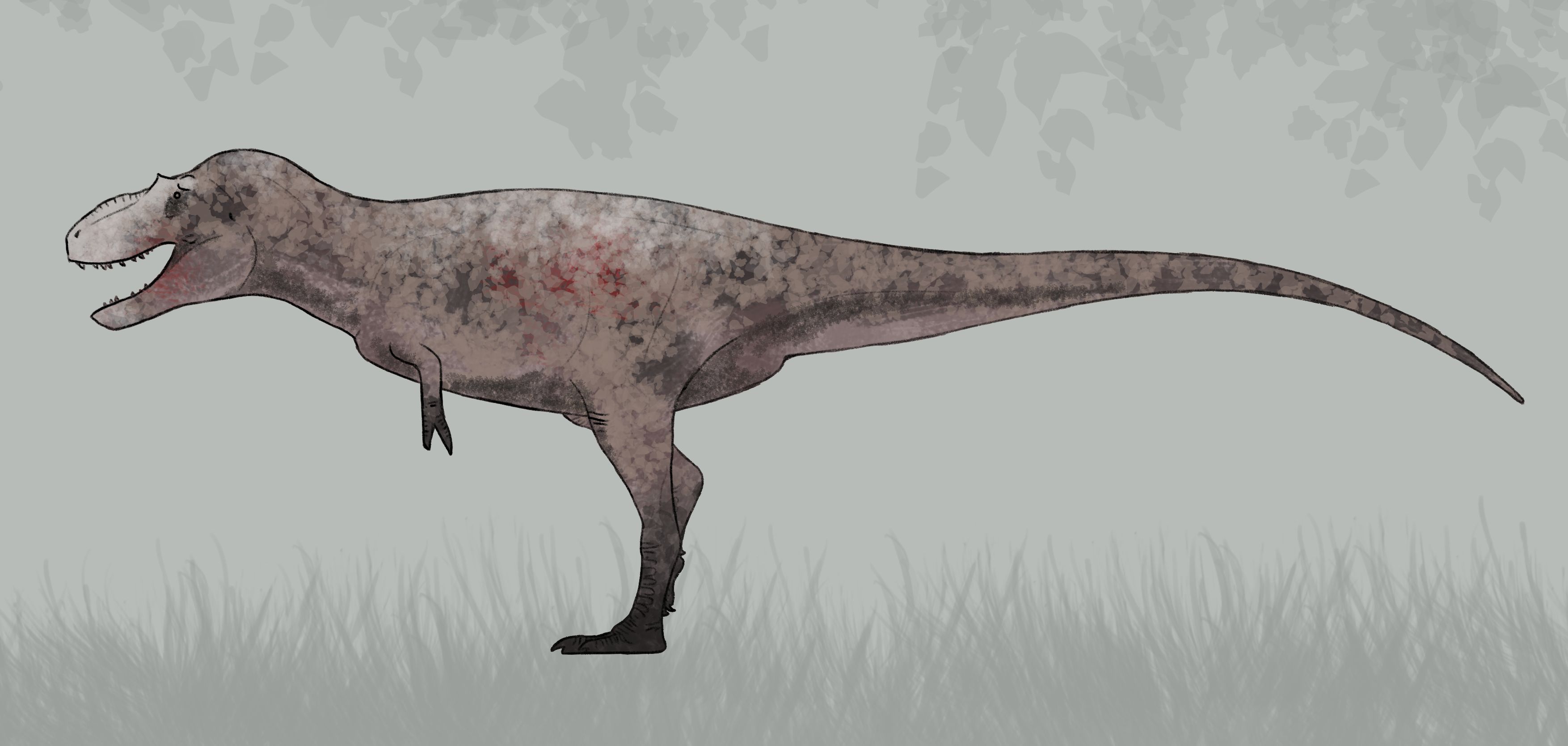
Daspletosaurus torosus was a large tyrannosaurid predator from the Oldman Formation of Alberta. Its deep skull, thick teeth, powerful hind limbs and exceptionally small two-fingered arms show the characteristic body plan that later reached its greatest size in Tyrannosaurus. The type skeleton preserves much of the skull and body, making D. torosus an important reference for the anatomy and evolution of Campanian tyrannosaurines.
Its fossils occur between approximately 77 and 75.6 million years ago. Values shown here are approximate and reflect the current curated seed dataset.
Form and function
The large, deep skull carried robust, serrated teeth and heavy bony ornament around the eyes and snout. Fused nasal bones strengthened the top of the muzzle. The neck and hind limbs were strongly built, while the forelimbs were extremely reduced but retained two clawed fingers. A long muscular tail balanced the head and torso over the hips.
Evolutionary position
This simplified classification path shows one placement from Dinosauria to this species. Each step is clickable, and other analyses may support alternative relationships.
Open interactive positionScale
Simplified length comparison using preferred dataset estimates; body shape and posture are not represented.
Scientific record
Charles M. Sternberg collected the type specimen, CMN 8506, near Steveville in Alberta in 1921. It was initially referred to Gorgosaurus. Dale Russell recognized its distinctive, more robust anatomy and named Daspletosaurus torosus in his 1970 review of western Canadian tyrannosaurs. The genus name means frightful lizard, while torosus refers to its muscular build.
Discovery credit: Charles M. Sternberg.
Naming authors: Dale A. Russell.
Palaeoenvironment
The Oldman Formation records river channels, floodplains and seasonally dry coastal lowlands on western Laramidia. Daspletosaurus shared these environments with horned dinosaurs, hadrosaurs, ankylosaurs and the more lightly built tyrannosaurid Gorgosaurus.
Daspletosaurus was an apex predator equipped to bite and dismember large prey. Tooth marks and healed injuries document feeding and violent encounters, but they do not establish routine pack hunting. Differences between the robust Daspletosaurus and slender Gorgosaurus have inspired niche-partitioning hypotheses that remain difficult to test directly.
Worth knowing
Fossil distribution
Alberta, Canada
Oldman Formation
regional marker
Markers are deliberately approximate. They identify published fossil areas without exposing sensitive excavation coordinates.
Open interactive mapFossil specimen record
Ottawa, Canada
The museum houses holotype CMN 8506 and displays a largely real mounted skeleton of Daspletosaurus torosus.
A research repository is not necessarily a public exhibit. Loan and display status can change, so check with the institution before visiting.
Media record
Evidence
Dale A. Russell · National Museum of Natural Sciences Publications in Palaeontology 1, 1–34 · 1970
Open sourceCanadian Museum of Nature
Open source