Cloverly fossil region
Southern Montana, United States
Cloverly Formation
regional marker
Pronunciation: dye-NON-ih-kus an-TIR-oh-pus
A feathered Early Cretaceous dromaeosaurid with a raised second-toe claw, grasping hands and a reinforced tail. John Ostrom's study of it helped transform the modern view of dinosaurs as active, bird-like animals.
Last updated 13 July 2026
Field guide
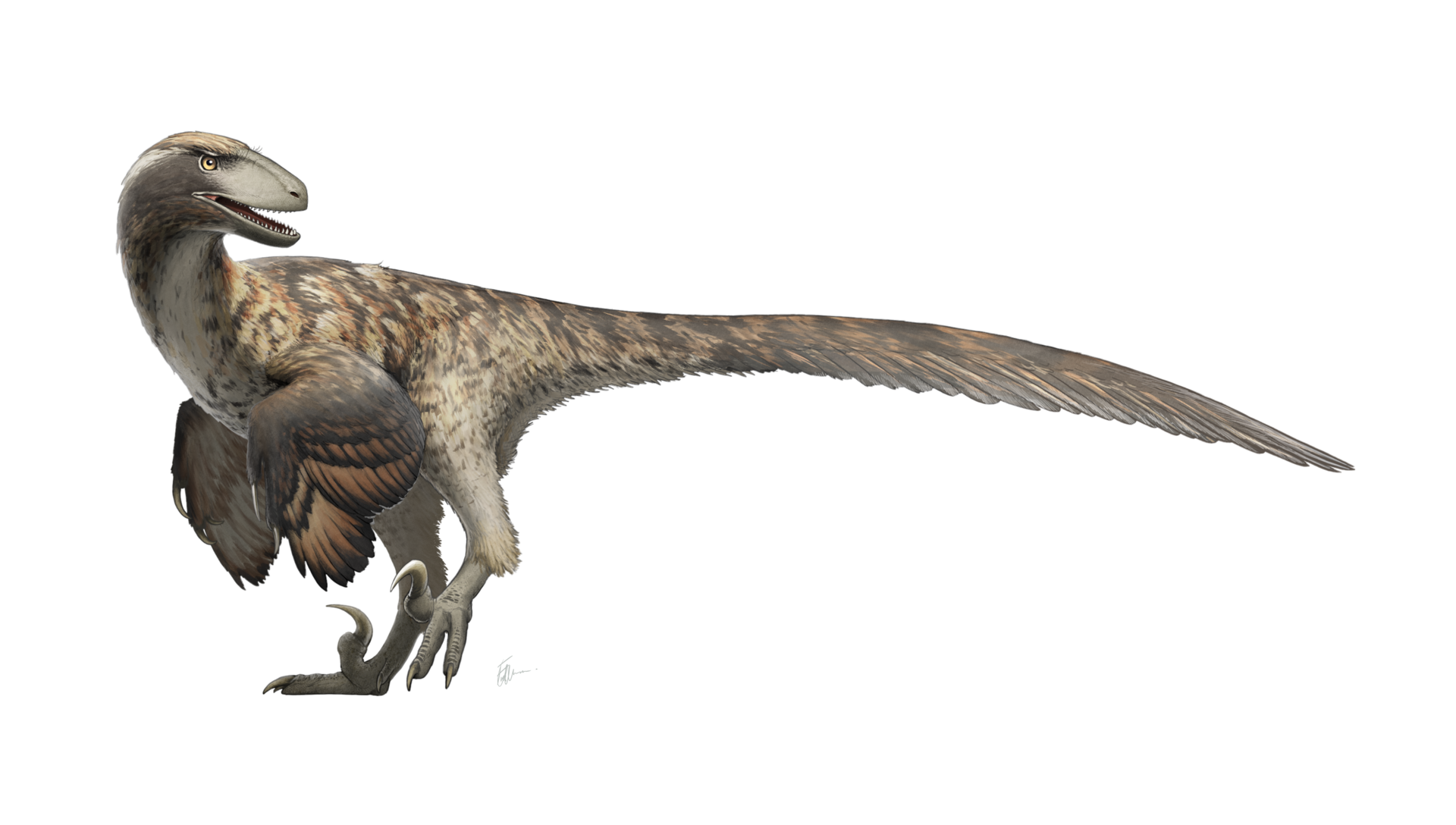
Deinonychus antirrhopus was a medium-sized predatory dinosaur from Early Cretaceous North America. Its enlarged second-toe claw, long grasping hands, lightly built skeleton and tail stiffened by elongated bony processes formed a highly specialised predatory body plan. Although no feather impressions are known from Deinonychus itself, feathers are strongly supported by its position among feathered dromaeosaurids and close bird relatives. John Ostrom's 1969 descriptions challenged the then-common image of dinosaurs as uniformly slow reptiles and became central to the dinosaur renaissance and renewed study of the dinosaur–bird relationship.
Its fossils occur between approximately 115 and 108 million years ago. Values shown here are approximate and reflect the current curated seed dataset.
Form and function
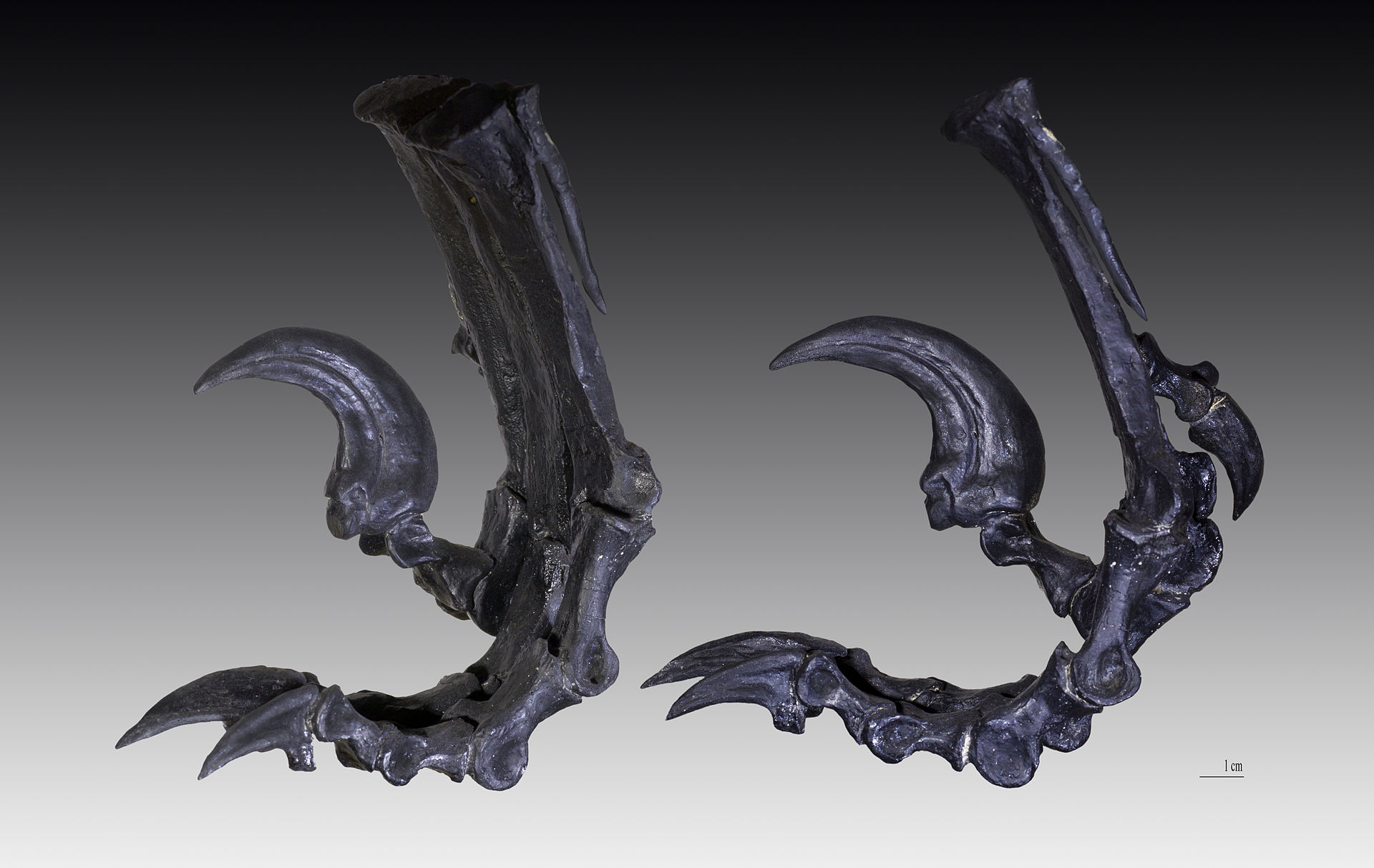
The holotype, YPM 5205, is limited to a complete left foot and part of the right foot. Much of the broader reconstruction comes from numerous referred bones recovered from the same quarry, so the familiar skeleton represents a species-level composite rather than one articulated individual. The enlarged claw on pedal digit II was held clear of the ground. Its shape and foot mechanics are consistent with gripping and pinning prey, while the reinforced tail provided balance without being completely rigid.
Evolutionary position
This simplified classification path shows one placement from Dinosauria to this species. Each step is clickable, and other analyses may support alternative relationships.
Open interactive positionScale
Simplified length comparison using preferred dataset estimates; body shape and posture are not represented.
Scientific record
Barnum Brown collected the first recognised Deinonychus material in Montana in 1931, but his proposed name 'Daptosaurus' was never formally published. In 1964 John H. Ostrom led a Yale Peabody Museum expedition to the Cloverly Formation near Bridger, Montana, where the team recovered abundant remains from several individuals. Ostrom named Deinonychus antirrhopus in February 1969 and followed it with a detailed osteological monograph later that year. Deinonychus means 'terrible claw'; antirrhopus refers to the tail's counterbalancing role.
Discovery credit: John H. Ostrom, Yale Peabody Museum field team.
Naming authors: John H. Ostrom.
Palaeoenvironment
Deinonychus inhabited river floodplains and seasonally variable lowlands represented by the Cloverly and Antlers formations. The landscape supported conifers, ferns and other low vegetation around channels and wetter areas. Tenontosaurus, the armoured Sauropelta, small ornithopods, crocodilians, turtles, mammals and several other theropods shared parts of this ecosystem.
Bite marks and shed teeth associated with Tenontosaurus provide direct evidence that Deinonychus fed on this much larger herbivore, although a particular association cannot always distinguish hunting from scavenging. Foot mechanics support using the enlarged toe claw to grip and restrain prey rather than slicing it open. Stable-isotope differences between smaller and larger teeth suggest diet changed during growth and do not support a modern wolf-like pack structure. Individuals may still have gathered at carcasses or interacted socially; the fossils do not reveal one fixed social system.
Worth knowing
Fossil distribution
Southern Montana, United States
Cloverly Formation
regional marker
Markers are deliberately approximate. They identify published fossil areas without exposing sensitive excavation coordinates.
Open interactive mapFossil specimen record
New Haven, United States
Research repository for holotype YPM 5205—the complete left foot and part of the right—and numerous referred Cloverly Formation bones used by John Ostrom. The museum has historically displayed a reconstructed skeletal mount, but public display of the original type bones is not guaranteed.
A research repository is not necessarily a public exhibit. Loan and display status can change, so check with the institution before visiting.
Media record
Evidence
John H. Ostrom · Postilla · 1969
Open sourceJohn H. Ostrom · Bulletin of the Peabody Museum of Natural History · 1969
Open sourcePaul M. Gignac, Peter J. Makovicky, Gregory M. Erickson, Robert P. Walsh · Journal of Vertebrate Paleontology · 2010
Open sourceDenver W. Fowler, Elizabeth A. Freedman, John B. Scannella, Robert E. Kambic · PLOS ONE · 2011
Open sourceJoseph A. Frederickson, Michael H. Engel, Richard L. Cifelli · Palaeogeography, Palaeoclimatology, Palaeoecology · 2020
Open sourceYale Peabody Museum
Open source