Kayenta fossil region
Northern Arizona, United States
Kayenta Formation
regional marker
Pronunciation: dye-LOF-oh-SORE-us weth-er-ILL-eye
A large Early Jurassic predator from Navajo Nation lands in Arizona, distinguished by two thin crests built from several skull bones. It was far larger and more powerfully constructed than its small, venom-spitting film counterpart—and no fossil supports either venom or a neck frill.
Last updated 13 July 2026
Field guide
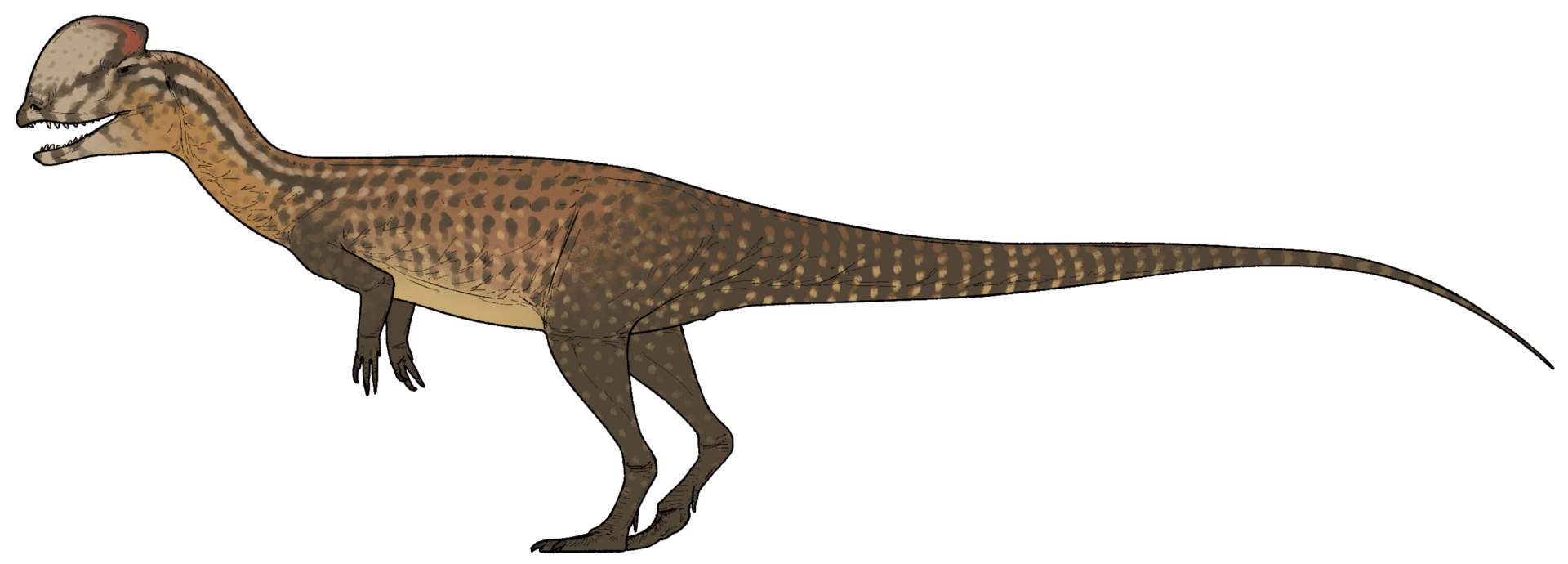
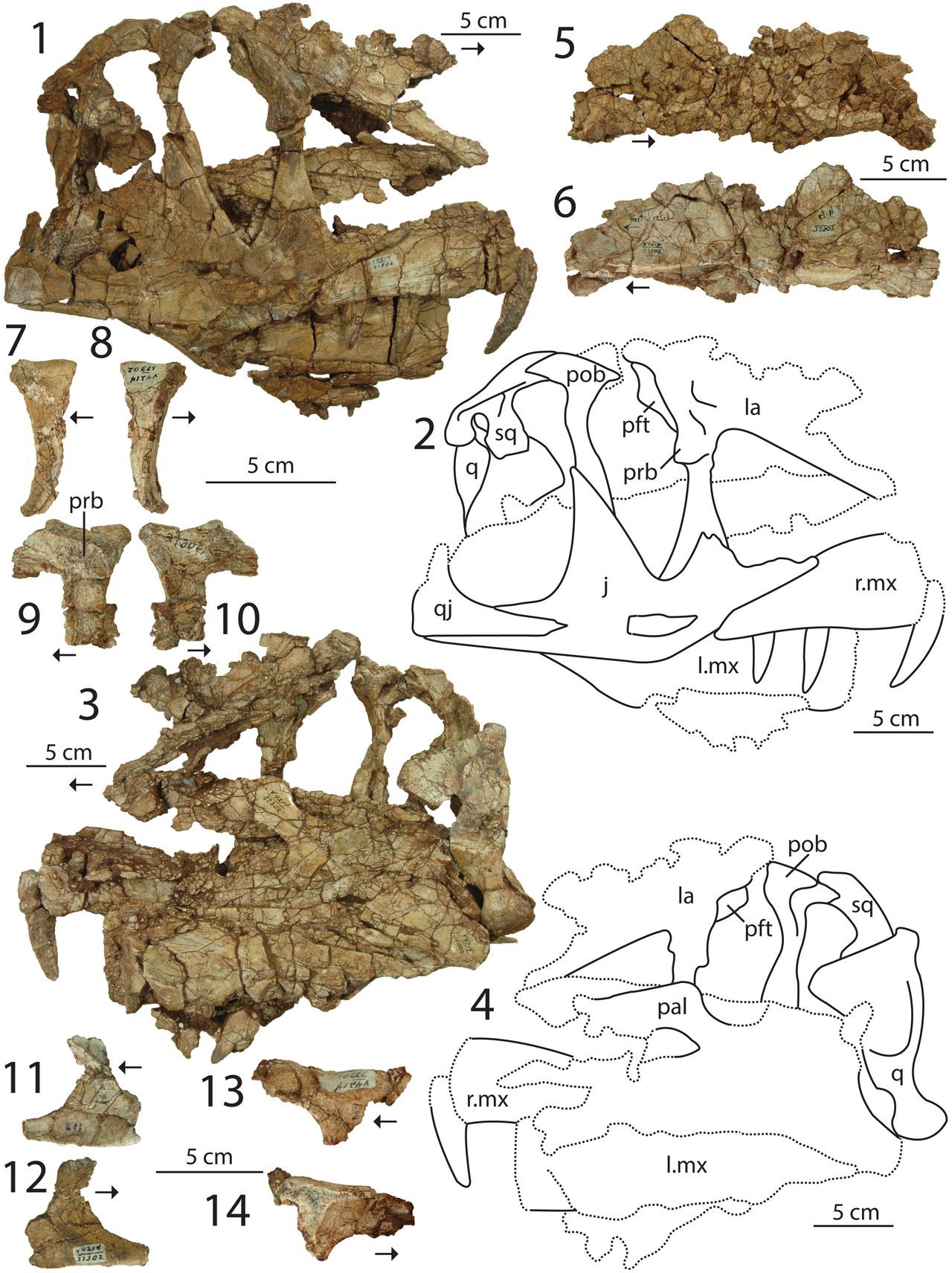
Dilophosaurus wetherilli was an early large-bodied theropod from the Kayenta Formation of northern Arizona. At roughly seven metres long, it was among the largest North American land animals of its time. Two tall, parallel nasolacrimal crests rose above its skull, while a deep snout, recurved serrated teeth, strong neck, grasping hands and powerful hind limbs equipped it as an active macropredator. A comprehensive 2020 redescription united five skeletons as one species and placed it outside both Coelophysoidea and Ceratosauria, near the stem leading toward later averostran theropods.
Its fossils occur between approximately 193 and 183 million years ago. Values shown here are approximate and reflect the current curated seed dataset.
Form and function
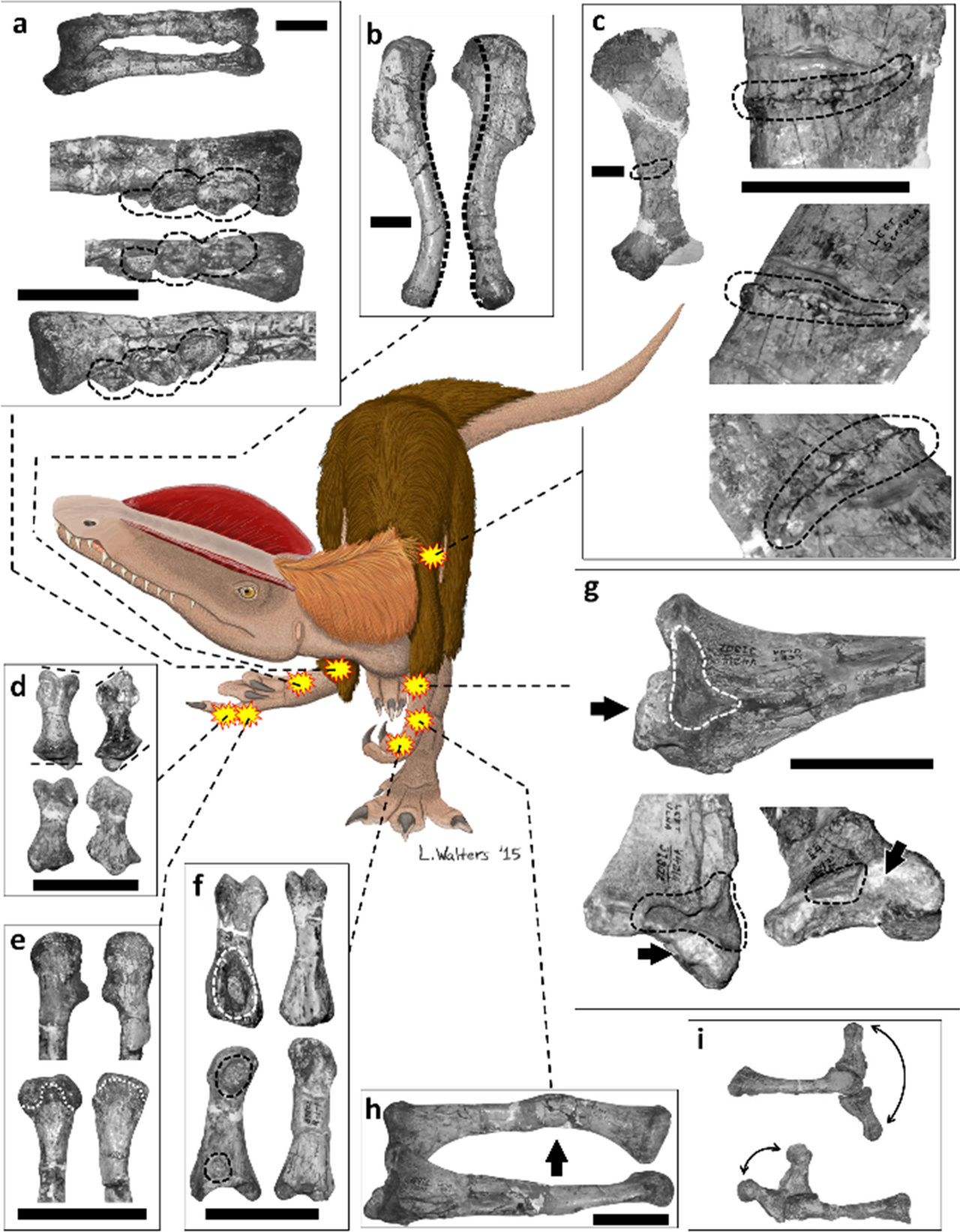
Each head crest was a compound structure involving the premaxilla, nasal and lacrimal bones and connecting with air spaces in the snout. The crests were too thin for forceful combat and probably contributed to visual display or species recognition, although colour and exact function are unknown. The neck and trunk vertebrae contain hollows and bony partitions associated with an air-sac respiratory system. The arms were not useless: the shoulder and forelimb were robust, the first three fingers were well developed and clawed, and a fourth digit was reduced. The skull's joints were more firmly connected than older weak-jawed reconstructions suggested.
Evolutionary position
This simplified classification path shows one placement from Dinosauria to this species. Each step is clickable, and other analyses may support alternative relationships.
Open interactive positionScale
Simplified length comparison using preferred dataset estimates; body shape and posture are not represented.
Scientific record
Jesse Williams, a Navajo man, discovered the first two skeletons near Tuba City in 1940 and brought the site to the attention of Samuel P. Welles and the University of California Museum of Paleontology. Welles's team excavated them in 1942. He named the species Megalosaurus wetherilli in 1954, honouring local explorer John Wetherill. A third skeleton found in 1964 preserved enough of the skull to reveal the paired crests, leading Welles to establish the genus Dilophosaurus in 1970. Later fieldwork by Timothy Rowe's teams recovered two more individuals, including a juvenile. All known specimens held in Berkeley and Austin remain the property of the Navajo Nation.
Discovery credit: Jesse Williams, Samuel P. Welles.
Naming authors: Samuel P. Welles.
Palaeoenvironment
Dilophosaurus lived on the broad river plains and sandy channels recorded by the silty facies of the Kayenta Formation. The Early Jurassic landscape of what is now northern Arizona included seasonal waterways, dunes and patches of vegetation. It shared the region with the sauropodomorph Sarahsaurus, armoured Scelidosaurus-like herbivores, smaller theropods, crocodylomorphs, turtles and early mammals. The fossil region lies within the Navajo Nation, and the marker on the map is deliberately regional rather than an excavation coordinate.
Its size, teeth, reinforced snout, strong neck and grasping forelimbs identify Dilophosaurus as an active predator capable of handling substantial prey. Bite marks and shed theropod teeth occur with herbivore remains in the Kayenta Formation, but they do not preserve a complete hunting event or identify every feeder with certainty. The twin crests were probably visual signals rather than weapons. There is no fossil evidence for venom glands, projectile venom or an expandable neck frill, and no evidence that the animal regularly hunted in coordinated packs.
Worth knowing
Fossil distribution
Northern Arizona, United States
Kayenta Formation
regional marker
Markers are deliberately approximate. They identify published fossil areas without exposing sensitive excavation coordinates.
Open interactive mapFossil specimen record
Berkeley, United States
Research repository for original holotype UCMP 37302, paratype UCMP 37303 and another referred individual. These fossils remain the property of the Navajo Nation; repository custody must not be confused with ownership. Current public display of the type material is not confirmed.
Austin, United States
Research repository for two later original specimens recovered by University of Texas teams, including a juvenile. The material remains the property of the Navajo Nation, and current public display is not confirmed.
A research repository is not necessarily a public exhibit. Loan and display status can change, so check with the institution before visiting.
Media record
Evidence
Adam D. Marsh, Timothy B. Rowe · Journal of Paleontology 94, Memoir 78 · 2020
Open sourceAdam D. Marsh · Cambridge Core Blog · 2020
Open sourcePhil Senter, Sara L. Juengst · PLOS ONE · 2016
Open source