Aphae Island fossil area
Shinan County, South Jeolla Province, South Korea
Ilseongsan Formation
regional marker
Pronunciation: DOO-lee-SORE-us HOOM-in-eye
A juvenile, small-bodied thescelosaurid from South Korea whose partly hidden skull and skeleton were revealed in three dimensions by computed-tomography scans.
Last updated 16 July 2026
Field guide
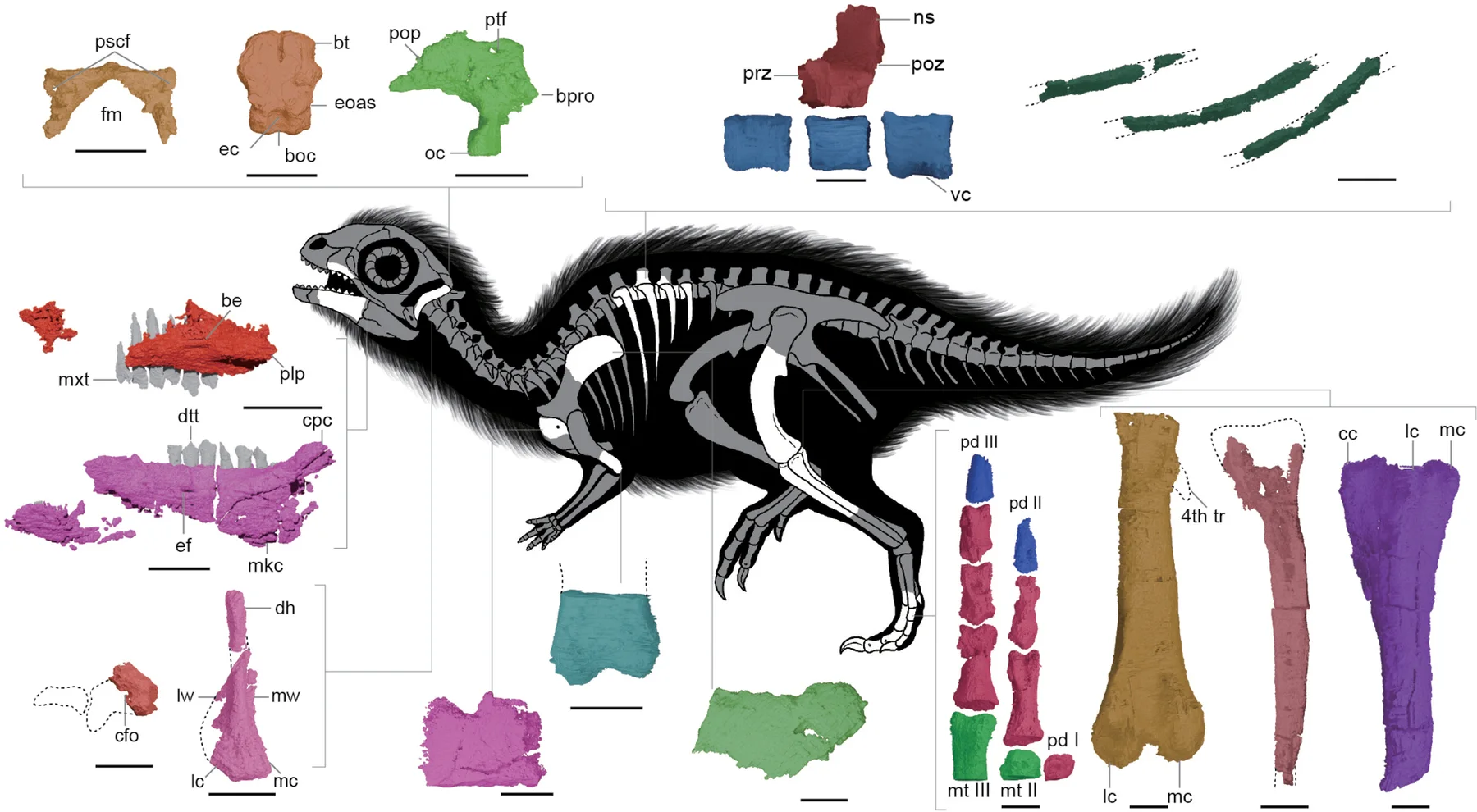
Doolysaurus huhmini is a small early-diverging ornithischian from the mid-Cretaceous Ilseongsan Formation of Aphae Island. Its associated skeleton includes diagnostic cranial material, making it the first Korean dinosaur named from a skull that can be distinguished anatomically rather than from footprints, eggs or isolated bones. Much of the animal remains embedded in two adjoining blocks, so CT imaging was central to identifying the jaws, braincase, vertebrae and limbs. Bone histology indicates that the individual was only zero to two years old and still growing; its adult proportions and size are unknown.
Its fossils occur between approximately 113 and 97 million years ago. Values shown here are approximate and reflect the current curated seed dataset.
Form and function
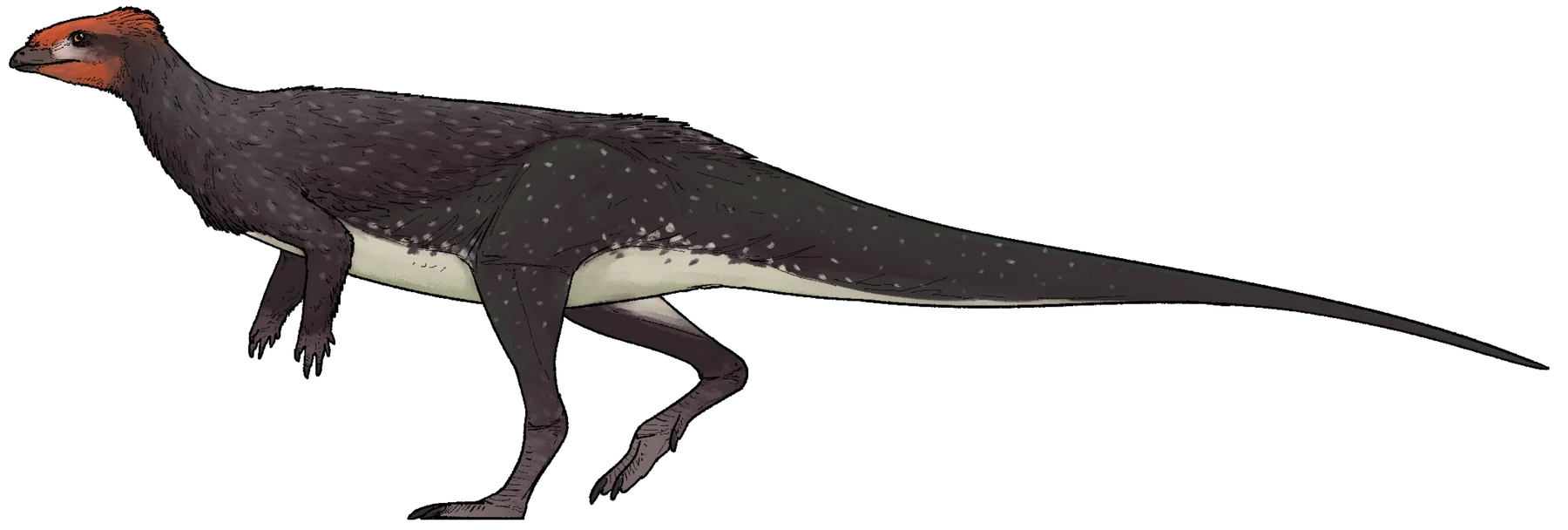
The specimen preserves parts of the dentary and maxilla with small leaf-shaped cheek teeth, a quadrate and braincase elements, as well as dorsal vertebrae, ribs, a femur, tibia, fibula, metatarsals and toe bones. The reconstructed femur was about 12 to 13 centimetres long. A cluster of polished stones interpreted as gastroliths weighed 30.7 grams. Diagnostic details occur mainly in the jaw, quadrate and braincase. No skin or feathers are preserved.
Evolutionary position
This simplified classification path shows one placement from Dinosauria to this species. Each step is clickable, and other analyses may support alternative relationships.
Open interactive positionScale
Simplified length comparison using preferred dataset estimates; body shape and posture are not represented.
Scientific record
KDRC-SA-V001 was excavated from reddish sandy mudstone of the Ilseongsan Formation on Aphae Island in Shinan County, southwestern South Korea. The associated bones occur in two contiguous blocks and are curated at the Korea Dinosaur Research Center of Chonnam National University in Gwangju. Jongyun Jung, Minguk Kim, Hyemin Jo and Julia A. Clarke named the species in March 2026. The genus honours Dooly the Little Dinosaur, a famous Korean cartoon character, and the species honours Korean palaeontologist Min Huh.
Naming authors: Jongyun Jung, Minguk Kim, Hyemin Jo, Julia A. Clarke.
Palaeoenvironment
Sedimentology places the animal on a warm mid-Cretaceous floodplain. Reddish sandy mudstone, palaeosols and crevasse-splay deposits record rivers periodically spilling across the landscape. The preserved carcass was buried in this low-energy continental setting.
The hind-limb proportions support primarily bipedal movement. Teeth and gastroliths are compatible with processing plant matter, while the describers note that the skull may fit a generalized or omnivorous feeding strategy. Because the only individual is a juvenile and gut contents are absent, diet, speed, sociality and parental behaviour remain uncertain.
Worth knowing
Fossil distribution
Shinan County, South Jeolla Province, South Korea
Ilseongsan Formation
regional marker
Markers are deliberately approximate. They identify published fossil areas without exposing sensitive excavation coordinates.
Open interactive mapFossil specimen record
Gwangju, South Korea
Permanent research repository of the original two-block partial skeleton. Its public exhibition status is not confirmed.
A research repository is not necessarily a public exhibit. Loan and display status can change, so check with the institution before visiting.
Media record
Evidence
Jongyun Jung, Minguk Kim, Hyemin Jo, Julia A. Clarke · Fossil Record 29(1) · 2026
Open sourceNatural History Museum, London · 2026
Open sourceChonnam National University
Open source