Reed's Quarry 5 fossil region
Como Bluff, Albany County, Wyoming, United States
Morrison Formation, upper Brushy Basin Member
regional marker
Pronunciation: DRY-oh-SORE-us AL-tus
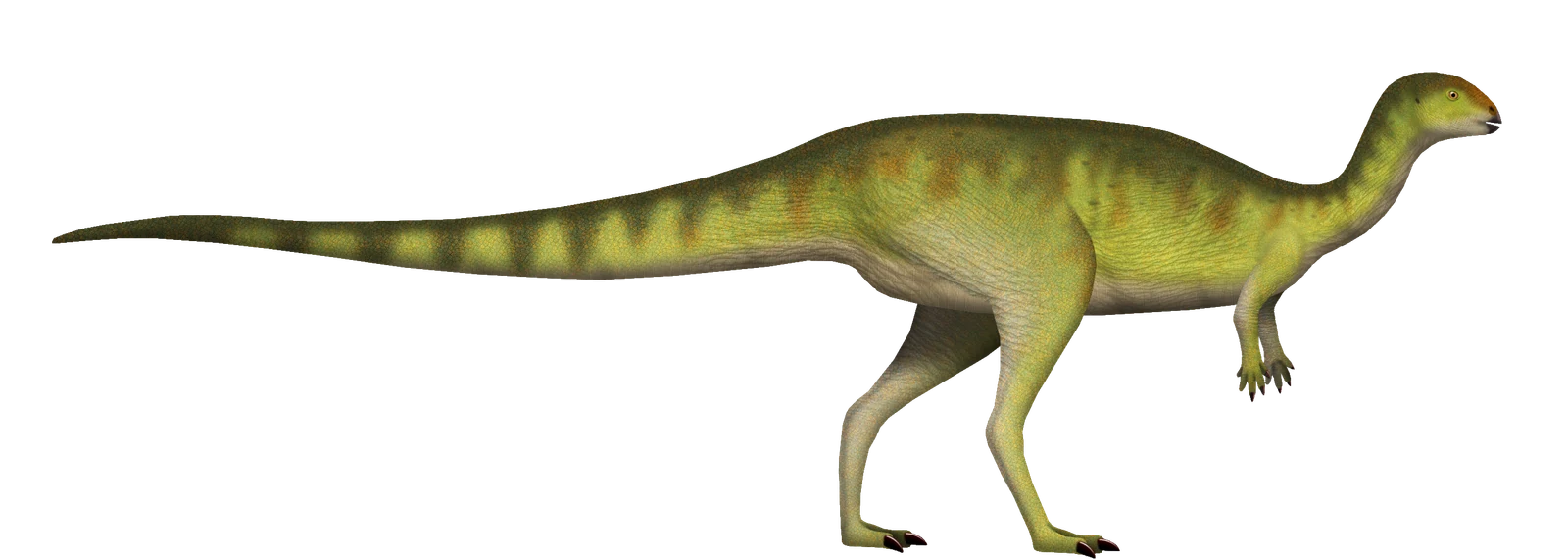
A lightly built Late Jurassic herbivore from the Morrison Formation, with long hind limbs, a balancing tail and a small beaked head.
Last updated 2 August 2026
Field guide
Dryosaurus altus was a small-bodied dryosaurid ornithopod from the Late Jurassic Morrison Formation of western North America. Its long lower legs and compact torso produced a much lighter build than the contemporary Camptosaurus, while a deep tail helped balance the body during bipedal movement. The front of the mouth formed a toothless beak and the cheek teeth processed vegetation. The holotype includes a partial skeleton and important cranial material, and later discoveries have expanded knowledge of the genus. Some of the most famous skeletons historically displayed as D. altus, however, were separated as Dryosaurus elderae in 2018, so older books and museum labels can combine material that is no longer assigned to the same species.
Its fossils occur between approximately 155 and 145 million years ago. Values shown here are approximate and reflect the current curated seed dataset.
Form and function
The head was small with a beak at the front, leaf-shaped cheek teeth and large eye openings. Short forelimbs ended in five-fingered hands, while the much longer hind limbs had powerful upper segments and elongated feet. Ossified tendons stiffened parts of the back and tail, helping the tail act as a dynamic counterbalance. Unlike hadrosaurs, Dryosaurus lacked a deep dental battery and did not have forelimbs specialized into weight-bearing columns.
Evolutionary position
This simplified classification path shows one placement from Dinosauria to this species. Each step is clickable, and other analyses may support alternative relationships.
Open interactive positionScale
Simplified length comparison using preferred dataset estimates; body shape and posture are not represented.
Scientific record
Samuel Wendell Williston found the holotype at Reed's Quarry 5 near Como Bluff, Wyoming, in 1876 during the early years of the Bone Wars. Othniel Charles Marsh described it in 1878 as Laosaurus altus and created the separate genus Dryosaurus in 1894. The holotype, YPM VP 001876, remains in the Yale Peabody Museum. Carnegie Museum expeditions later collected excellent dryosaur material at Dinosaur National Monument, but a 2018 revision distinguished those Utah skeletons as D. elderae rather than D. altus.
Discovery credit: Samuel Wendell Williston.
Naming authors: Othniel Charles Marsh.
Palaeoenvironment
Dryosaurus inhabited the river channels, floodplains and seasonally dry woodland mosaics of the Morrison Formation. It lived among much larger herbivores including sauropods, stegosaurs and Camptosaurus, as well as predators such as Allosaurus and Ceratosaurus. Its small body likely gave it access to low vegetation and ecological space different from the giant browsers. The map point represents the broad Como Bluff quarry region, not a publicly released excavation coordinate.
Dryosaurus cropped low vegetation with its beak and sliced it with cheek teeth. Long hind limbs and a counterbalancing tail support agile bipedal locomotion, but fossils cannot provide a reliable maximum running speed. Speed was probably useful when avoiding predators, although direct chase evidence is absent. No nest, trackway or mass accumulation securely demonstrates its group size, parental care or migratory behaviour.
Worth knowing
Fossil distribution
Como Bluff, Albany County, Wyoming, United States
Morrison Formation, upper Brushy Basin Member
regional marker
Markers are deliberately approximate. They identify published fossil areas without exposing sensitive excavation coordinates.
Open interactive mapFossil specimen record
New Haven, Connecticut, United States
Repository of the Dryosaurus altus holotype from Reed's Quarry 5 at Como Bluff. The catalogued partial skeleton is the name-bearing reference for the species and is available through the museum's vertebrate palaeontology collection.
A research repository is not necessarily a public exhibit. Loan and display status can change, so check with the institution before visiting.
Media record
Evidence
Kenneth Carpenter, Peter M. Galton · Geology of the Intermountain West 5, 167-207 · 2018
Open sourceYale Peabody Museum Vertebrate Paleontology Collection
Open sourceDinosaur National Monument, U.S. National Park Service
Open sourceNatural History Museum, London
Open source