Urlibe Khudak locality
Eastern Gobi Desert, Mongolia
Bayanshiree Formation
approximate site marker
Pronunciation: doo-ON-ih-kus tsogt-BAH-tar-eye
A medium-sized Mongolian therizinosaur with only two functional fingers and a rare three-dimensionally preserved keratin claw sheath.
Last updated 16 July 2026
Field guide
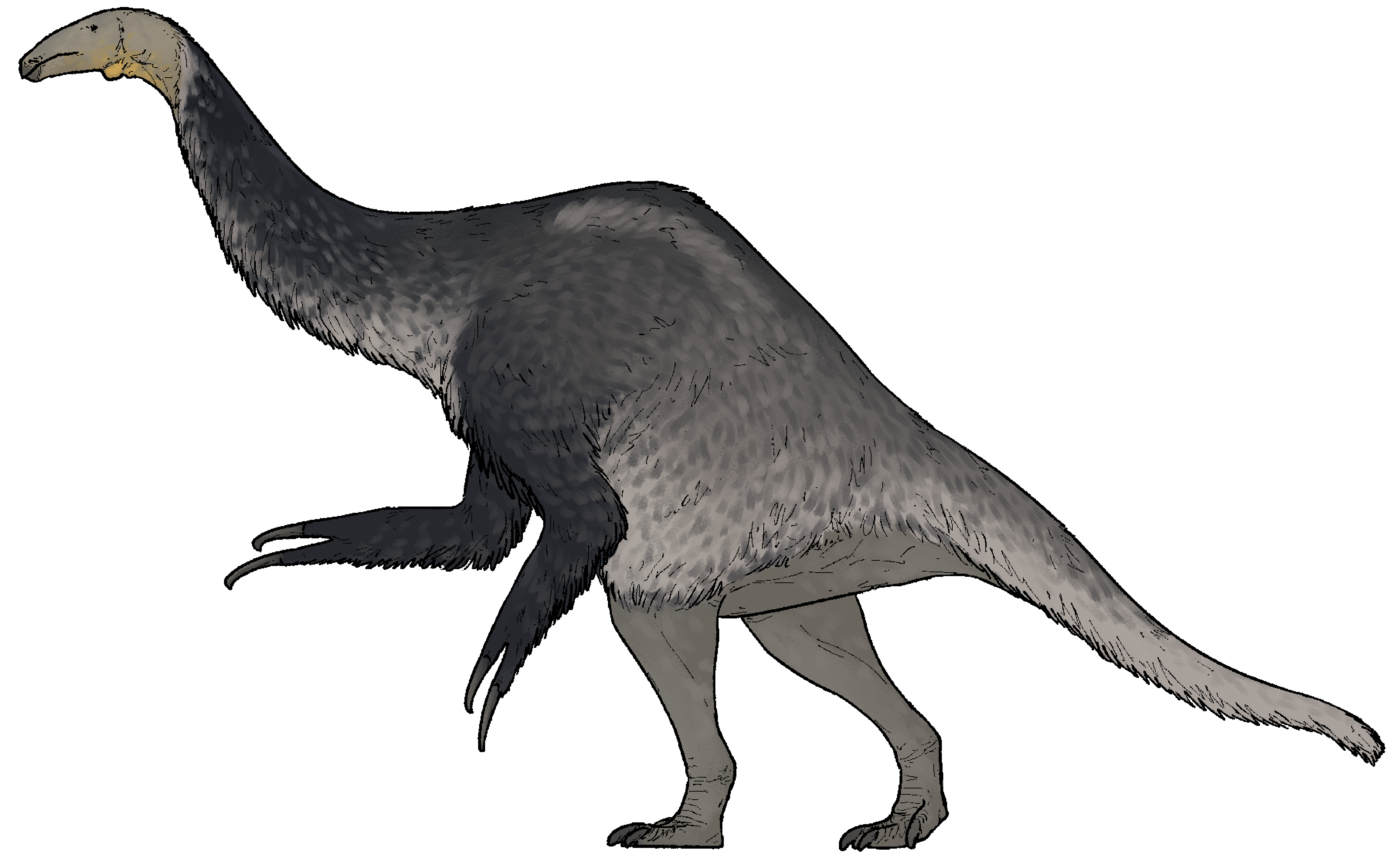
Duonychus tsogtbaatari is a therizinosaurid from the Bayanshiree Formation of Mongolia's eastern Gobi Desert. Its partial articulated skeleton preserves both arms and hands well enough to show that the third finger had been reduced to a splint, leaving two functional claw-bearing digits. Even more unusually, the first finger retains much of its keratinous claw sheath. This soft covering lengthened and increased the curvature of the bony claw, giving direct evidence about a structure usually reconstructed only from bone.
Its fossils occur between approximately 95.9 and 89.6 million years ago. Values shown here are approximate and reflect the current curated seed dataset.
Form and function
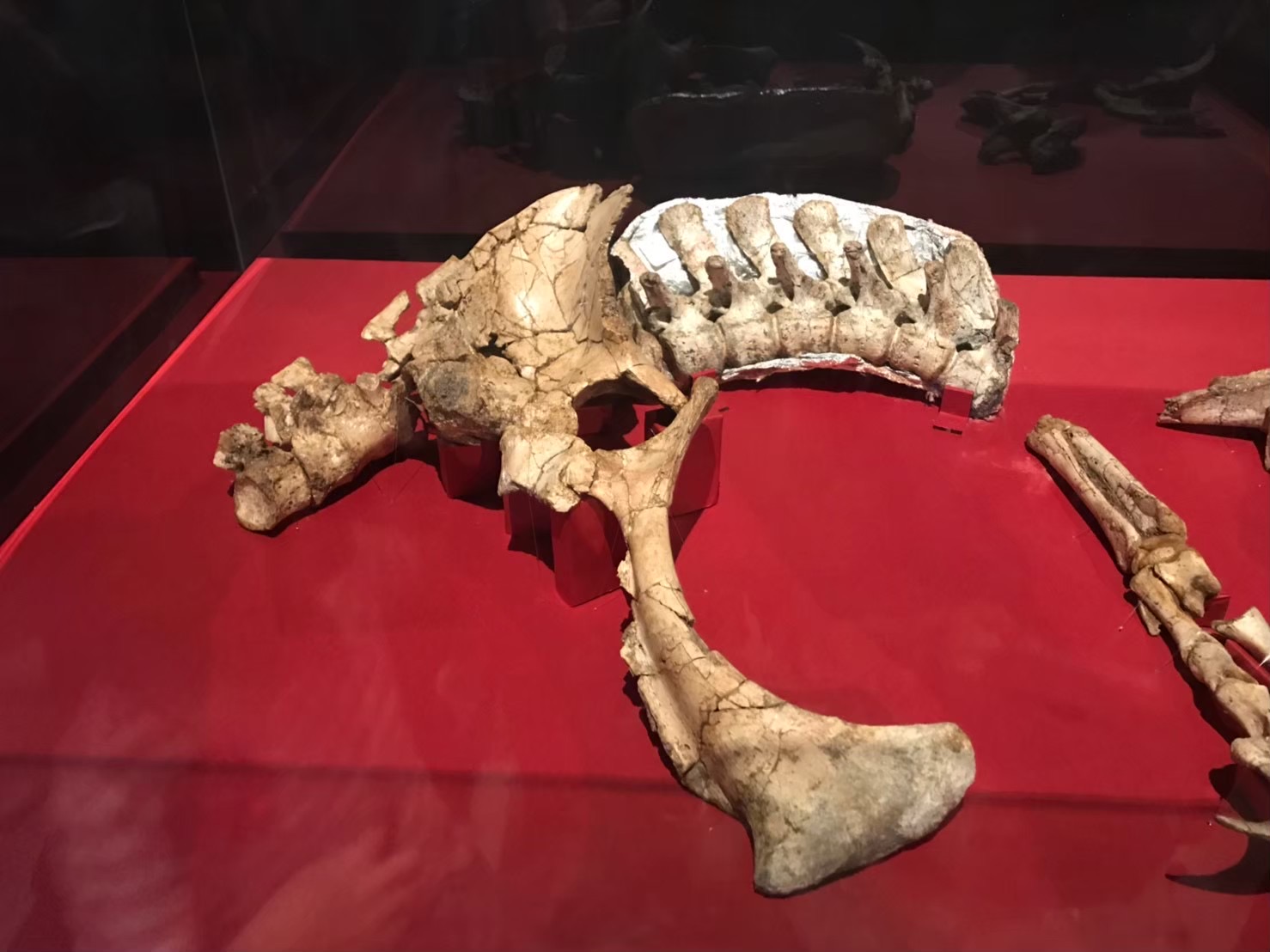
The holotype preserves six dorsal vertebrae, six sacrals, the first tail vertebra, ribs, part of the shoulder girdle, both upper and lower arms, wrists and hands, and portions of the pelvis. Metacarpal III is reduced and does not support a normal functional finger. The nearly complete sheath on left manual digit I brings that claw to about 30 centimetres along its outer curve. Joint mobility and claw curvature indicate a powerful grasp capable of pulling branches toward the body.
Evolutionary position
This simplified classification path shows one placement from Dinosauria to this species. Each step is clickable, and other analyses may support alternative relationships.
Open interactive positionScale
Simplified length comparison using preferred dataset estimates; body shape and posture are not represented.
Scientific record
MPC-D 100/85 was collected at Urlibe Khudak in the Bayanshiree Formation of the eastern Gobi Desert and was publicly shown before receiving a formal name. Yoshitsugu Kobayashi, Darla Zelenitsky, Anthony Fiorillo and Tsogtbaatar Chinzorig described it in March 2025. The genus combines duo, two, with onyx, claw, while the species honours Mongolian palaeontologist and former institute director Khishigjav Tsogtbaatar.
Naming authors: Yoshitsugu Kobayashi, Darla K. Zelenitsky, Anthony R. Fiorillo, Tsogtbaatar Chinzorig.
Palaeoenvironment
The Bayanshiree Formation records alluvial and river deposits in a seasonally dry eastern Gobi setting with meandering channels and wetter local habitats. Duonychus shared this ecosystem with other therizinosaurs, hadrosauroids, armoured dinosaurs, tyrannosauroids and large dromaeosaurids.
Biomechanical analysis supports using the two large fingers together as a grasp, probably to hook and pull vegetation within reach of the head. This is more specific than simply calling the claws weapons, but it does not exclude display or defence. Diet is reconstructed as predominantly plant-based from therizinosaur anatomy; no skull, gut contents or direct feeding trace is preserved with this specimen.
Worth knowing
Fossil distribution
Eastern Gobi Desert, Mongolia
Bayanshiree Formation
approximate site marker
Markers are deliberately approximate. They identify published fossil areas without exposing sensitive excavation coordinates.
Open interactive mapFossil specimen record
Ulaanbaatar, Mongolia
Permanent research repository of the original partial skeleton and keratin-bearing hand. Past temporary exhibition does not guarantee that the specimen is currently on public display.
A research repository is not necessarily a public exhibit. Loan and display status can change, so check with the institution before visiting.
Media record
Evidence
Yoshitsugu Kobayashi, Darla K. Zelenitsky, Anthony R. Fiorillo, Tsogtbaatar Chinzorig · iScience 28(4) · 2025
Open sourceHokkaido University · 2025
Open source