Lance fossil region
Eastern Wyoming, United States
Lance Formation
regional marker
Pronunciation: ed-MON-toh-SORE-us an-NEK-tenz
A very large, broad-billed hadrosaur from the final few million years of the Cretaceous. Complete skeletons, growth series and exceptional ‘mummies’ preserve its scales, fleshy back crest, tail spikes and hind-foot hooves in unusual detail.
Last updated 13 July 2026
Field guide
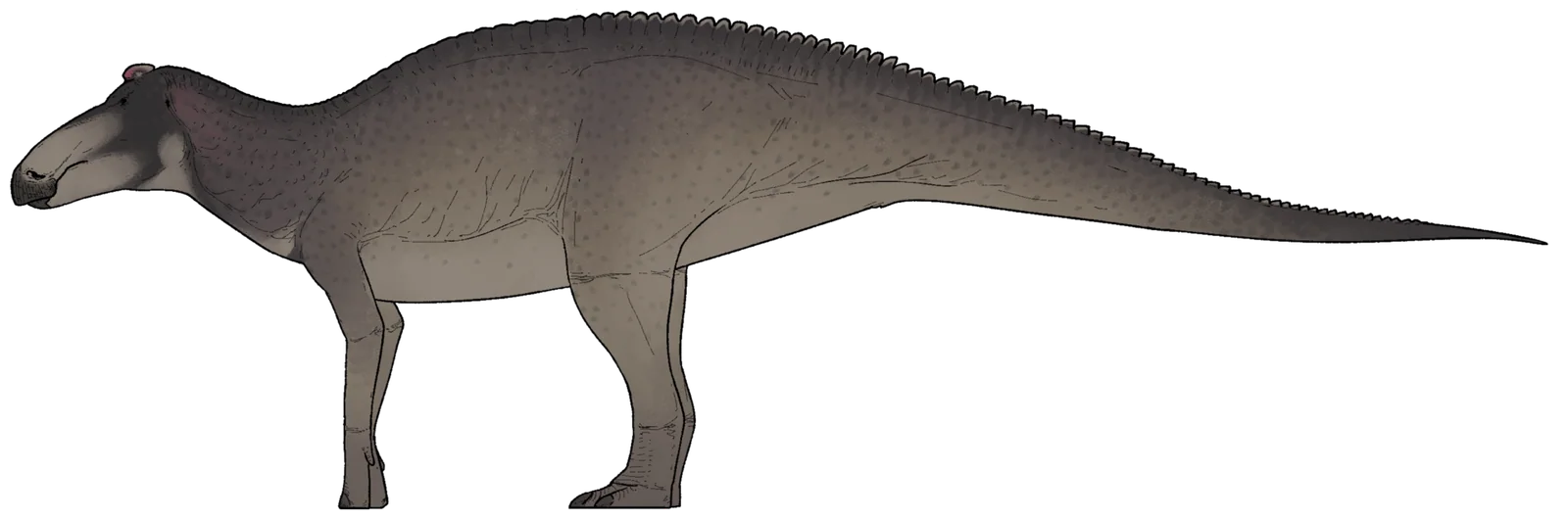
Edmontosaurus annectens was one of the most abundant large herbivores on the river plains of latest Cretaceous western North America. It had a long, low skull, a broad toothless beak and immense dental batteries for processing vegetation. Numerous skulls and articulated skeletons document substantial changes in skull proportions as the animal grew; this evidence led researchers to fold the long-snouted Anatotitan copei into the adult growth series of E. annectens. Exceptionally preserved carcasses from Wyoming add a rare external view. A 2026 study found that their scales, a fleshy midline crest, interlocking tail spikes and hoof sheaths survive as a paper-thin clay template rather than original organic tissue.
Its fossils occur between approximately 68 and 66 million years ago. Values shown here are approximate and reflect the current curated seed dataset.
Form and function
The skull was elongate and low, widening into a toothless keratin-covered beak. Behind it, closely packed columns of replacement teeth formed dental batteries that maintained broad grinding surfaces as worn teeth were shed. The body was deep and muscular, balanced by a long tail reinforced with ossified tendons. Robust hind limbs and shorter forelimbs allowed quadrupedal walking, while the proportions remain compatible with bipedal movement in some circumstances. Clay-templated specimens show tiny pebble-like scales over much of the body, a tall fleshy crest along the neck and trunk, a single interlocking spike row over the hips and tail, and wedge-shaped hoof sheaths around all three hind toes.
Evolutionary position
This simplified classification path shows one placement from Dinosauria to this species. Each step is clickable, and other analyses may support alternative relationships.
Open interactive positionScale
Simplified length comparison using preferred dataset estimates; body shape and posture are not represented.
Scientific record
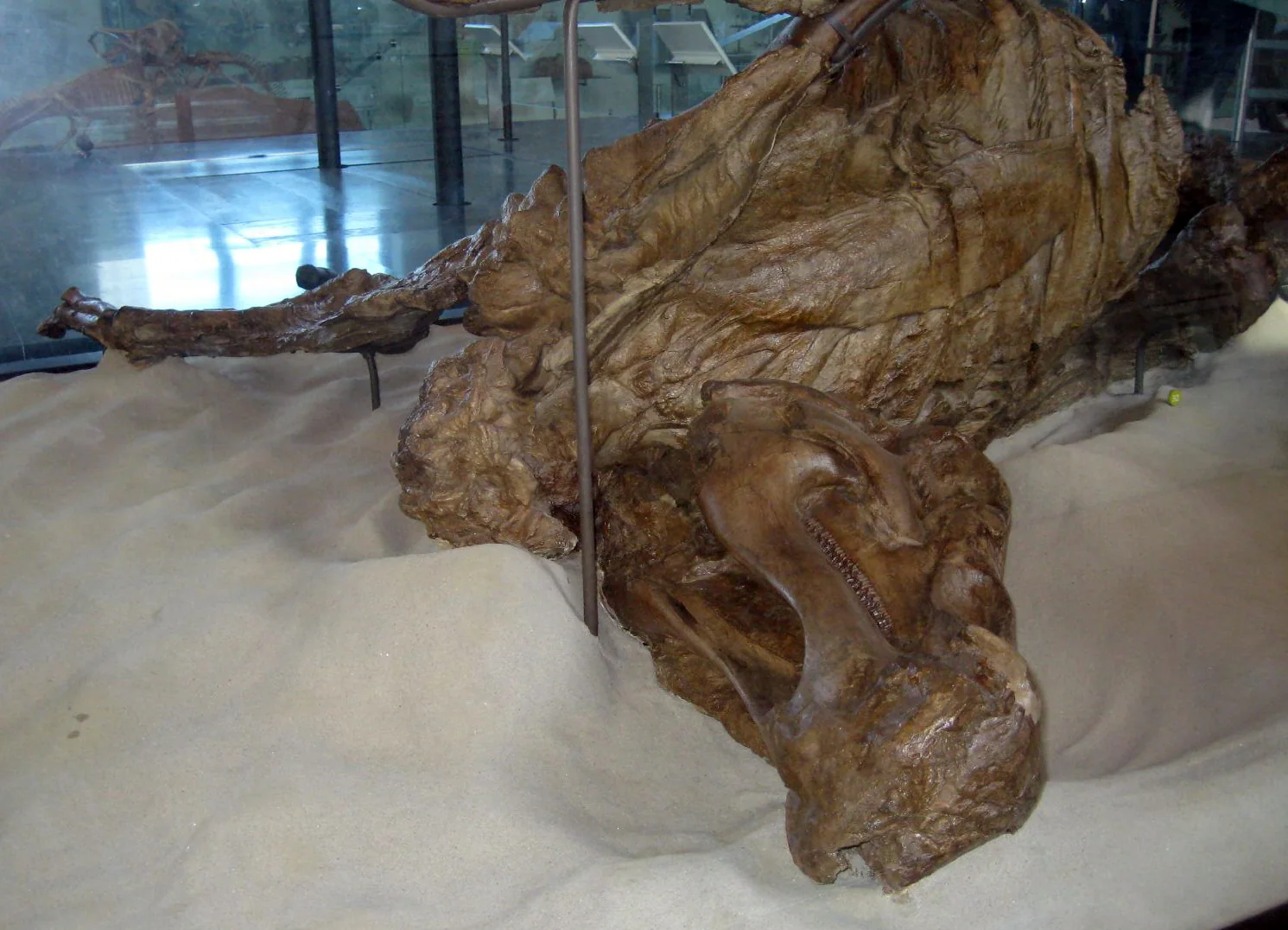
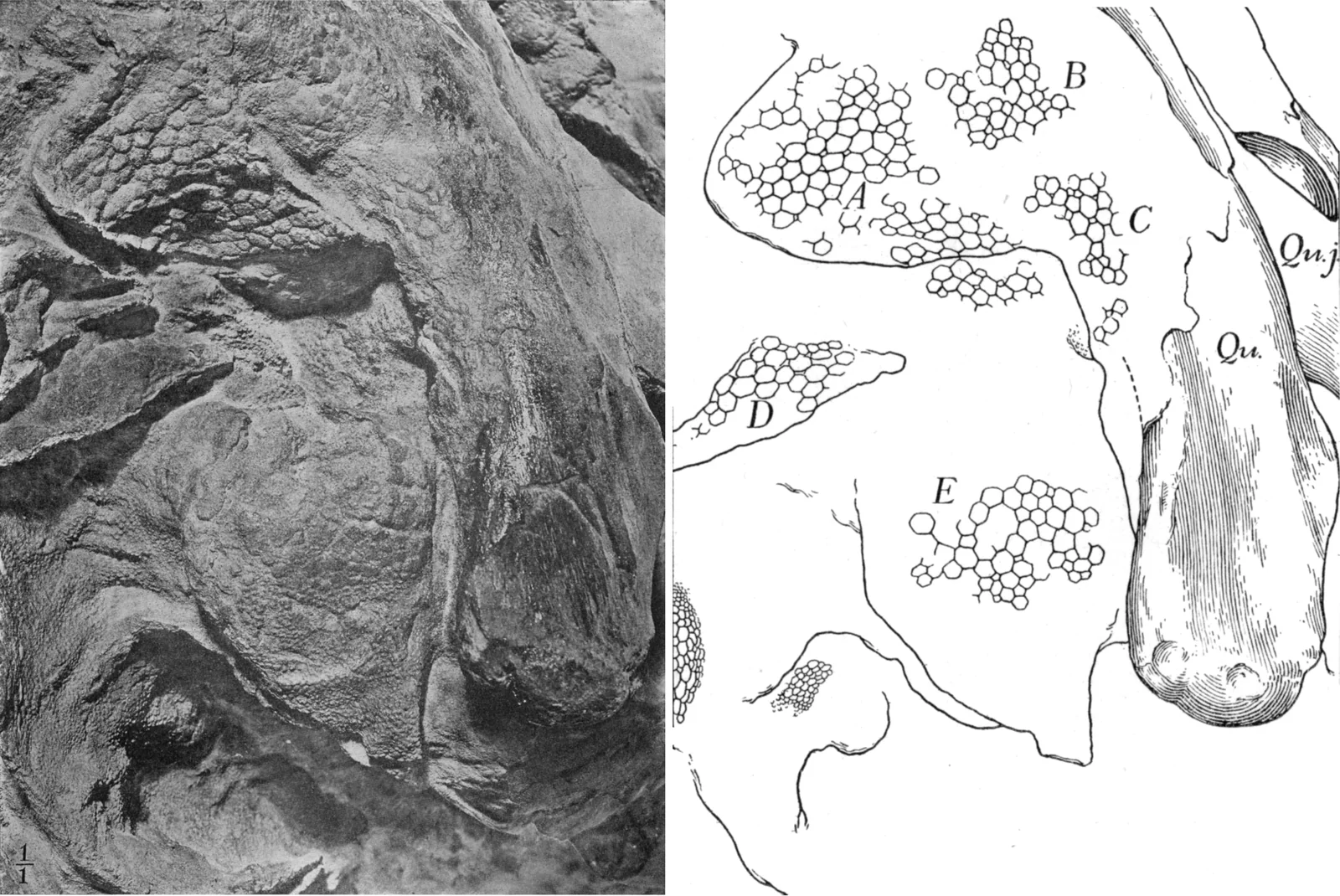
John Bell Hatcher, William H. Sullins and Adam Hermann Utterback collected the exceptionally complete holotype USNM 2414 in Niobrara County, Wyoming, in September 1891. Othniel Charles Marsh named it Claosaurus annectens in 1892. The species later passed through Thespesius, Anatosaurus and Anatotitan before modern revision placed it in Edmontosaurus. Charles H. Sternberg found the famous AMNH 5060 ‘mummy’ in the Lance Formation near Lusk in 1908; Henry Fairfield Osborn described its skin impressions in 1912. Two newly studied Wyoming mummies, one juvenile and one early adult, were described in 2026 and revealed an almost continuous external body profile.
Discovery credit: John Bell Hatcher, William H. Sullins, A. H. Utterback.
Naming authors: Othniel Charles Marsh.
Palaeoenvironment
Edmontosaurus annectens occupied low coastal plains east of the young Rocky Mountains during the final part of the Maastrichtian. The Lance, Hell Creek and equivalent formations record broad rivers, shifting channels, ponds, swamps and seasonally wet floodplains draining toward the Western Interior. Conifers, flowering trees, shrubs, ferns and low ground cover formed a varied plant community. Triceratops, Thescelosaurus and Ankylosaurus shared parts of this landscape, while Tyrannosaurus was the largest predator.
Its beak could crop a broad swath of vegetation and the dental batteries repeatedly sliced and crushed food, but fossils do not identify one preferred plant. Limb proportions support efficient quadrupedal travel and permit bipedal movement, without revealing how often each posture was used. Bonebeds and sites with several individuals show that edmontosaurs sometimes died together and may have gathered, but they do not establish permanent herds or a particular migration route. Hoof sheaths and a padded hind foot refine how the animal contacted soft ground; they do not imply horse-like speed or behaviour.
Worth knowing
Fossil distribution
Eastern Wyoming, United States
Lance Formation
regional marker
Markers are deliberately approximate. They identify published fossil areas without exposing sensitive excavation coordinates.
Open interactive mapFossil specimen record
New York, United States
AMNH 5060, collected by Charles H. Sternberg in 1908, is a real articulated Edmontosaurus annectens skeleton with extensive fossilized surface impressions. It remains a highlighted specimen in the fossil halls; restored portions should not be confused with the original skeleton and clay-templated integument.
Washington, D.C., United States
Research repository of holotype USNM 2414, a remarkably complete skull and skeleton collected in 1891 from the Lance Formation. The museum’s current catalogue verifies the original material and type status; permanent public display is not confirmed.
A research repository is not necessarily a public exhibit. Loan and display status can change, so check with the institution before visiting.
Media record
Evidence
Othniel Charles Marsh · American Journal of Science · 1892
Open sourceNicolás E. Campione, David C. Evans · PLOS ONE · 2011
Open sourceHenry Fairfield Osborn · Memoirs of the American Museum of Natural History · 1912
Open sourcePaul C. Sereno, Evan T. Saitta, Daniel Vidal and 7 coauthors · Science · 2026
Open sourceAmerican Museum of Natural History · 2017
Open sourceSmithsonian National Museum of Natural History
Open source