Skull Creek Estates fossil locality
Moffat County, Colorado, United States
Morrison Formation
approximate site marker
Pronunciation: ee-NIG-ma-KUR-sor molly-BORTH-wick-ee
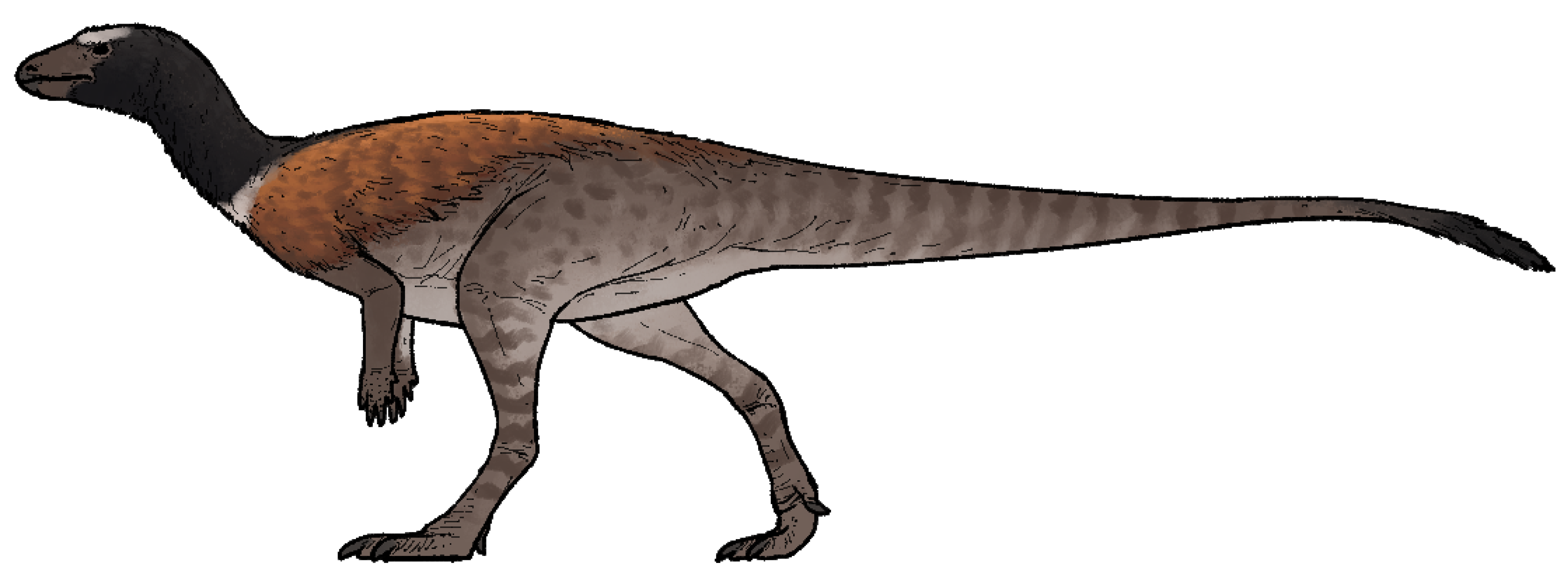
A small, long-legged Late Jurassic plant-eater from Colorado represented by the most complete securely named small neornithischian skeleton from the Morrison Formation.
Last updated 16 July 2026
Field guide
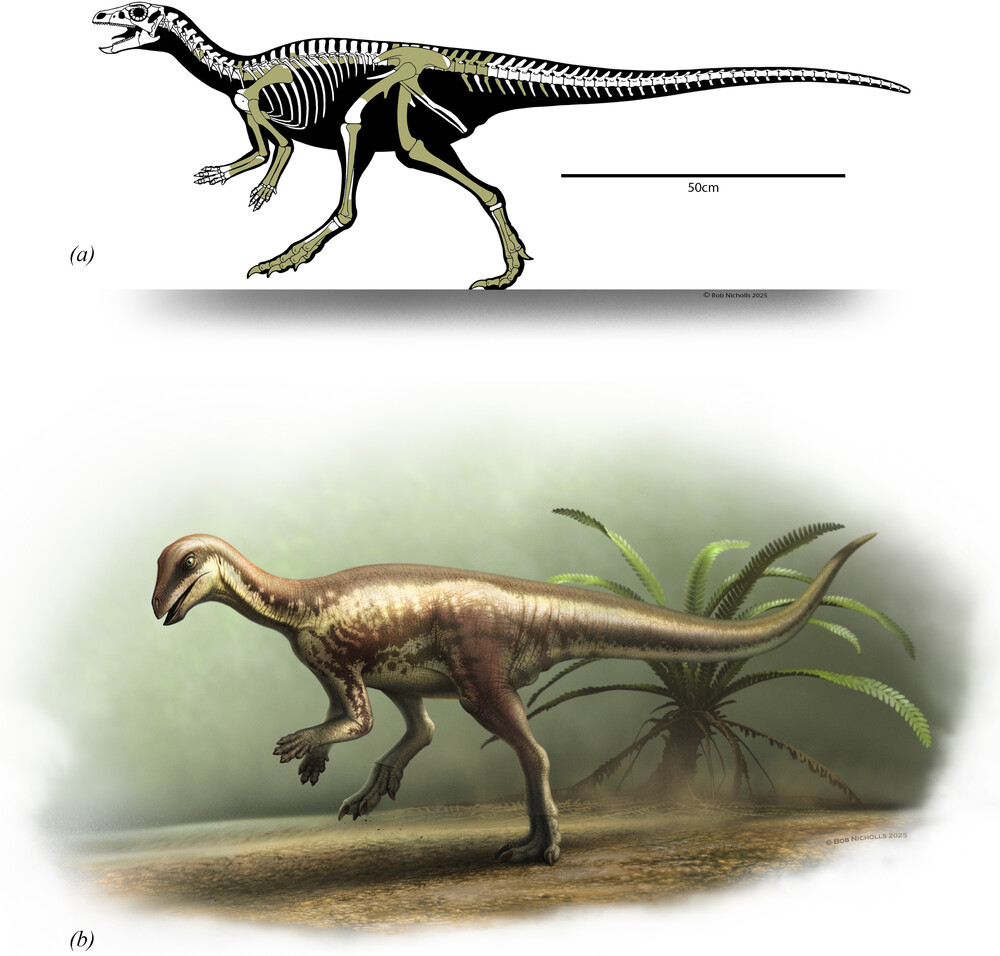
Enigmacursor mollyborthwickae is a small, bipedal neornithischian from the Morrison Formation. Historic names for similar Morrison dinosaurs are based on incomplete or poorly diagnostic fossils, creating more than a century of taxonomic confusion. The three-dimensionally preserved Enigmacursor holotype supplies a modern anatomical reference built from much more of the body, although most of the skull is still absent. Phylogenetic analysis places it outside Cerapoda and identifies the Chinese Yandusaurus as its closest sampled relative.
Its fossils occur between approximately 152 and 145 million years ago. Values shown here are approximate and reflect the current curated seed dataset.
Form and function
NHMUK PV R 39000 includes three teeth, 21 vertebrae from the neck through tail, ribs and chevrons, both shoulder blades, much of both forelimbs, parts of the pelvis and both hind limbs and feet. The femur is 169 millimetres long and the tibia 209 millimetres, producing the long lower-leg proportions behind its runner name. Diagnostic details include the alignment of articular facets on the front dorsal vertebrae and a hooked inner condyle on the upper tibia. The skull is otherwise unknown.
Evolutionary position
This simplified classification path shows one placement from Dinosauria to this species. Each step is clickable, and other analyses may support alternative relationships.
Open interactive positionScale
Simplified length comparison using preferred dataset estimates; body shape and posture are not represented.
Scientific record
Dinosaurs of America LLC excavated the specimen in 2021–2022 at Skull Creek Estates in Moffat County, Colorado. It entered the Natural History Museum, London collection in 2024 after Molly and David Lowell Borthwick funded its acquisition. Susannah Maidment and Paul Barrett named it in June 2025. Enigma refers to the confused taxonomy of small Morrison ornithischians, cursor is Latin for runner, and mollyborthwickae honours Molly Borthwick.
Discovery credit: Dinosaurs of America LLC field team.
Naming authors: Susannah C. R. Maidment, Paul M. Barrett.
Palaeoenvironment
Northern Colorado's Morrison Formation preserves river channels and seasonally wet floodplains with ferns, cycads, conifers and other low vegetation. Enigmacursor lived alongside much larger dinosaurs including Allosaurus, Stegosaurus and Diplodocus, but occupied a small-bodied terrestrial herbivore niche that is comparatively poorly sampled.
Long lower legs and feet support an agile running interpretation, probably useful when escaping predators. Small denticulate teeth are consistent with herbivory, but the missing skull prevents a detailed reconstruction of bite mechanics or food selectivity. Sociality, burrowing, nesting and parental care are unknown.
Worth knowing
Fossil distribution
Moffat County, Colorado, United States
Morrison Formation
approximate site marker
Markers are deliberately approximate. They identify published fossil areas without exposing sensitive excavation coordinates.
Open interactive mapFossil specimen record
London, United Kingdom
Original partial skeleton acquired in 2024 and placed on permanent public display on the first-floor Earth Hall mezzanine in June 2025.
A research repository is not necessarily a public exhibit. Loan and display status can change, so check with the institution before visiting.
Media record
Evidence
Susannah C. R. Maidment, Paul M. Barrett · Royal Society Open Science 12(6) · 2025
Open sourceNatural History Museum, London · 2025
Open source