Ischigualasto Basin
San Juan Province, Argentina
Ischigualasto Formation
regional marker
Pronunciation: EE-oh-RAP-tor loo-NEN-sis
A small, lightly built Late Triassic dinosaur from Argentina known from a remarkably complete skeleton, with a five-fingered hand and a varied set of serrated teeth near the earliest saurischian radiation.
Last updated 13 July 2026
Field guide
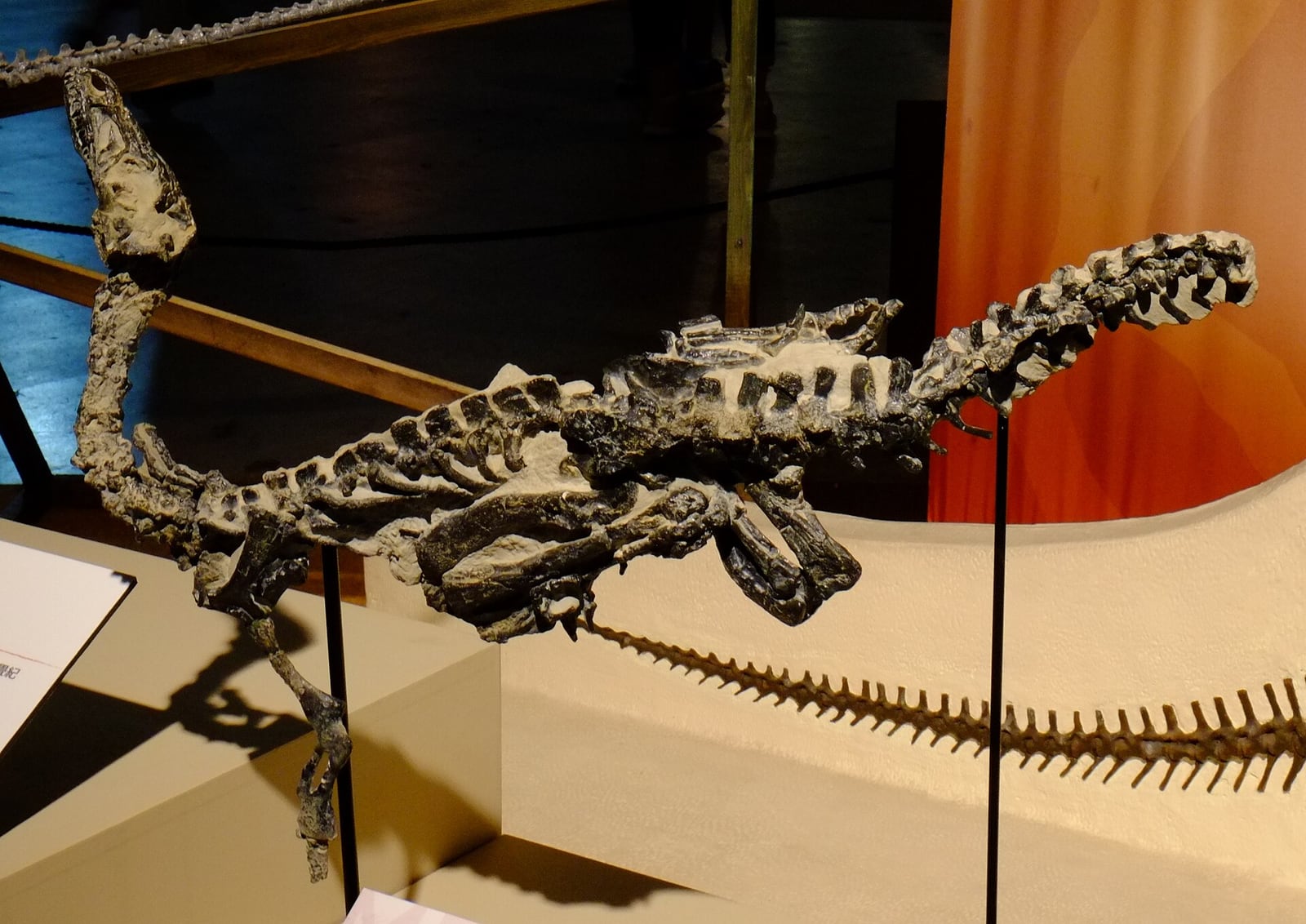
Eoraptor lunensis was a small biped from the Ischigualasto Formation, known from the largely articulated holotype PVSJ 512 and additional fragmentary individuals. Its long tail, slender hind limbs, grasping hands and lightly built skull preserve a body plan close to the early diversification of saurischian dinosaurs. The original description placed Eoraptor outside the specialized branches of Dinosauria; it was later interpreted first as an early theropod and then, in influential 2011 and 2013 studies, as one of the earliest sauropodomorphs. That uncertainty is scientifically useful: Eoraptor is not the known ancestor of later dinosaurs, but a close relative that samples an early evolutionary experiment.
Its fossils occur between approximately 230.8 and 228.9 million years ago. Values shown here are approximate and reflect the current curated seed dataset.
Form and function
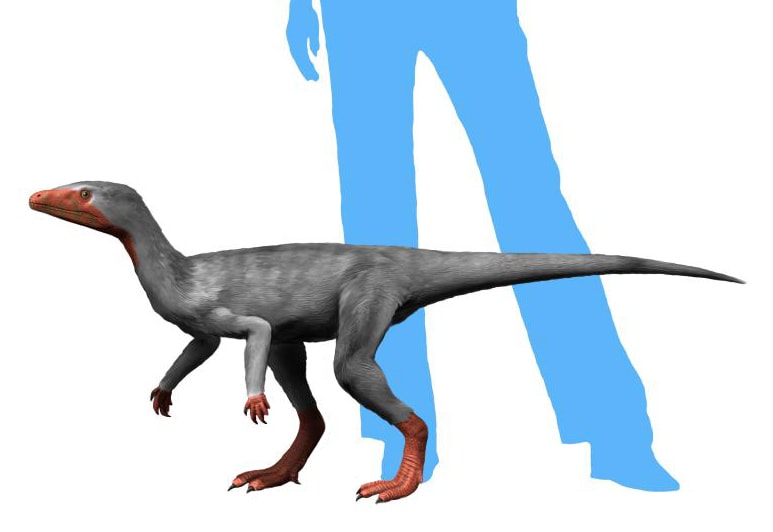
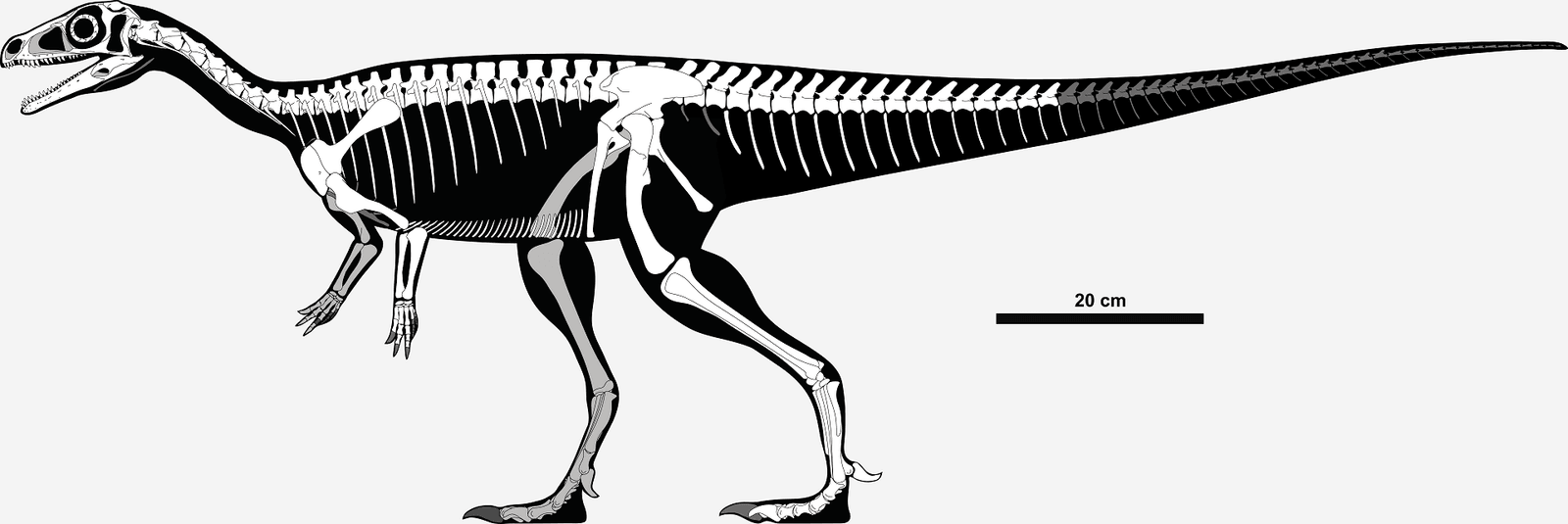
The skull was low and lightly constructed, with large openings and a dentition that changed along the jaw. Some teeth were recurved and serrated, whereas others were straighter and more leaf-shaped. The forelimb was less than half the length of the hind limb, supporting habitual bipedalism. Each hand retained five digits: the middle three were the principal grasping fingers and carried claws, while the outer digits were reduced. Slender, hollow limb bones, elongated lower legs and a long balancing tail produced an agile-looking skeleton, but no direct trackway belongs to the species.
Evolutionary position
This simplified classification path shows one placement from Dinosauria to this species. Each step is clickable, and other analyses may support alternative relationships.
Open interactive positionScale
Simplified length comparison using preferred dataset estimates; body shape and posture are not represented.
Scientific record
Ricardo N. Martínez discovered the holotype PVSJ 512 in 1991 during fieldwork in the Cancha de Bochas Member of the Ischigualasto Formation. Paul Sereno, Catherine Forster, Raymond Rogers and Alfredo Monetta named Eoraptor lunensis in Nature in 1993. The generic name combines words for dawn and plunderer, while lunensis refers to Valle de la Luna, the Moon Valley name used for Ischigualasto. A detailed 2013 monograph redescribed the nearly complete holotype and referred specimens and argued that several subtle skull, vertebral and limb features place Eoraptor near the base of Sauropodomorpha.
Discovery credit: Ricardo N. Martínez.
Naming authors: Paul C. Sereno, Catherine A. Forster, Raymond R. Rogers, Alfredo M. Monetta.
Palaeoenvironment
Eoraptor lived on the same seasonal Ischigualasto floodplains as Herrerasaurus. River channels crossed broad, arid to semi-arid flood basins that experienced severe droughts as well as episodic flooding. Rhynchosaurs and cynodonts were substantially more abundant than dinosaurs. The ecosystem also supported armored aetosaurs, large crocodile-line archosaurs, amphibians and several other small early dinosaurs, showing that Dinosauria had diversified before it became ecologically dominant.
Eoraptor was a small habitual biped able to grasp with its hands, but its feeding ecology remains unsettled. Its mixed tooth shapes traditionally supported an omnivorous interpretation. A 2022 biomechanical comparison found mechanically weak, finely serrated teeth compatible with cutting soft animal tissue, making faunivory plausible, while the less recurved crowns and possible sauropodomorph affinities still leave room for a varied diet. Bone histology published in 2024 records episodes of rapid growth interrupted by temporary slowdowns. No fossil preserves stomach contents, nests, skin or social behaviour.
Worth knowing
Fossil distribution
San Juan Province, Argentina
Ischigualasto Formation
regional marker
Markers are deliberately approximate. They identify published fossil areas without exposing sensitive excavation coordinates.
Open interactive mapFossil specimen record
San Juan, Argentina
Research repository of original holotype PVSJ 512 and referred Eoraptor material from Ischigualasto. The holotype is a largely articulated skull and skeleton; the museum's public institutional page confirms its research and exhibition remit but does not promise continuous display of the original specimen.
Valle Fértil, San Juan Province, Argentina
Museum stops in the fossil-bearing park display real Ischigualasto fossils and explain the Triassic ecosystem. The official tourism listing does not identify the Eoraptor holotype as a permanent exhibit, so this is included as locality context rather than as its repository.
A research repository is not necessarily a public exhibit. Loan and display status can change, so check with the institution before visiting.
Media record
Evidence
Paul C. Sereno, Catherine A. Forster, Raymond R. Rogers, Alfredo M. Monetta · Nature · 1993
Open sourceRicardo N. Martínez, Paul C. Sereno, Oscar A. Alcober and 4 coauthors · Science · 2011
Open sourcePaul C. Sereno, Ricardo N. Martínez, Oscar A. Alcober · Journal of Vertebrate Paleontology · 2013
Open sourceSterling J. Nesbitt · Bulletin of the American Museum of Natural History · 2011
Open sourceAntonio Ballell, Michael J. Benton, Emily J. Rayfield · Science Advances · 2022
Open sourceKristina Curry Rogers, Ricardo N. Martínez, Carina Colombi and 2 coauthors · PLOS ONE · 2024
Open sourceFacultad de Ciencias Exactas, Físicas y Naturales, Universidad Nacional de San Juan
Open sourceUNESCO World Heritage Centre
Open sourceLa Ruta Natural, Argentina
Open source