Dinosaur Provincial Park region
Alberta, Canada
Dinosaur Park Formation
regional marker
Pronunciation: yoo-OP-loh-SEFF-ah-lus TOO-tus
A low, broad ankylosaurid from Alberta's Dinosaur Park Formation, protected by skull tiles, neck armour and body osteoderms and equipped with a stiff-handled tail club. Modern revision has greatly narrowed which fossils truly belong to it.
Last updated 13 July 2026
Field guide
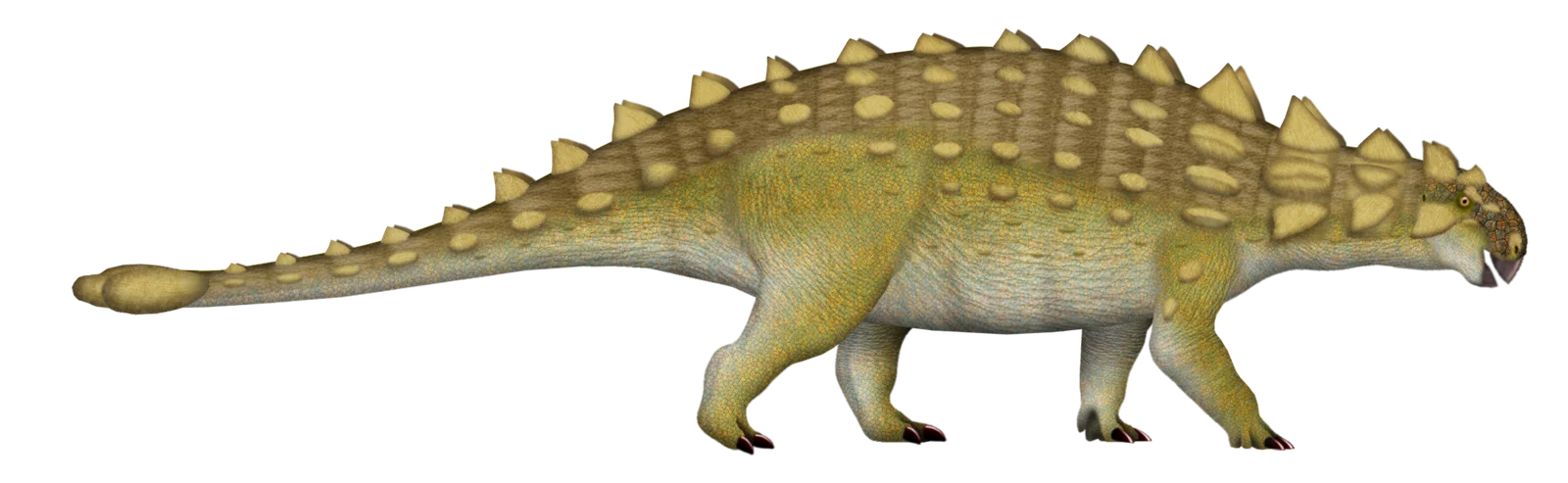
Euoplocephalus tutus was a large, four-legged plant eater from the Campanian coastal plain of southern Alberta. Its broad torso, short powerful limbs, reinforced skull and extensive skin armour produced the classic ankylosaur body plan. A tail club is represented among securely referred specimens, but the fragmentary holotype preserves only part of the skull roof and the first armoured neck band. For much of the twentieth century Euoplocephalus became a catch-all name for Albertan ankylosaurids spanning almost nine million years. A specimen-by-specimen revision in 2013 separated Anodontosaurus, Dyoplosaurus and Scolosaurus again, restricting E. tutus chiefly to the Dinosaur Park Formation.
Its fossils occur between approximately 76.5 and 74.9 million years ago. Values shown here are approximate and reflect the current curated seed dataset.
Form and function
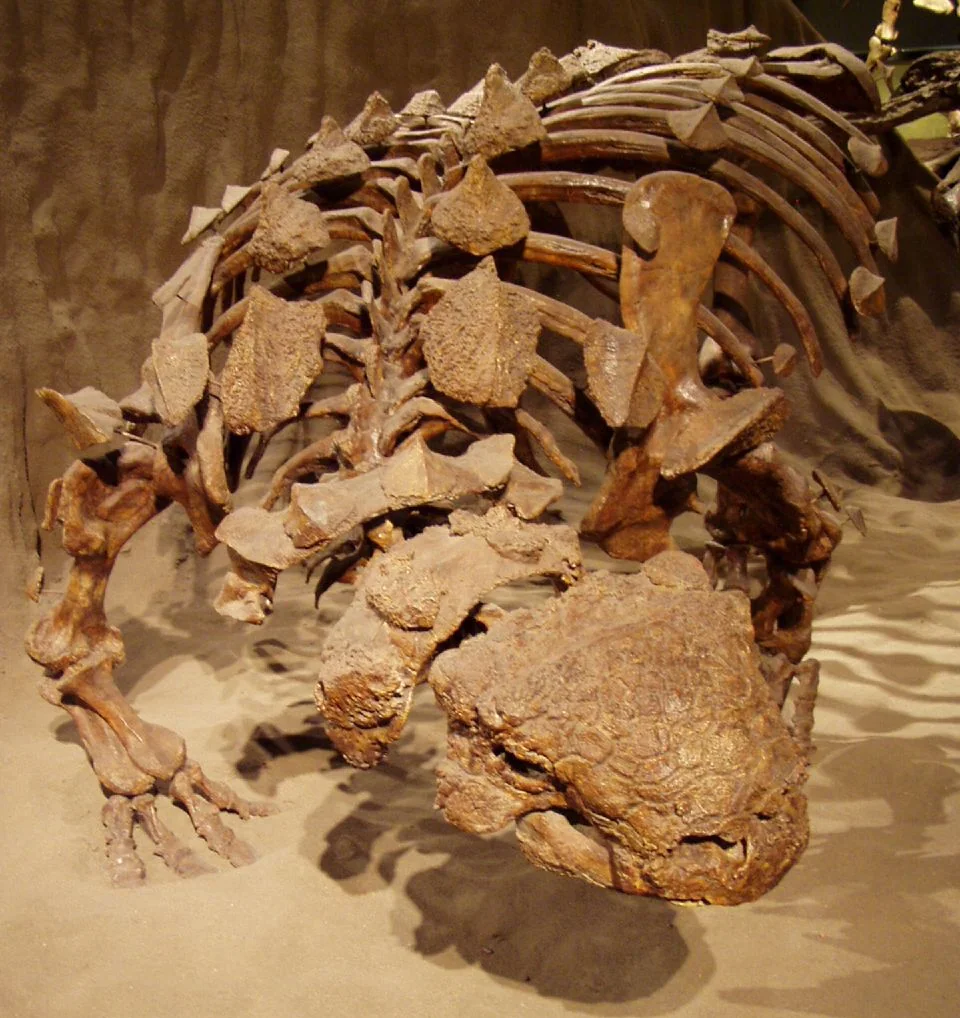
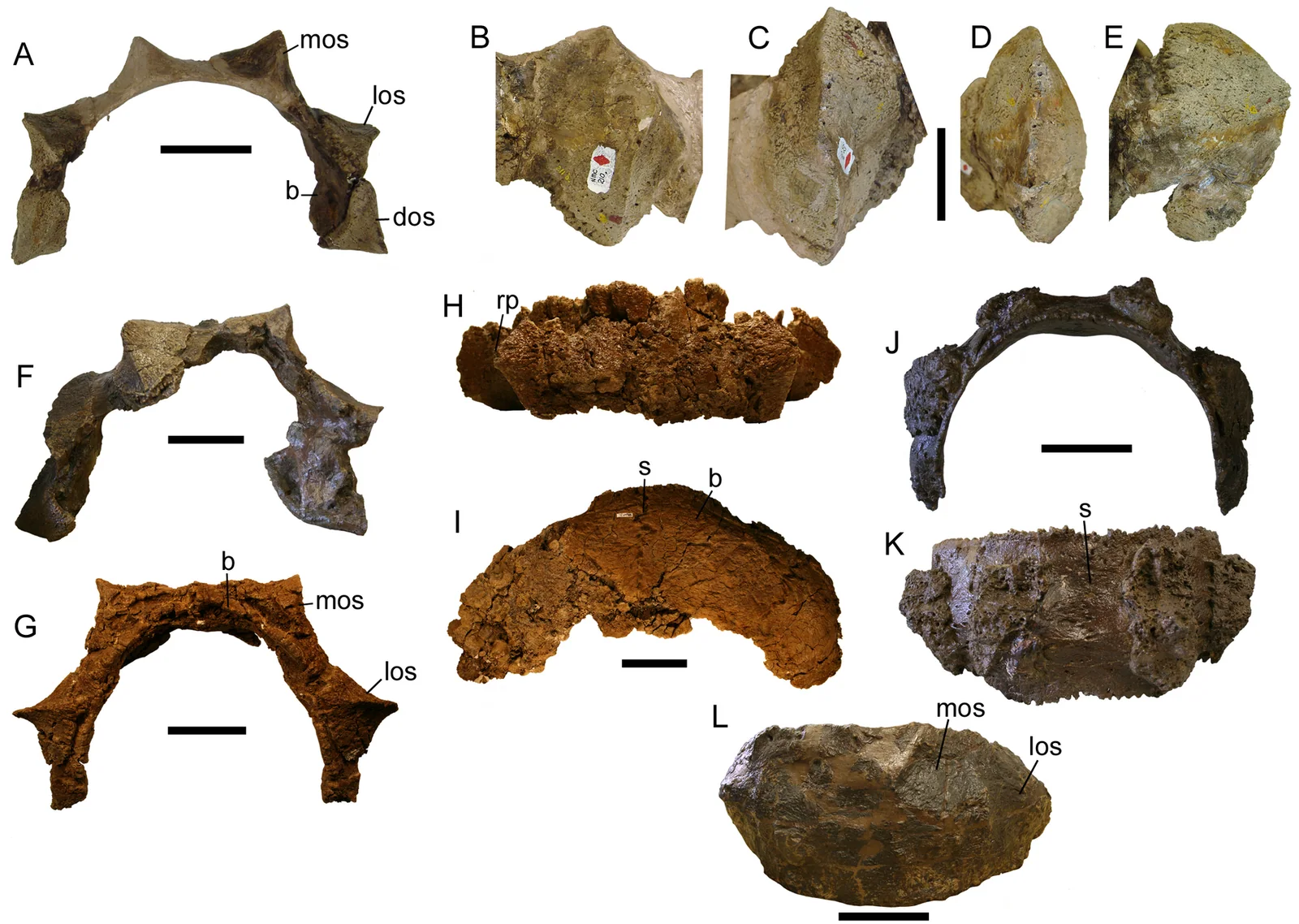
Polygonal caputegulae formed a tiled surface over the low, wide skull, with small horn-like projections at its rear corners. A toothless beak cropped plants before rows of small leaf-shaped cheek teeth cut the food. Two cervical half-rings guarded the neck, and keeled osteoderms were embedded across the back and flanks, although no securely referred specimen preserves the entire armour layout in place. Toward the tail tip, tightly interlocking vertebrae and elongated tendons formed a rigid handle. Paired enlarged osteoderms created a rounded club knob capable of being swung from side to side.
Evolutionary position
This simplified classification path shows one placement from Dinosauria to this species. Each step is clickable, and other analyses may support alternative relationships.
Open interactive positionScale
Simplified length comparison using preferred dataset estimates; body shape and posture are not represented.
Scientific record
Lawrence M. Lambe collected holotype CMN 210 in 1897 on the east side of the Red Deer River near the mouth of Berry Creek, in what is now the northwestern part of Dinosaur Provincial Park. He named the species Stereocephalus tutus in 1902 from a fragmentary skull roof and part of the first cervical half-ring. Because Stereocephalus was already occupied by another animal, Lambe supplied the replacement genus name Euoplocephalus in 1910. Later expeditions recovered numerous skulls and partial skeletons, but modern revision showed that several of the most familiar historical specimens belong to other ankylosaur genera.
Discovery credit: Lawrence M. Lambe.
Naming authors: Lawrence M. Lambe.
Palaeoenvironment
Euoplocephalus lived on the warm, humid coastal plain represented by the Dinosaur Park Formation, west of the Western Interior Seaway. Meandering rivers, floodplains, ponds, swamps and forested areas supported conifers, ferns and flowering plants. The genus is most common in the formation's lower megaherbivore assemblage zone, alongside animals such as Centrosaurus, Corythosaurus, Parasaurolophus and the tyrannosaurids Gorgosaurus and Daspletosaurus.
The low muzzle and small teeth indicate selective browsing close to the ground, with swallowed vegetation probably broken down in a large fermenting gut. Biomechanical modelling shows that the largest ankylosaurid clubs could generate substantial impact forces, making defence or combat plausible. It does not reveal the target, frequency or social context of a strike. No trackway, nest or mass association securely demonstrates herd structure, parental care or other social behaviour in Euoplocephalus.
Worth knowing
Fossil distribution
Alberta, Canada
Dinosaur Park Formation
regional marker
Markers are deliberately approximate. They identify published fossil areas without exposing sensitive excavation coordinates.
Open interactive mapFossil specimen record
Drumheller, Canada
The museum's current visitor material identifies Euoplocephalus as a Dinosaur Hall highlight. The displayed reconstruction presents original fossil material together with restored portions and should be read as a composite museum mount.
Gatineau, Canada
Repository of the original holotype CMN 210, consisting of a fragmentary skull roof and part of the first cervical half-ring. The specimen establishes the species but cannot by itself supply a complete skeletal reconstruction; permanent public display is not confirmed.
A research repository is not necessarily a public exhibit. Loan and display status can change, so check with the institution before visiting.
Media record
Evidence
Victoria M. Arbour · PLOS ONE · 2009
Open sourceCanadian Museum of Nature
Open sourceLawrence M. Lambe · Contributions to Canadian Palaeontology · 1902
Open sourceLawrence M. Lambe · The Ottawa Naturalist · 1910
Open sourceVictoria M. Arbour, Philip J. Currie · PLOS ONE · 2013
Open sourceRoyal Tyrrell Museum of Palaeontology · 2023
Open sourceUNESCO World Heritage Centre
Open source