Villa El Chocon fossil region
Neuquen Province, Patagonia, Argentina
Candeleros Formation
regional marker
Pronunciation: JIG-ah-NOH-toh-SORE-us care-oh-LEE-nye
One of the largest well-supported terrestrial predators, a long-skulled Patagonian carcharodontosaurid known chiefly from a single substantial partial skeleton.
Last updated 16 July 2026
Field guide
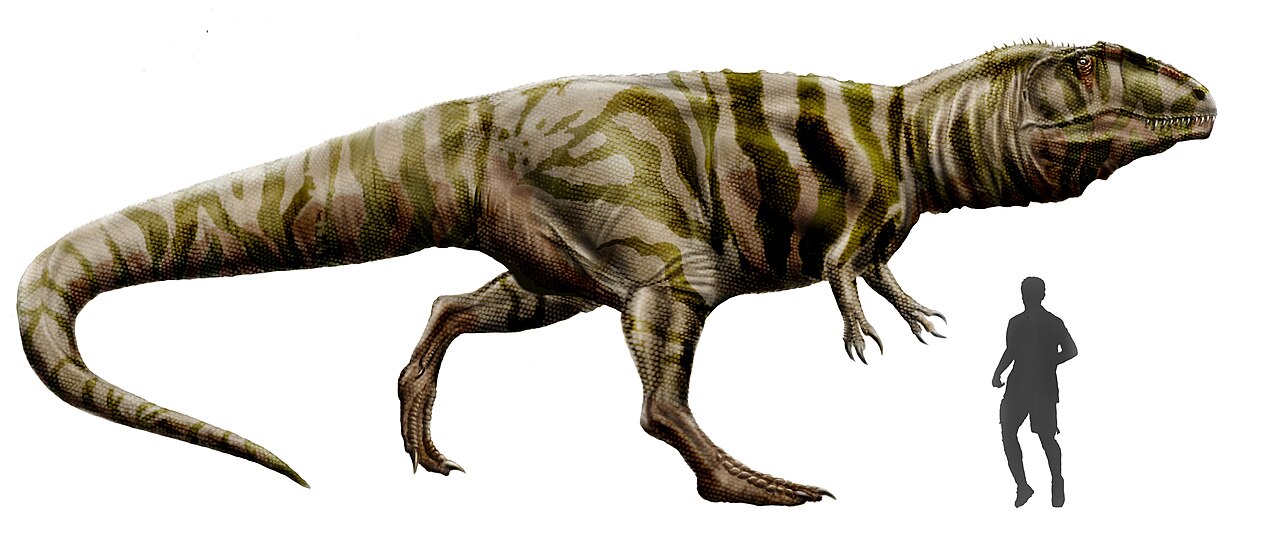
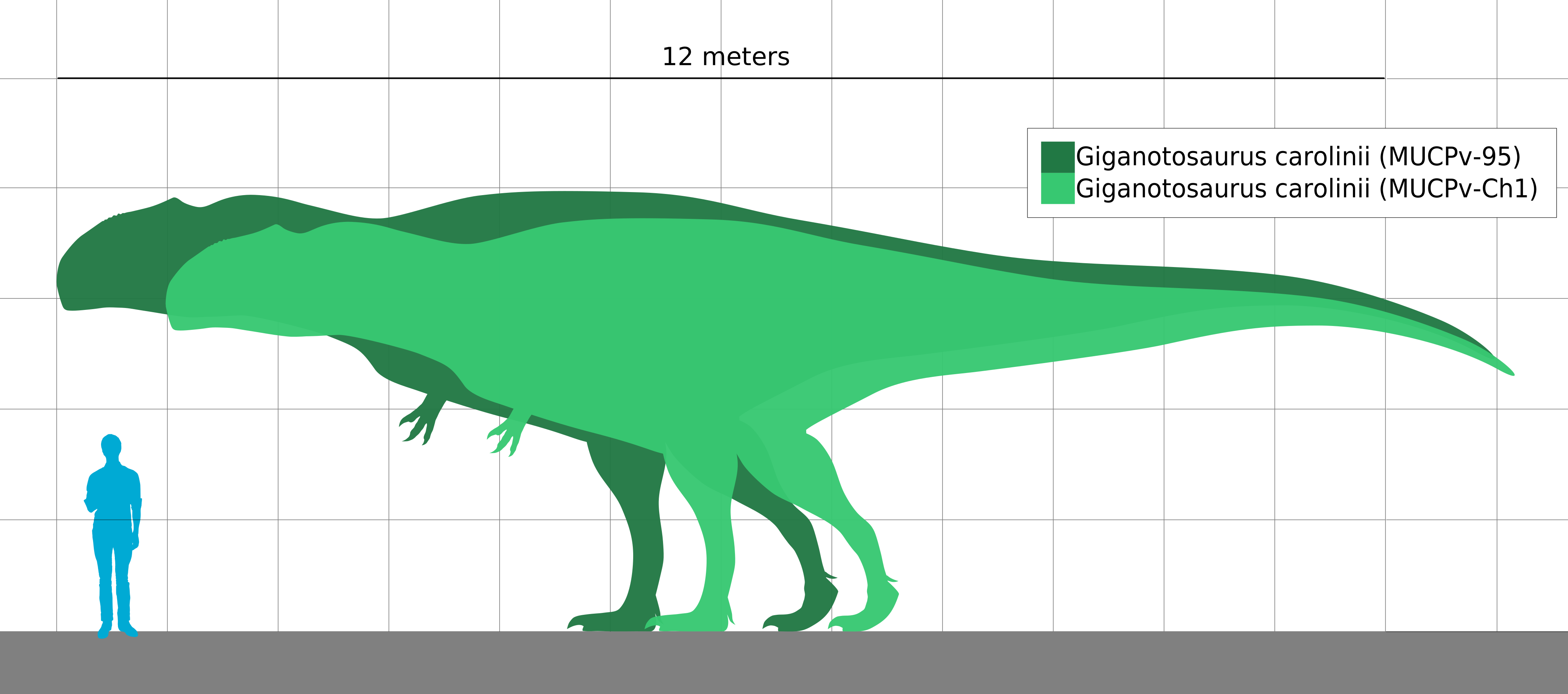
Giganotosaurus carolinii was a giant carcharodontosaurid from the Candeleros Formation of Patagonia. Its long, low skull, laterally compressed serrated teeth and lightly built facial bones differ markedly from the deeper, more powerfully braced skull of Tyrannosaurus. The holotype preserves much of the skeleton and establishes an animal around twelve metres long. A second isolated lower-jaw fragment may represent a larger individual, but scaling a whole body from that one bone introduces considerable uncertainty.
Its fossils occur between approximately 99.6 and 95 million years ago. Values shown here are approximate and reflect the current curated seed dataset.
Form and function
Holotype MUCPv-Ch1 includes much of the skull, vertebral column, shoulder and pelvic girdles, both femora and most of the left lower leg. The skull was elongated and relatively low, with large openings and blade-like teeth adapted to slicing flesh. The neck and back vertebrae were robust, the hind limbs massive, and the three-fingered forelimbs proportionally small but not reduced to the two-fingered condition of tyrannosaurids. The skull roof and nasal bones carried low rugose surfaces rather than tall horns or crests.
Evolutionary position
This simplified classification path shows one placement from Dinosauria to this species. Each step is clickable, and other analyses may support alternative relationships.
Open interactive positionScale
Simplified length comparison using preferred dataset estimates; body shape and posture are not represented.
Scientific record
Amateur fossil hunter Ruben Dario Carolini found the first bone in 1993 while exploring badlands near Villa El Chocon in Neuquen Province. A team from the National University of Comahue excavated the disarticulated skeleton. Rodolfo Coria and Leonardo Salgado named Giganotosaurus carolinii in Nature in 1995. The genus combines Greek words for giant, southern and lizard, while the species honours Carolini. The holotype is preserved at the Ernesto Bachmann Paleontological Museum close to the discovery region.
Discovery credit: Ruben Dario Carolini.
Naming authors: Rodolfo A. Coria, Leonardo Salgado.
Palaeoenvironment
The Candeleros Formation records river channels, floodplains and wind-worked sediments in a warm, seasonally dry Patagonian landscape. Large sauropods, smaller herbivores, crocodile-line reptiles and other theropods occupied the broader formation. Those occurrences span different sites and times, so they do not by themselves identify particular prey or direct encounters for the Giganotosaurus holotype.
Its large body, slicing teeth and reinforced neck identify Giganotosaurus as a macropredator capable of attacking substantial vertebrate prey or scavenging large carcasses. Exactly how it killed, how fast it ran and whether it hunted sauropods remain unresolved. The multi-individual bonebed known for the related Mapusaurus is not evidence that Giganotosaurus itself hunted in coordinated packs.
Worth knowing
Fossil distribution
Neuquen Province, Patagonia, Argentina
Candeleros Formation
regional marker
Markers are deliberately approximate. They identify published fossil areas without exposing sensitive excavation coordinates.
Open interactive mapFossil specimen record
Villa El Chocon, Argentina
Repository near the discovery site for the original partial skeleton and a mounted reconstruction. Individual elements may rotate between research and display.
A research repository is not necessarily a public exhibit. Loan and display status can change, so check with the institution before visiting.
Media record
Evidence
Rodolfo A. Coria, Leonardo Salgado · Nature 377 · 1995
Open sourceNatural History Museum, London
Open source