Dinosaur Provincial Park fossil region
Red Deer River badlands, Alberta, Canada
Dinosaur Park Formation
regional marker
Pronunciation: GOR-goh-SORE-us lie-BRAY-tus
A slender, long-legged tyrannosaur from Alberta known from an exceptional growth series, including a juvenile with the remains of two small dinosaurs preserved in its stomach.
Last updated 16 July 2026
Field guide
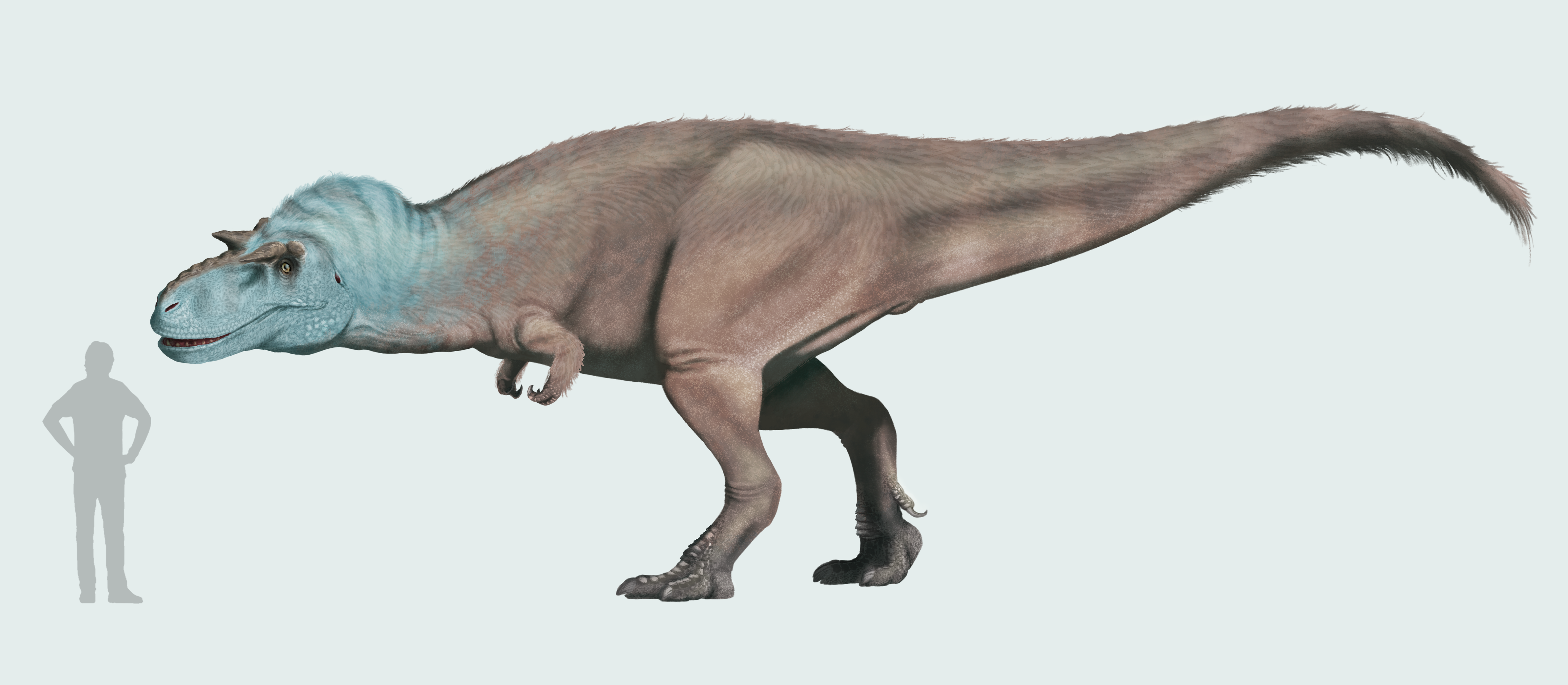
Gorgosaurus libratus was the common albertosaurine tyrannosaur of Alberta's Dinosaur Park Formation. Adults approached nine metres but remained more lightly built than Tyrannosaurus rex, with a shallower skull and proportionally long lower legs. More than a dozen good skeletons and skulls span young juveniles to mature adults, making Gorgosaurus one of the best dinosaurs for studying how tyrannosaur bodies and feeding changed during growth. It lived alongside the more robust tyrannosaur Daspletosaurus, although fossil occurrence alone does not reveal exactly how the two divided habitats or prey.
Its fossils occur between approximately 76.6 and 75.1 million years ago. Values shown here are approximate and reflect the current curated seed dataset.
Form and function
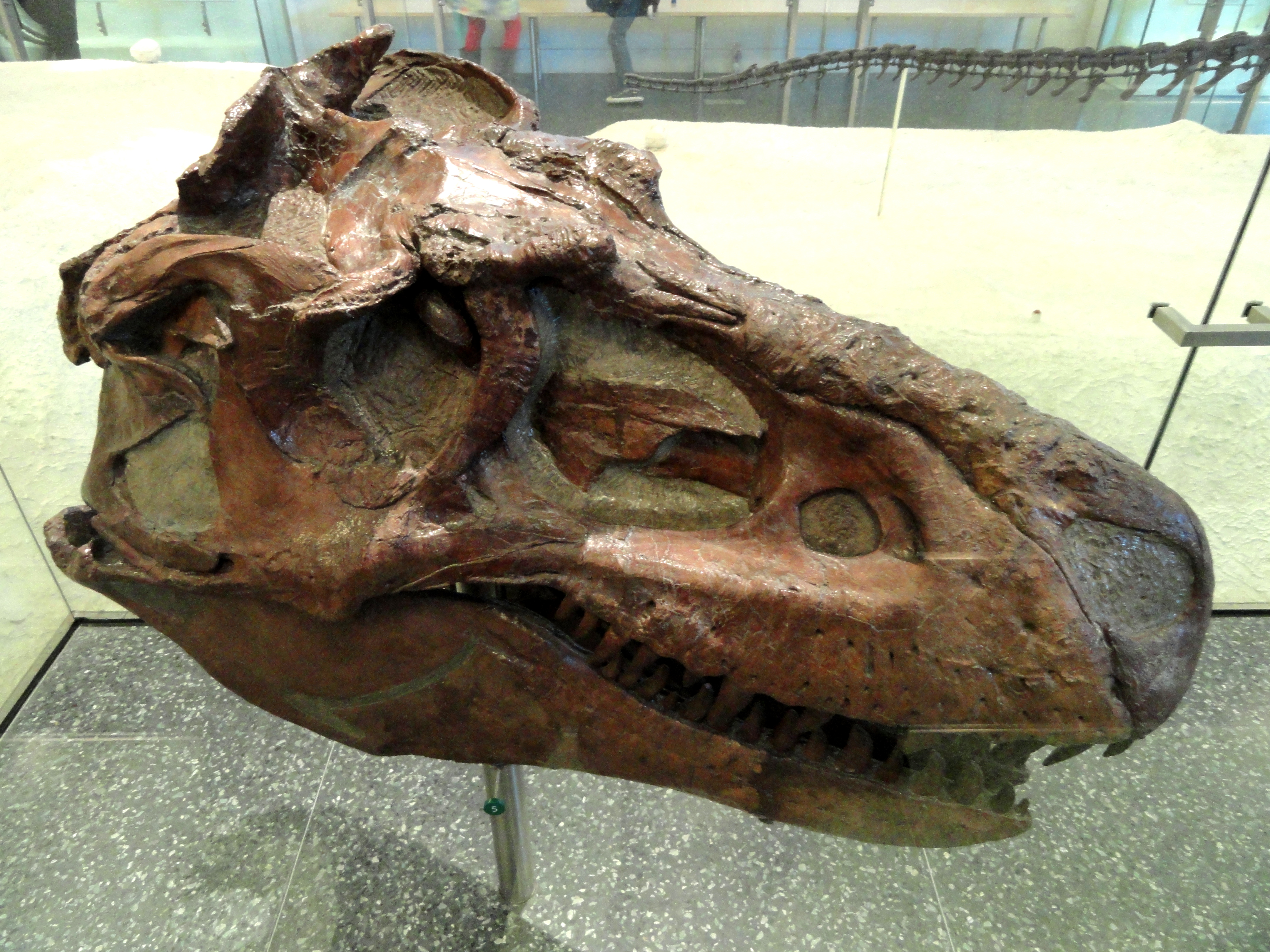
The adult skull was long and moderately deep, with roughened lacrimal bosses in front of the eyes, broad jaw-muscle attachment areas and thick, serrated teeth. Very short arms ended in two functional fingers, while the hind limbs and metatarsals were comparatively slender and elongate. Young animals had shallow skulls, narrow slicing teeth and especially gracile legs. Through growth, the snout deepened, jaw muscles enlarged, teeth became more robust and the body shifted from a lightly built runner toward a heavier predator capable of handling larger carcasses.
Evolutionary position
This simplified classification path shows one placement from Dinosauria to this species. Each step is clickable, and other analyses may support alternative relationships.
Open interactive positionScale
Simplified length comparison using preferred dataset estimates; body shape and posture are not represented.
Scientific record
Charles M. Sternberg discovered the nearly complete skeleton CMN 2120 beside Alberta's Red Deer River in 1913 while leading a Geological Survey of Canada field party. Lawrence Lambe named Gorgosaurus libratus in 1914 and published a detailed monograph in 1917. The specimen preserved a complete two-fingered hand, then a rare feature in the tyrannosaur record. American Museum of Natural History crews soon collected several additional skulls and skeletons from the same formation. Gorgosaurus was later merged with Albertosaurus for much of the twentieth century, but modern anatomical and growth studies generally recognise the two as separate genera.
Discovery credit: Charles M. Sternberg.
Naming authors: Lawrence M. Lambe.
Palaeoenvironment
The Dinosaur Park Formation records river channels, forested floodplains, ponds and coastal lowlands beside the Western Interior Seaway. Gorgosaurus shared the regional fauna with horned dinosaurs such as Centrosaurus and Chasmosaurus, hadrosaurs, armoured dinosaurs, smaller theropods and the more robust tyrannosaur Daspletosaurus. The formation accumulated over roughly a million and a half years, so its entire species list should not be treated as one frozen community.
A juvenile Gorgosaurus, TMP 2009.12.14, preserves hind limbs from two young Citipes in its abdominal cavity. Their different digestive states show that they were eaten in separate meals, providing direct evidence that a five-to-seven-year-old tyrannosaur selected small prey and swallowed choice body parts. Combined with the deepening skull and thickening teeth of adults, this supports a shift toward larger prey during growth. It does not establish pack hunting, a universal menu or whether the juvenile killed rather than scavenged every prey item.
Worth knowing
Fossil distribution
Red Deer River badlands, Alberta, Canada
Dinosaur Park Formation
regional marker
Markers are deliberately approximate. They identify published fossil areas without exposing sensitive excavation coordinates.
Open interactive mapFossil specimen record
Gatineau, Quebec, Canada
Research repository of the nearly complete original skeleton and skull that define Gorgosaurus libratus. The collections facility is not open to the public.
Drumheller, Alberta, Canada
A current public display of an exceptionally articulated juvenile skeleton. The museum identifies it as a rare specimen with the bones arranged as they were in life.
A research repository is not necessarily a public exhibit. Loan and display status can change, so check with the institution before visiting.
Media record
Evidence
Canadian Museum of Nature
Open sourceLawrence M. Lambe · The Ottawa Naturalist 28 · 1914
Open sourceLawrence M. Lambe · Geological Survey of Canada Memoir 100 · 1917
Open sourceThomas D. Carr · Journal of Vertebrate Paleontology 19(3) · 1999
Open sourceFrançois Therrien, Darla K. Zelenitsky, Kohei Tanaka and 3 coauthors · Science Advances 9(49) · 2023
Open sourceRoyal Tyrrell Museum
Open source