Wucaiwan fossil area
Junggar Basin, Xinjiang, China
Shishugou Formation
regional marker
Pronunciation: GWAN-long woo-TSY-eye
A small Late Jurassic tyrannosauroid from China with a tall, delicate crest extending along the middle of its snout and skull roof.
Last updated 23 July 2026
Field guide
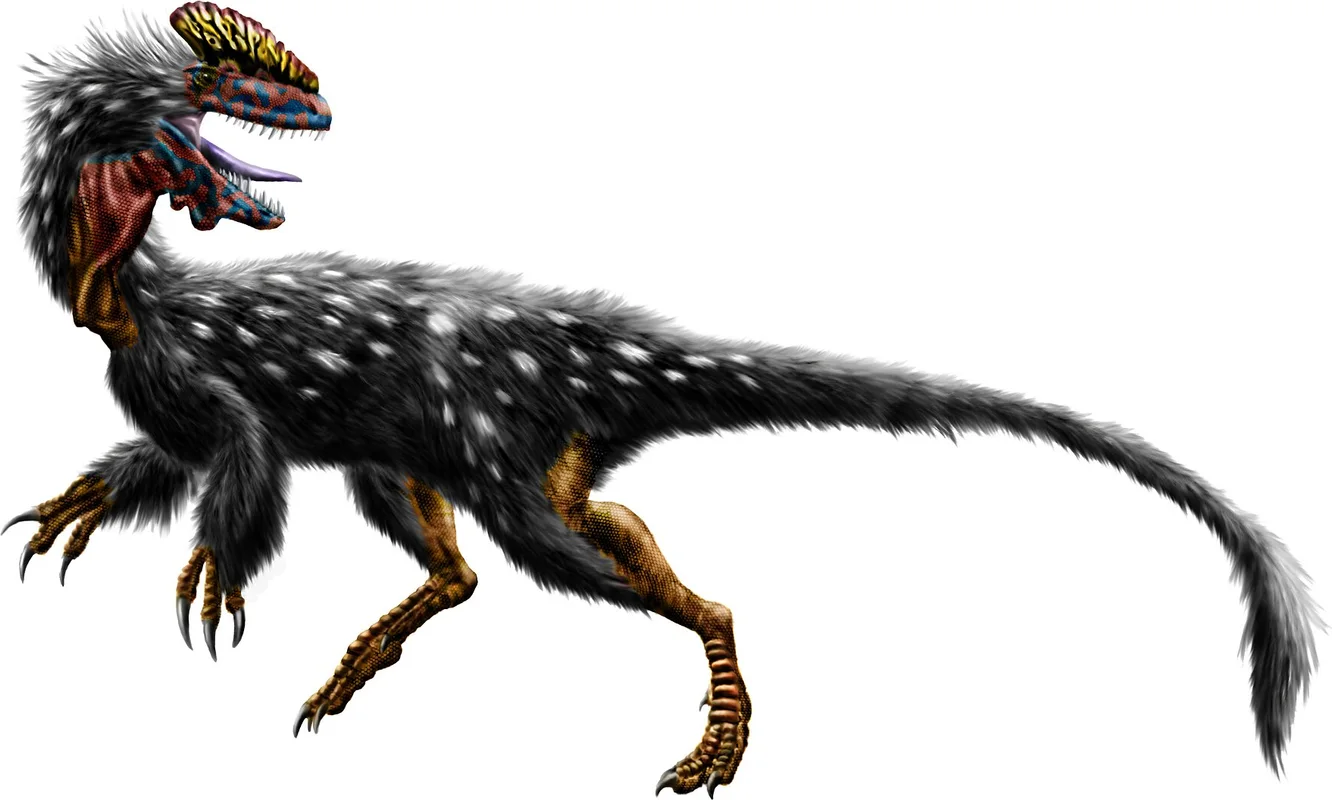
Guanlong wucaii was an early tyrannosauroid that lived roughly ninety million years before Tyrannosaurus. Two skeletons preserve both adult and juvenile anatomy, revealing a lightly built, long-armed predator unlike the massive, two-fingered tyrannosaurids of the Late Cretaceous. Its most conspicuous feature was a large, thin crest along the skull midline. The crest was poorly suited to resisting force and is therefore commonly interpreted as a visual display structure, although its colour and social meaning remain unknown.
Its fossils occur between approximately 161.2 and 159.7 million years ago. Values shown here are approximate and reflect the current curated seed dataset.
Form and function
Guanlong had a long, low skull armed with small serrated teeth and topped by a thin crest built mainly from the nasal bones. Large openings and delicate struts reduced the crest's mass. The adult had a proportionally larger, more elaborate crest than the juvenile. Its forelimbs remained long and ended in three functional fingers, while long hind limbs and a balancing tail supported bipedal locomotion. A coat of simple filamentous feathers is plausible from related tyrannosauroids but is not preserved with either Guanlong skeleton.
Evolutionary position
This simplified classification path shows one placement from Dinosauria to this species. Each step is clickable, and other analyses may support alternative relationships.
Open interactive positionScale
Simplified length comparison using preferred dataset estimates; body shape and posture are not represented.
Scientific record
A joint Institute of Vertebrate Paleontology and Paleoanthropology–George Washington University expedition recovered two individuals from the Shishugou Formation at Wucaiwan in 2002. Xu Xing and seven coauthors named them in Nature in 2006. The holotype IVPP V14531 is a partly articulated adult, while IVPP V14532 is a more complete juvenile. Guanlong means crowned dragon; wucaii refers to the multicoloured badlands of Wucaiwan rather than the dinosaur's colour.
Naming authors: Xu Xing, James M. Clark, Catherine A. Forster and 5 coauthors.
Palaeoenvironment
The upper Shishugou Formation at Wucaiwan records a seasonally dry landscape crossed by rivers and dotted with wetlands and volcanic deposits. Guanlong shared the region with sauropods, small ornithischians and other theropods. Some vertebrate skeletons accumulated in deep mud-filled depressions, but the two Guanlong individuals do not establish that the species hunted or lived socially.
Its teeth and agile theropod proportions identify Guanlong as a predator of comparatively small animals. The fragile cranial crest was probably more useful for visual signalling than combat, but no fossil reveals display posture, sex differences or crest colour. The adult and juvenile specimens provide growth information, not evidence of parental care or a family group.
Worth knowing
Fossil distribution
Junggar Basin, Xinjiang, China
Shishugou Formation
regional marker
Markers are deliberately approximate. They identify published fossil areas without exposing sensitive excavation coordinates.
Open interactive mapFossil specimen record
Beijing, China
Repository of the adult holotype and juvenile referred skeleton described in 2006. Continuous public exhibition is not confirmed.
A research repository is not necessarily a public exhibit. Loan and display status can change, so check with the institution before visiting.
Media record
Evidence
Xu Xing, James M. Clark, Catherine A. Forster and 5 coauthors · Nature 439, 715–718 · 2006
Open sourceOliver W. M. Rauhut, Angela C. Milner, Scott Moore-Fay · Zoological Journal of the Linnean Society 158(1), 155–195 · 2010
Open source