Ischigualasto Basin
San Juan Province, Argentina
Ischigualasto Formation
regional marker
Pronunciation: heh-RAIR-ah-SORE-us ish-ee-gwah-LAS-ten-sis
A large, lightly built Late Triassic predator from Argentina with a long low skull, serrated teeth, grasping three-clawed hands and a mixture of primitive and theropod-like skeletal features.
Last updated 13 July 2026
Field guide
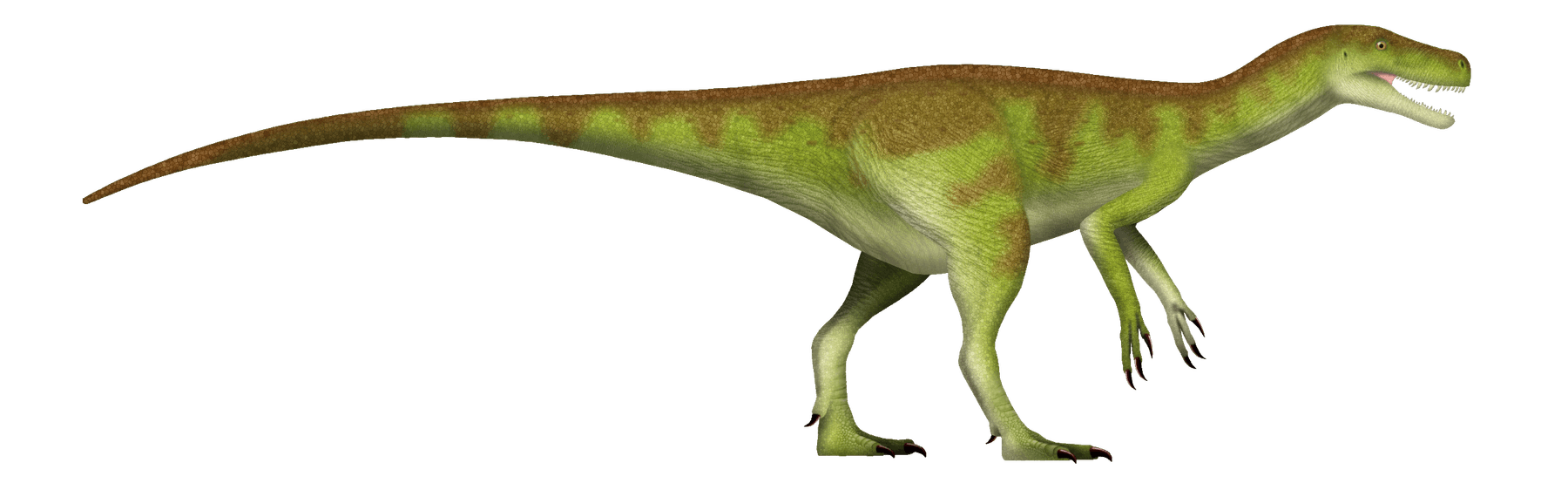
Herrerasaurus ischigualastensis was one of the largest dinosaurs in the earliest well-documented dinosaur communities. It lived on the seasonal floodplains of the Ischigualasto Formation when dinosaurs were still a minor part of the fauna. Although its overall silhouette resembles a later theropod, its skeleton combines predatory specializations with early saurischian features such as only two sacral vertebrae. Several associated skeletons make Herrerasaurus one of the anatomically best-known Late Triassic dinosaurs, but its exact position near the base of the dinosaur family tree remains sensitive to the characters and taxa used in each analysis.
Its fossils occur between approximately 231.4 and 228.9 million years ago. Values shown here are approximate and reflect the current curated seed dataset.
Form and function
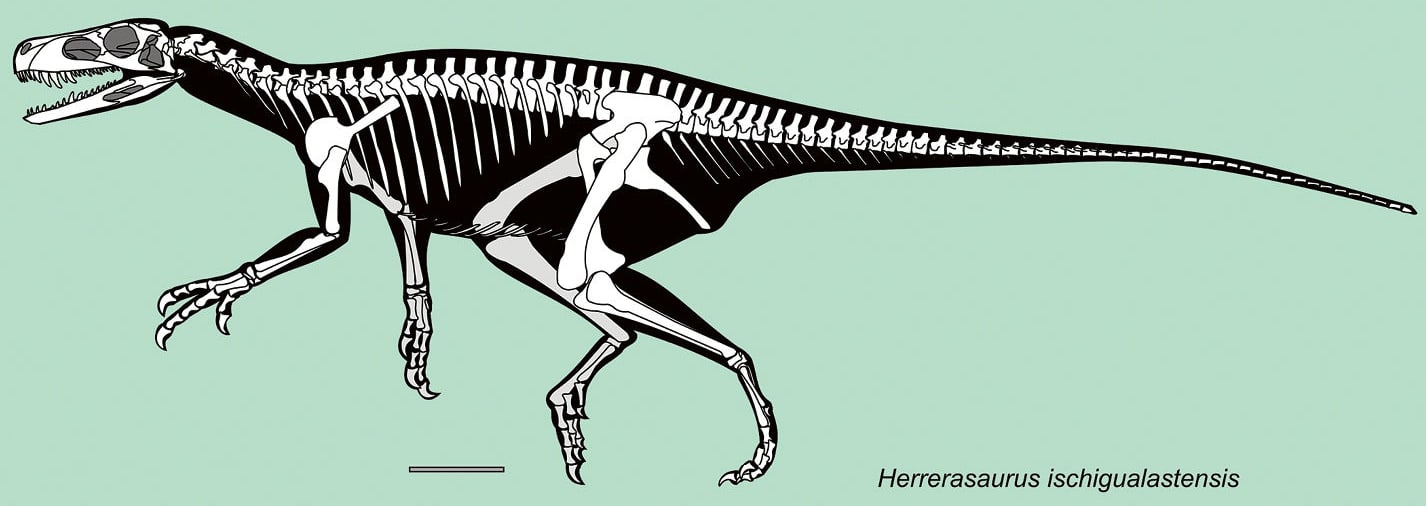
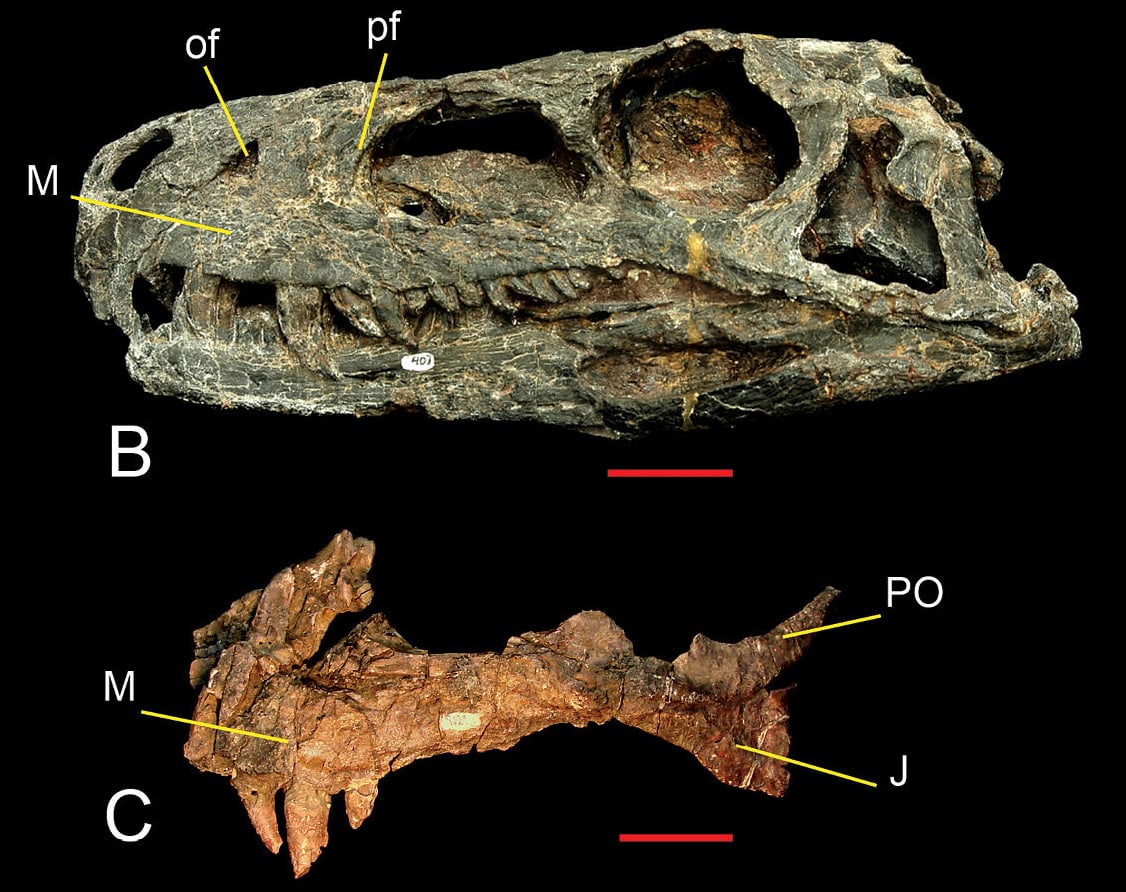
The skull was long, low and narrow, with large openings that reduced its weight and deep recesses for jaw-closing muscles. Recurved, finely serrated teeth and a mobile joint within the lower jaw formed an effective cutting apparatus. The forelimbs were shorter than the hind limbs but remained powerful: five manual digits were present, while the first three carried large curved claws and the outer two were reduced. Long hind limbs and three principal weight-bearing toes supported bipedal locomotion. A stiffened tail balanced the torso, and the pelvis retained only two sacral vertebrae despite a broadly dinosaurian open hip socket.
Evolutionary position
This simplified classification path shows one placement from Dinosauria to this species. Each step is clickable, and other analyses may support alternative relationships.
Open interactive positionScale
Simplified length comparison using preferred dataset estimates; body shape and posture are not represented.
Scientific record
Victorino Herrera collected the partial skeleton PVL 2566 in the Ischigualasto badlands in 1961. Osvaldo A. Reig named Herrerasaurus ischigualastensis in 1963, honouring Herrera and the fossil-bearing region. The holotype lacks a skull and much of the front half of the body, so the discovery of additional articulated skeletons transformed understanding of the animal. PVSJ 373 preserves much of the postcranial skeleton, while PVSJ 407 includes an exceptionally complete skull and skeleton described by Paul Sereno, Fernando Novas and colleagues in the early 1990s. Material originally named Ischisaurus and Frenguellisaurus was later interpreted as belonging to Herrerasaurus.
Discovery credit: Victorino Herrera.
Naming authors: Osvaldo A. Reig.
Palaeoenvironment
Herrerasaurus inhabited river channels and floodplains in an arid to semi-arid, strongly seasonal part of southwestern Pangaea. Droughts and episodic floods shaped the Ischigualasto ecosystem. Dinosaurs represented only a small fraction of the vertebrate assemblage; abundant neighbours included the beaked rhynchosaur Hyperodapedon, the cynodont Exaeretodon, armored aetosaurs and large crocodile-line predators such as Saurosuchus. Eoraptor and several other early dinosaurs shared the same formation.
Skull mechanics, serrated teeth and grasping hands identify Herrerasaurus as an active carnivore capable of securing and cutting relatively large prey. Its long hind limbs also indicate effective bipedal movement, although running speed cannot be calculated reliably from the skeleton alone. Bone microstructure published in 2024 records fast, sustained growth and shows that the sampled large individual was still growing when it died. No trackway, nest or mass association demonstrates coordinated pack hunting, territoriality or parental care.
Worth knowing
Fossil distribution
San Juan Province, Argentina
Ischigualasto Formation
regional marker
Markers are deliberately approximate. They identify published fossil areas without exposing sensitive excavation coordinates.
Open interactive mapFossil specimen record
San Miguel de Tucumán, Argentina
Research repository of partial original holotype PVL 2566, including vertebrae, most of the pelvis and much of a hind limb. The collection page confirms that the PVL vertebrate fossils belong to the Universidad Nacional de Tucumán; permanent public display of the holotype is not confirmed.
San Juan, Argentina
Repository of important original referred skeletons including the nearly complete PVSJ 407 and articulated PVSJ 373. These specimens supply much of the skull and postcranial anatomy absent from the holotype; the museum's public page does not guarantee that the originals are continuously exhibited.
A research repository is not necessarily a public exhibit. Loan and display status can change, so check with the institution before visiting.
Media record
Evidence
Osvaldo A. Reig · Ameghiniana · 1963
Paul C. Sereno, Fernando E. Novas · Science · 1992
Open sourceFernando E. Novas · Journal of Vertebrate Paleontology · 1994
Open sourcePaul C. Sereno, Fernando E. Novas · Journal of Vertebrate Paleontology · 1994
Open sourceOscar A. Alcober, Ricardo N. Martínez · ZooKeys · 2010
Open sourceSterling J. Nesbitt · Bulletin of the American Museum of Natural History · 2011
Open sourceAntonio Ballell, Michael J. Benton, Emily J. Rayfield · Science Advances · 2022
Open sourceKristina Curry Rogers, Ricardo N. Martínez, Carina Colombi and 2 coauthors · PLOS ONE · 2024
Open sourceFacultad de Ciencias Exactas, Físicas y Naturales, Universidad Nacional de San Juan
Open sourceFacultad de Ciencias Naturales e Instituto Miguel Lillo
Open sourceUNESCO World Heritage Centre
Open source