Voyizane–Tyinindini fossil region
Eastern Cape, South Africa
Upper Elliot Formation
regional marker
Pronunciation: HET-er-oh-DON-toh-SORE-us TUCK-eye
A small Early Jurassic ornithischian with a beak, grinding cheek teeth and prominent tusk-like caniniforms in the same jaws.
Last updated 23 July 2026
Field guide
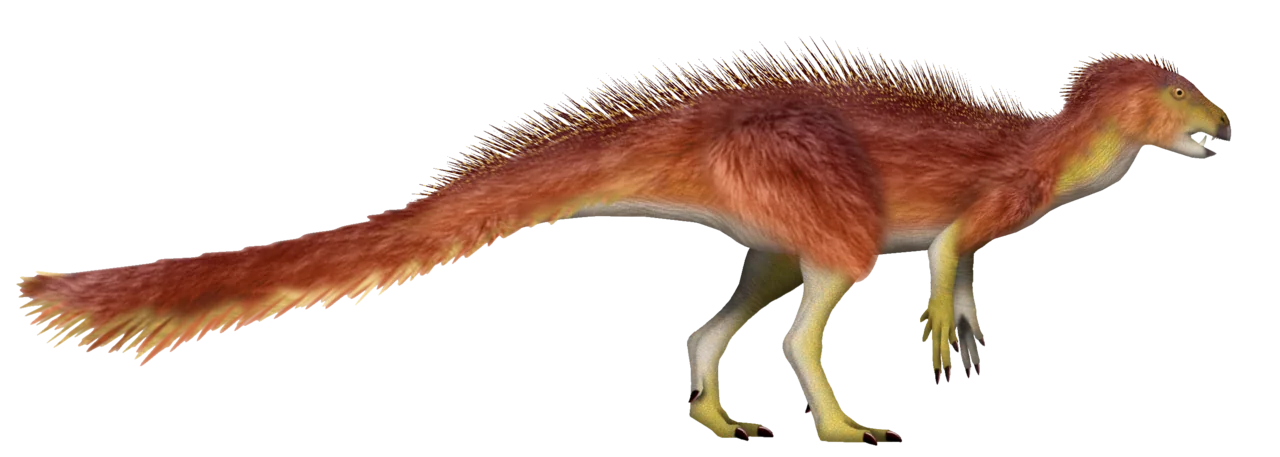
Heterodontosaurus tucki was a small, agile ornithischian from southern Africa. Its name refers to its strikingly differentiated dentition: a toothless beak at the jaw tip, enlarged tusk-like caniniform teeth and tightly packed cheek teeth with broad wear surfaces. A nearly complete skull and skeleton make it one of the best-known early ornithischians. The limbs show an animal primarily adapted for bipedal running but capable of using long, grasping hands. Bristle-like filaments are not preserved in Heterodontosaurus itself; they are commonly reconstructed from the related heterodontosaurid Tianyulong.
Its fossils occur between approximately 200.5 and 190.8 million years ago. Values shown here are approximate and reflect the current curated seed dataset.
Form and function
The short deep skull had a beak at the front, a gap in the tooth row, large upper and lower caniniforms, and tall cheek teeth that wore against one another. The jaw joint and tooth wear indicate sophisticated plant processing. Large eye sockets and a compact body accompanied long hind limbs. The forelimbs were relatively powerful, and the hand retained five digits: the inner three carried curved claws while the outer two were reduced. Fused lower-leg and ankle bones strengthened the hind limb.
Evolutionary position
This simplified classification path shows one placement from Dinosauria to this species. Each step is clickable, and other analyses may support alternative relationships.
Open interactive positionScale
Simplified length comparison using preferred dataset estimates; body shape and posture are not represented.
Scientific record
A British–South African expedition found the holotype skull SAM-PK-K337 near Tyinindini in 1961–1962. A. W. Crompton and Alan Charig named Heterodontosaurus tucki in Nature in 1962. A later expedition recovered the exceptionally complete skull and skeleton SAM-PK-K1332 near Voyizane; Albert Santa Luca, Crompton and Charig described its postcranial anatomy in 1976. The genus means different-toothed lizard, and the species honours George C. Tuck, whose company supported the original expedition.
Naming authors: A. W. Crompton, Alan J. Charig.
Palaeoenvironment
The upper Elliot and Clarens formations record river floodplains that became increasingly dry and dune-influenced during the Early Jurassic. Heterodontosaurus lived among early sauropodomorphs, crocodylomorph relatives, theropods and other small ornithischians. Seasonal conditions have sometimes been linked to speculative aestivation, but no Heterodontosaurus burrow or dormant individual is known.
Wear on the cheek teeth shows repeated processing of resistant vegetation. The caniniforms could have served in defence, display or competition and do not by themselves prove meat eating. Occasional animal food is possible for a small-bodied herbivore, but direct dietary evidence favours plant processing. Heterodontosaurus was primarily bipedal; its strong hands may have grasped vegetation or assisted during slow movement.
Worth knowing
Fossil distribution
Eastern Cape, South Africa
Upper Elliot Formation
regional marker
Markers are deliberately approximate. They identify published fossil areas without exposing sensitive excavation coordinates.
Open interactive mapFossil specimen record
Cape Town, South Africa
Iziko preserves the holotype skull SAM-PK-K337 and the exceptionally complete referred skeleton SAM-PK-K1332.
A research repository is not necessarily a public exhibit. Loan and display status can change, so check with the institution before visiting.
Media record
Evidence
A. W. Crompton, Alan J. Charig · Nature 196, 1074–1077 · 1962
Open sourceAlbert P. Santa Luca, A. W. Crompton, Alan J. Charig · Nature 264, 324–328 · 1976
Open sourcePaul C. Sereno · ZooKeys 226, 1–225 · 2012
Open sourceNatural History Museum, London
Open source