Cowleaze Chine fossil region
Southwest coast of the Isle of Wight, United Kingdom
Wessex Formation
regional marker
Pronunciation: hip-sih-LOF-oh-don FOX-ee-eye
A small, agile, ground-dwelling plant-eater from the Early Cretaceous Isle of Wight, known from numerous well-preserved skeletons.
Last updated 2 August 2026
Field guide
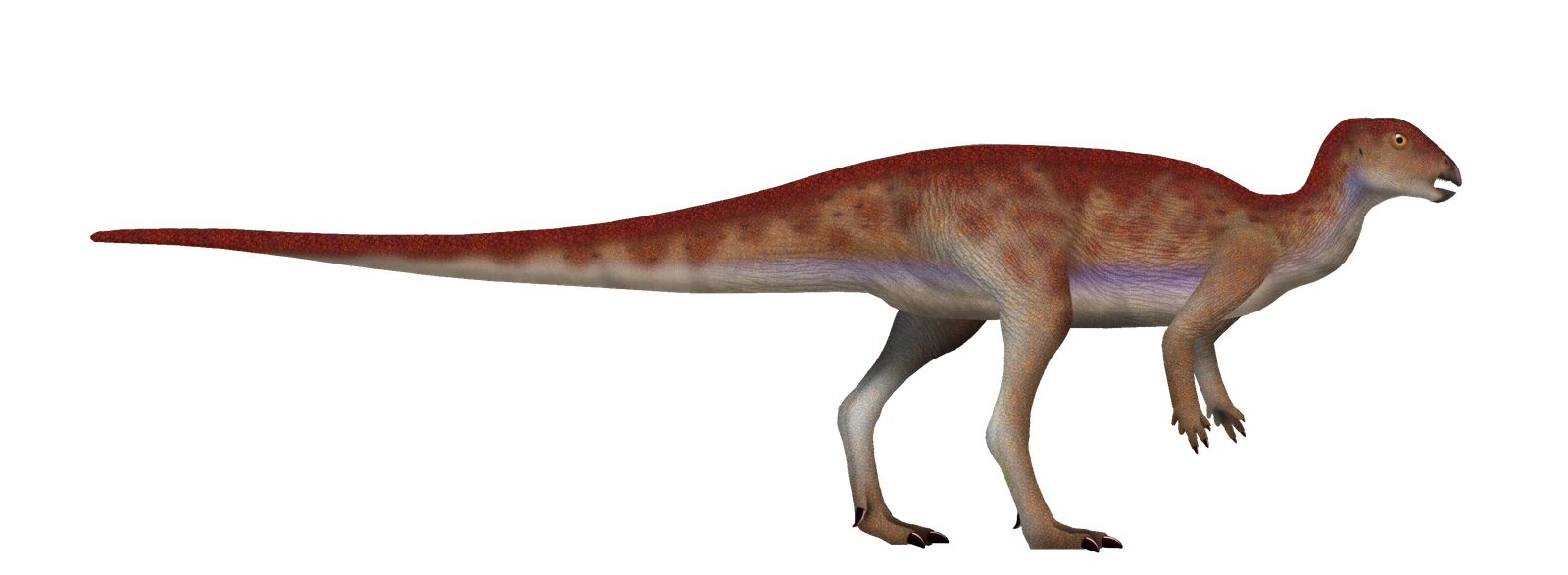
Hypsilophodon foxii was a small bipedal neornithischian from the Early Cretaceous Wessex Formation of the Isle of Wight. Numerous skeletons, including juveniles, make it one of the best-known small ornithischians. It had a lightly built body, long hind limbs, a stiff balancing tail, a horny beak and closely packed cheek teeth for slicing vegetation. Victorian anatomists once reconstructed it as an armoured tree climber, but later study showed that its first toe was not opposable and that supposed armour belonged to another reptile. Modern reconstructions therefore place Hypsilophodon on the ground as a fast-moving browser.
Its fossils occur between approximately 130 and 125 million years ago. Values shown here are approximate and reflect the current curated seed dataset.
Form and function
A short beak cropped plants, while teeth at the front of the upper jaw and ridged cheek teeth helped process food. The hands retained five fingers and could probably grasp, but the forelimbs were too short for normal four-legged walking. Long lower legs and feet supported efficient bipedal movement. Ossified tendons stiffened the back and tail. The first toe pointed forward rather than opposing the others, removing the anatomical basis for the old tree-climbing reconstruction.
Evolutionary position
This simplified classification path shows one placement from Dinosauria to this species. Each step is clickable, and other analyses may support alternative relationships.
Open interactive positionScale
Simplified length comparison using preferred dataset estimates; body shape and posture are not represented.
Scientific record
The first remains were unearthed on the Isle of Wight in 1849 and were initially mixed into the complicated history of Iguanodon. Reverend William Darwin Fox later obtained the distinctive skull that became the name-bearing specimen. Thomas Henry Huxley recognized a separate animal and named Hypsilophodon foxii in 1869; his formal paper appeared in 1870. Continued collecting around Cowleaze Chine produced many additional skeletons and allowed Peter Galton's detailed 1974 monograph to correct the long-lived tree-climbing interpretation.
Discovery credit: Reverend William Darwin Fox.
Naming authors: Thomas Henry Huxley.
Palaeoenvironment
Hypsilophodon lived on the warm, seasonally wet floodplains represented by the Wessex Formation. Rivers, ponds and forested areas supported ferns, horsetails, cycads and conifers. The same ecosystem included large herbivores such as Iguanodon and predators including Neovenator. Fossils are concentrated along the southwest Isle of Wight coast; the map point is a generalized fossil region rather than an exposed specimen coordinate.
Its light build, long legs and stiff tail support agile ground-based locomotion. The beak and cheek teeth indicate herbivory, although occasional consumption of other foods cannot be tested directly. Several individuals found in the same area have been taken as possible evidence of grouping, but accumulation by water or repeated use of a locality can produce similar patterns. There is no direct evidence that Hypsilophodon climbed trees, carried armour, or had a specific top speed.
Worth knowing
Fossil distribution
Southwest coast of the Isle of Wight, United Kingdom
Wessex Formation
regional marker
Markers are deliberately approximate. They identify published fossil areas without exposing sensitive excavation coordinates.
Open interactive mapFossil specimen record
London, United Kingdom
The museum cares for the name-bearing skull and extensive original Isle of Wight material, including a juvenile skeleton. Its gardens also feature a modern bronze skeletal reconstruction informed by current anatomy.
A research repository is not necessarily a public exhibit. Loan and display status can change, so check with the institution before visiting.
Media record
Evidence
Natural History Museum, London
Open sourceThomas Henry Huxley · Quarterly Journal of the Geological Society of London 26, 3-12 · 1870
Open sourcePeter M. Galton · Bulletin of the British Museum (Natural History), Geology 25(1), 1-152 · 1974
Open sourceNatural History Museum, London
Open source