Buxexé fossil region
Near Santana do Cariri, Ceará, Brazil
Lower Romualdo Formation
regional marker
Pronunciation: IR-rih-tay-tor chal-LEN-jur-eye
A Brazilian spinosaurid known from the most complete spinosaurid skull yet described, revealing a fast-closing bite and unusually mobile lower jaws.
Last updated 7 August 2026
Field guide
Irritator challengeri was a long-snouted spinosaurid from the Early Cretaceous Romualdo Formation of northeastern Brazil. Its single known specimen, SMNS 58022, preserves most of a skull and lower jaws, making it uniquely informative even though the front of the snout and the entire postcranial skeleton are absent. Modern CT scans exposed a nearly complete palate, braincase, replacement teeth and jaw joints hidden within the limestone. The resulting reconstruction suggests an inclined snout, a relatively weak but rapid bite and lower jaws able to spread slightly sideways as the mouth opened. These features fit a predator that could seize fish and other small vertebrates without showing that it ate fish exclusively.
Its fossils occur between approximately 113 and 110 million years ago. Values shown here are approximate and reflect the current curated seed dataset.
Form and function
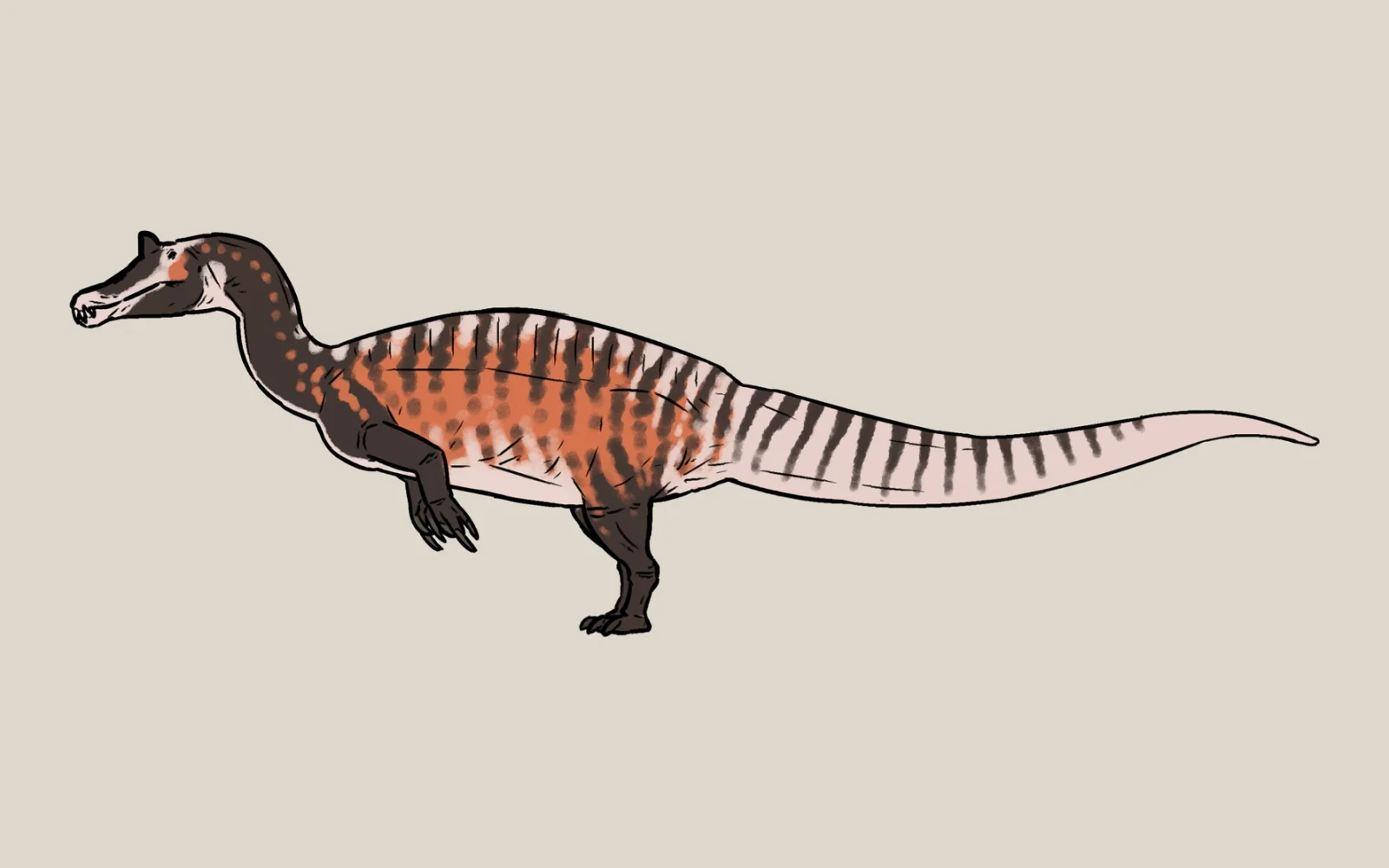
The skull was long, low and narrow, with the nostrils set back from the missing snout tip. Conical teeth lacked the broad blade-like form of many large theropods and were replaced continuously inside the jaws. A small crest ran along the skull roof. CT reconstruction showed a robust palate, a near-complete braincase and a distinctive retroarticular process behind each jaw joint. The lower jaws could rotate outward during opening, enlarging the throat entrance, while the jaw muscles favoured speed over an exceptionally powerful bite. The familiar sail, limbs and tail in life reconstructions are inferred from related spinosaurids because no bones behind the skull are known.
Evolutionary position
This simplified classification path shows one placement from Dinosauria to this species. Each step is clickable, and other analyses may support alternative relationships.
Open interactive positionScale
Simplified length comparison using preferred dataset estimates; body shape and posture are not represented.
Scientific record
The exact collection date and collector are not documented. The limestone nodule came from near Buxexé, close to Santana do Cariri in Ceará, and passed through the commercial fossil trade before the State Museum of Natural History Stuttgart bought it from a German dealer in 1991. Preparators discovered that missing parts of the snout had been extended with plaster and pieces of unrelated material. David Martill, Arthur Cruickshank, Eberhard Frey, Philip Small and Mark Clarke named Irritator challengeri in 1996. In April 2026, Brazil and Germany announced an agreement to return SMNS 58022 to Brazil, with the Plácido Cidade Nuvens Museum named as its intended repository; the transfer and public-display status still require confirmation.
Naming authors: David M. Martill, Arthur R. I. Cruickshank, Eberhard Frey and 2 coauthors.
Palaeoenvironment
Irritator lived around the Araripe Basin's coastal lagoons, rivers and wetlands during the late Aptian. The Romualdo Formation preserves fish, turtles, crocodile relatives and pterosaurs alongside terrestrial animals transported into the basin. Abundant aquatic prey and the animal's long, sensitive-looking jaws support frequent feeding near water, but the skull does not prove a wholly aquatic lifestyle. The map marker represents the broad Buxexé and Santana do Cariri fossil region rather than the lost collection point.
Conical teeth, a narrow snout and neuroanatomical comparisons support catching fish, while the spreading lower jaws may have helped accommodate slippery or bulky prey. Like other spinosaurs, Irritator could also have taken small terrestrial vertebrates and carrion. No limb bones, trackways, stomach contents or group assemblage are known, so swimming style, hunting posture, sociality and nesting behaviour remain unknown.
Worth knowing
Fossil distribution
Near Santana do Cariri, Ceará, Brazil
Lower Romualdo Formation
regional marker
Markers are deliberately approximate. They identify published fossil areas without exposing sensitive excavation coordinates.
Open interactive mapFossil specimen record
Santana do Cariri, Ceará, Brazil
Brazil and Germany announced in April 2026 that the original Irritator skull would return from Stuttgart and enter this museum's collection. The return was described as being in its final administrative and transport stages, so visitors should confirm that the transfer and any exhibition have been completed before travelling.
A research repository is not necessarily a public exhibit. Loan and display status can change, so check with the institution before visiting.
Media record
Evidence
Marco Schade, Oliver W. M. Rauhut, Christian Foth and 2 coauthors · Palaeontologia Electronica 26(2):a17 · 2023
Open sourceMarco Schade, Oliver W. M. Rauhut, Serjoscha W. Evers · Scientific Reports 10, 9259 · 2020
Open sourceNatural History Museum, London
Open sourceGovernment of the State of Ceará · 2026
Open source