Changma type locality
Changma Basin, Gansu Province, China
Xiagou Formation
approximate site marker
Pronunciation: jee-AHN chang-mah-EN-sis
A newly named microraptorine from northwestern China, represented by one articulated shoulder and forelimb from fossil beds otherwise famous for early birds.
Last updated 23 July 2026
Field guide
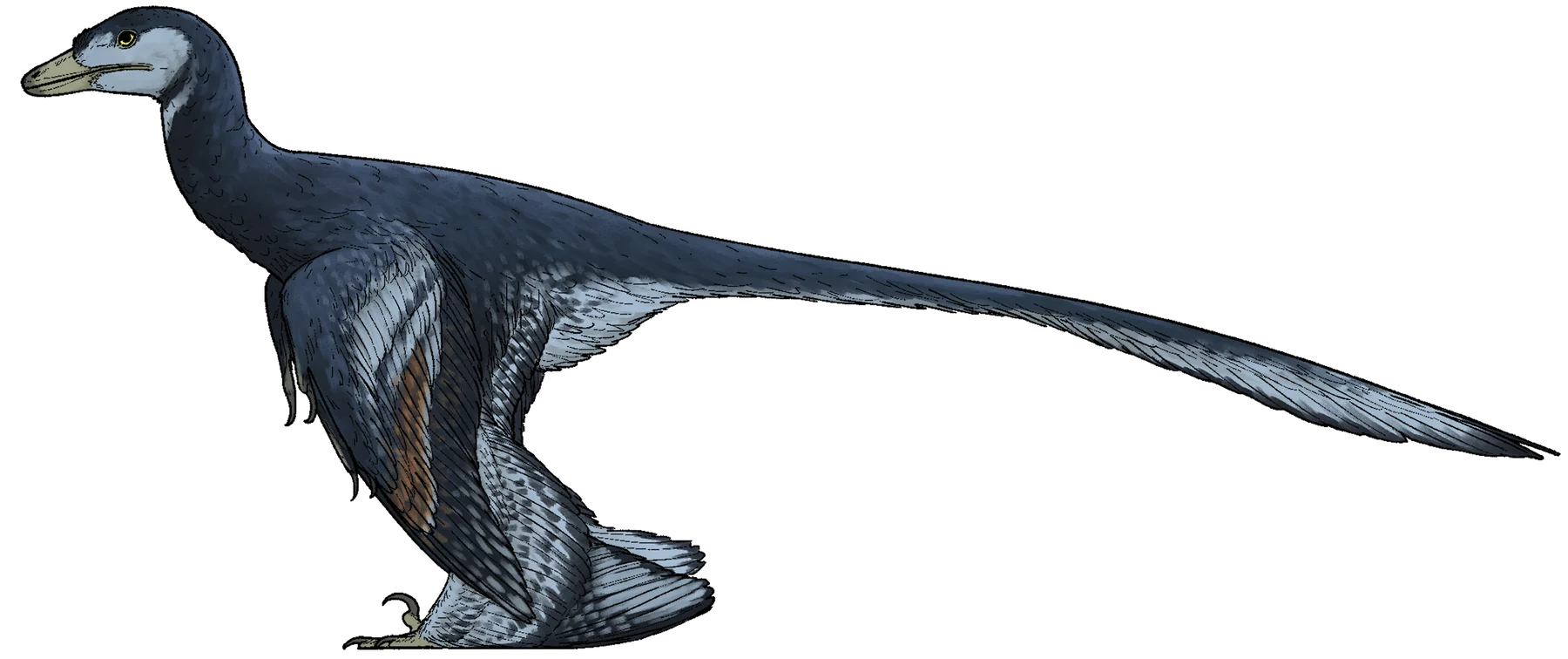
Jian changmaensis was a feathered dromaeosaurid closely related to Microraptor. Its only known specimen is incomplete but unusually informative: a three-dimensionally preserved left shoulder and forelimb with a unique combination of proportions and openings in the bones. Jian is the first non-avian dinosaur body fossil described from the bird-rich Xiagou Formation near Changma. The animal was probably similar to other four-winged microraptorines, but feathers, hind limbs, skull and tail are not preserved in the holotype.
Its fossils occur between approximately 124 and 120 million years ago. Values shown here are approximate and reflect the current curated seed dataset.
Form and function
Holotype GSGM-D050 contains a complete fused scapulocoracoid, humerus, radius and ulna. It is intermediate in skeletal dimensions between adult Microraptor and Sinornithosaurus. A proportionally long coracoid, cranially developed distal humeral condyles and a large foramen on the proximal radius diagnose the species. Fusion and bone-surface development indicate a mature or nearly mature individual.
Evolutionary position
This simplified classification path shows one placement from Dinosauria to this species. Each step is clickable, and other analyses may support alternative relationships.
Open interactive positionScientific record
The specimen was collected near Changma village in Gansu Province and was first mentioned in a 2010 conference abstract. Ling-Qi Zhou, Matthew Lamanna, Ashley Poust, Da-Qing Li, Hai-Lu You and Jingmai O'Connor formally named it on 4 June 2026. Jian refers to a one-winged bird in Chinese mythology, matching both the animal's bird-like affinities and the single preserved forelimb; changmaensis honours the type locality.
Naming authors: Ling-Qi Zhou, Matthew C. Lamanna, Ashley W. Poust and 3 coauthors.
Palaeoenvironment
The lower Aptian Xiagou Formation at Changma records a lake setting about 124–120 million years ago. More than one hundred partial bird skeletons, many with soft tissues, have been recovered from the same deposits. Jian is currently the only described non-avian dinosaur body fossil from this locality, although footprints document other dinosaurs in the wider formation.
Long arm and hind-limb feathers and gliding are inferred from close microraptorine relatives, not preserved on GSGM-D050. Jian was carnivorous and large enough to have taken the small birds abundant at Changma, making it a plausible producer of crushed bird-bone pellets from the site. That ecological link remains a hypothesis: no pellet contains a Jian tooth and no gut contents preserve a bird meal.
Worth knowing
Fossil distribution
Changma Basin, Gansu Province, China
Xiagou Formation
approximate site marker
Markers are deliberately approximate. They identify published fossil areas without exposing sensitive excavation coordinates.
Open interactive mapFossil specimen record
Lanzhou, China
Repository of the articulated left shoulder and forelimb. The paper confirms its catalogue and institutional home; current public display is not established.
A research repository is not necessarily a public exhibit. Loan and display status can change, so check with the institution before visiting.
Media record
Evidence
Ling-Qi Zhou, Matthew C. Lamanna, Ashley W. Poust and 3 coauthors · Annals of Carnegie Museum 92(2) · 2026
Open sourceField Museum · 2026
Open source