Tendaguru fossil region
Lindi Region, Tanzania
Tendaguru Formation
regional marker
Pronunciation: KEN-troh-SORE-us ee-thee-OH-pih-kus
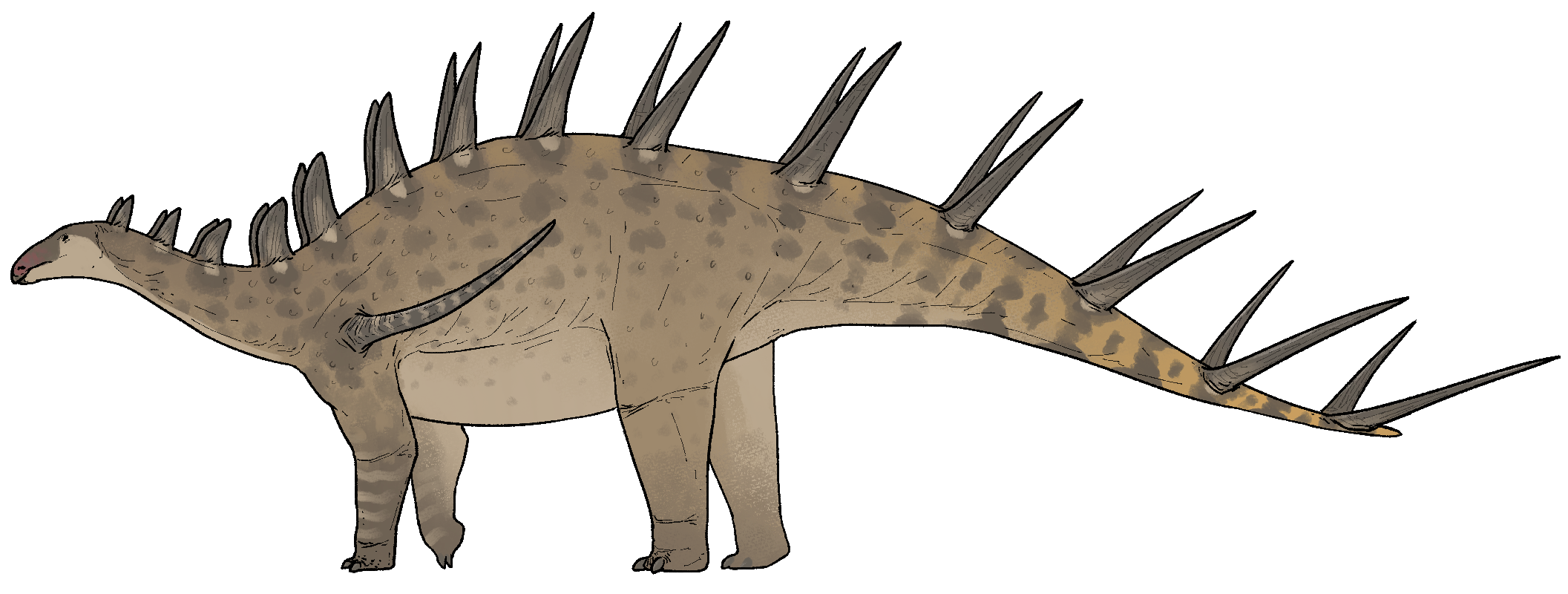
A compact Tanzanian stegosaur with plates over the front half of its back and increasingly long defensive spikes toward the hips and tail.
Last updated 16 July 2026
Field guide
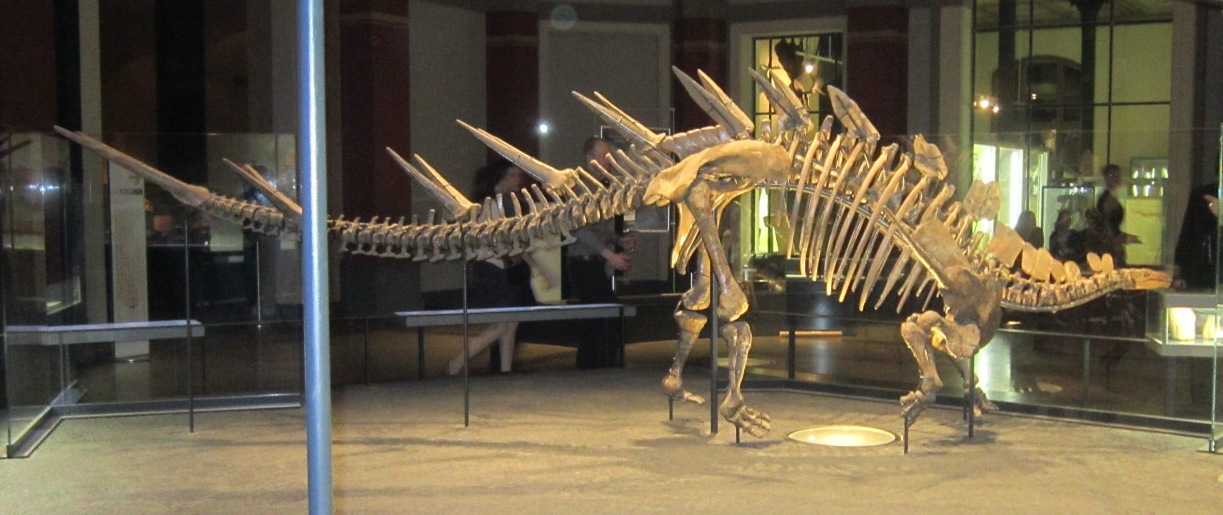
Kentrosaurus aethiopicus was a small, heavily armed stegosaur from the Tendaguru Formation of Tanzania. Low plates lined the neck and front of the back, while paired spikes became progressively longer over the hips and tail. Numerous partial skeletons collectively reveal most of the animal, but the famous Berlin mount is a composite assembled from several individuals. Kentrosaurus was excavated during Germany's colonial rule in East Africa; the scientific history must therefore acknowledge both the Tanzanian fossil heritage and the largely under-recorded local labour that made the expedition possible.
Its fossils occur between approximately 152 and 149 million years ago. Values shown here are approximate and reflect the current curated seed dataset.
Form and function
The head was small and low, ending in a toothless beak with simple leaf-shaped teeth farther back. Forelimbs were shorter than the hind limbs, producing a back that rose toward the hips. Paired plates protected or displayed the neck and trunk; long spikes projected from the rear body and tail, and an especially long pair is commonly reconstructed beside the shoulders. The tail base had powerful muscles and the distal tail remained flexible enough to sweep its spikes through a broad defensive arc.
Evolutionary position
This simplified classification path shows one placement from Dinosauria to this species. Each step is clickable, and other analyses may support alternative relationships.
Open interactive positionScale
Simplified length comparison using preferred dataset estimates; body shape and posture are not represented.
Scientific record
The German Tendaguru Expedition recovered Kentrosaurus material from several quarries between 1909 and 1912 in what was then colonial German East Africa. Werner Janensch recognised stegosaur bones in 1910, and Edwin Hennig named Kentrosaurus aethiopicus in 1915 without choosing one holotype from the multi-individual material. Hennig's later work established the partial Kindope skeleton MB.R.4800.1-37 as lectotype. Heinrich Mallison clarified that designation in 2011 after conflicting type claims had entered the literature. Bombing during the Second World War destroyed or dispersed some Tendaguru fossils, while substantial original material survives in Berlin and Tübingen.
Discovery credit: Tanzanian Tendaguru excavation workers, German Tendaguru Expedition, Werner Janensch.
Naming authors: Edwin Hennig.
Palaeoenvironment
The Tendaguru Formation records coastal plains, river channels, lagoons and seasonally dry landscapes close to the Late Jurassic Indian Ocean. Kentrosaurus shared the regional record with Giraffatitan, Dicraeosaurus, Dysalotosaurus and several theropods. Fossils occur in different members and quarries spanning time and habitat, so the complete Tendaguru list should not be treated as one simultaneous community.
Kentrosaurus cropped low vegetation with its beak and small cheek teeth, relying on a large gut for fermentation. Biomechanical models show that its muscular, mobile tail could bring the long spikes rapidly against an attacker, making defence a plausible function. Plates and spikes may also have contributed to display or species recognition. Differences in thigh-bone proportions have been proposed as evidence of two sexes, but sex cannot be verified independently from the bones and the interpretation remains debated.
Worth knowing
Fossil distribution
Lindi Region, Tanzania
Tendaguru Formation
regional marker
Markers are deliberately approximate. They identify published fossil areas without exposing sensitive excavation coordinates.
Open interactive mapFossil specimen record
Berlin, Germany
Current public mount combining 218 bones from several Tendaguru individuals, including material from partial lectotype MB.R.4800.1-37 and reconstructed elements. It must not be interpreted as one articulated skeleton.
A research repository is not necessarily a public exhibit. Loan and display status can change, so check with the institution before visiting.
Media record
Evidence
Edwin Hennig · Sitzungsberichte der Gesellschaft Naturforschender Freunde zu Berlin · 1915
Heinrich Mallison · Neues Jahrbuch für Geologie und Paläontologie - Abhandlungen 259(2) · 2011
Open sourceMuseum für Naturkunde Berlin
Open source