Bayshin Tsav fossil region
Southeastern Gobi Desert, Mongolia
Bayanshiree Formation
regional marker
Pronunciation: khan-KHOO-loo mon-go-lee-EN-sis
A medium-sized Mongolian tyrannosauroid that documents the gracile body plan near the evolutionary origin of the giant, deep-skulled tyrannosaurids.
Last updated 16 July 2026
Field guide
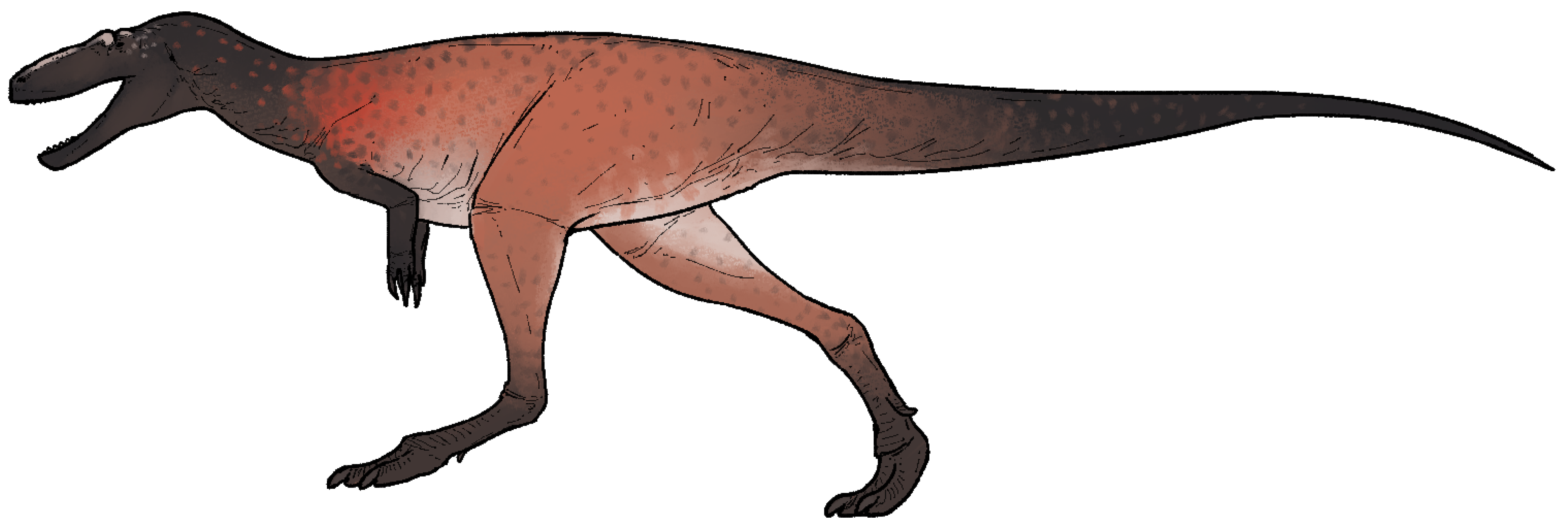
Khankhuuluu mongoliensis is a roughly four-metre tyrannosauroid from the Bayanshiree Formation. Fossils collected in the 1970s were long assigned to Alectrosaurus, but renewed preparation and comparison revealed a distinct animal. Its shallow skull, relatively long forelimb and lightly built skeleton retain the gracile proportions of earlier tyrannosauroids, while details of the snout and skull roof anticipate features emphasized in later eutyrannosaurs. The describing analysis placed it immediately outside Eutyrannosauria, making it a close evolutionary branch near their origin rather than a demonstrated direct ancestor.
Its fossils occur between approximately 95.9 and 89.6 million years ago. Values shown here are approximate and reflect the current curated seed dataset.
Form and function
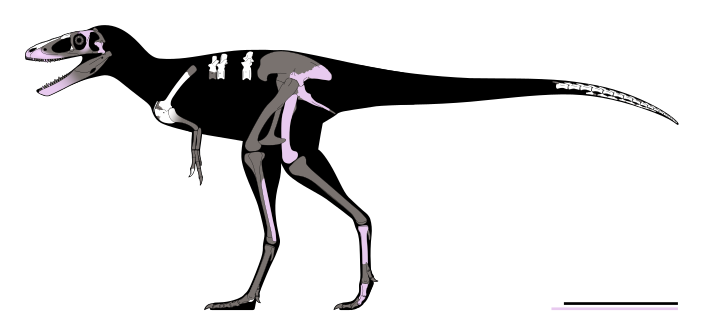
Three partial specimens collectively preserve much of the skull and skeleton, although no individual is complete and several bones reported historically can no longer be located. The skull was long and low with a rounded eye opening, blade-like teeth and modest rugosities rather than the massive, deep profile of Tyrannosaurus. The body was slender, the forelimbs remained proportionally longer, and the hind limbs were built for bipedal movement. Bone fusion and surface texture show that the best material represents a mature animal rather than a juvenile giant tyrannosaur.
Evolutionary position
This simplified classification path shows one placement from Dinosauria to this species. Each step is clickable, and other analyses may support alternative relationships.
Open interactive positionScale
Simplified length comparison using preferred dataset estimates; body shape and posture are not represented.
Scientific record
Mongolian palaeontologist Altangerel Perle collected the fossils during 1972-1973 fieldwork at Bayshin Tsav and referred them to Alectrosaurus in 1977. Study of the Ulaanbaatar collections beginning in 2023 led Jared Voris and seven colleagues to name Khankhuuluu mongoliensis in June 2025. The name combines Mongolian khankhuu, prince, with luu, dragon, while mongoliensis honours Mongolia. The specimens remain in the Institute of Paleontology of the Mongolian Academy of Sciences.
Discovery credit: Altangerel Perle, Mongolian field team.
Naming authors: Jared T. Voris, Darla K. Zelenitsky, Yoshitsugu Kobayashi and 5 coauthors.
Palaeoenvironment
The Bayanshiree Formation records river channels, floodplains and seasonally dry landscapes in the eastern Gobi. Herbivorous therizinosaurs, hadrosauroids and armoured dinosaurs occupied the same broad formation, alongside other predatory theropods. These fossils accumulated across different sites and intervals, so a formation-level species list is not evidence of one living community at one moment.
Serrated teeth and tyrannosauroid jaw anatomy identify Khankhuuluu as a carnivore. Its lighter skull and body imply a feeding and locomotor system unlike the bone-crushing giant tyrannosaurids, but prey preference and running performance have not been measured directly. No stomach contents, trackway, nest or multi-individual association establishes hunting style or social behaviour.
Worth knowing
Fossil distribution
Southeastern Gobi Desert, Mongolia
Bayanshiree Formation
regional marker
Markers are deliberately approximate. They identify published fossil areas without exposing sensitive excavation coordinates.
Open interactive mapFossil specimen record
Ulaanbaatar, Mongolia
Permanent research repository of the holotype and referred partial skeletons. Repository status is verified; continuous public display is not confirmed.
A research repository is not necessarily a public exhibit. Loan and display status can change, so check with the institution before visiting.
Media record
Evidence
Jared T. Voris, Darla K. Zelenitsky, Yoshitsugu Kobayashi and 5 coauthors · Nature 642 · 2025
Open sourceHokkaido University · 2025
Open source