Dinosaur Provincial Park fossil region
Alberta, Canada
Dinosaur Park Formation
regional marker
Pronunciation: LAM-bee-oh-SORE-us LAM-bye
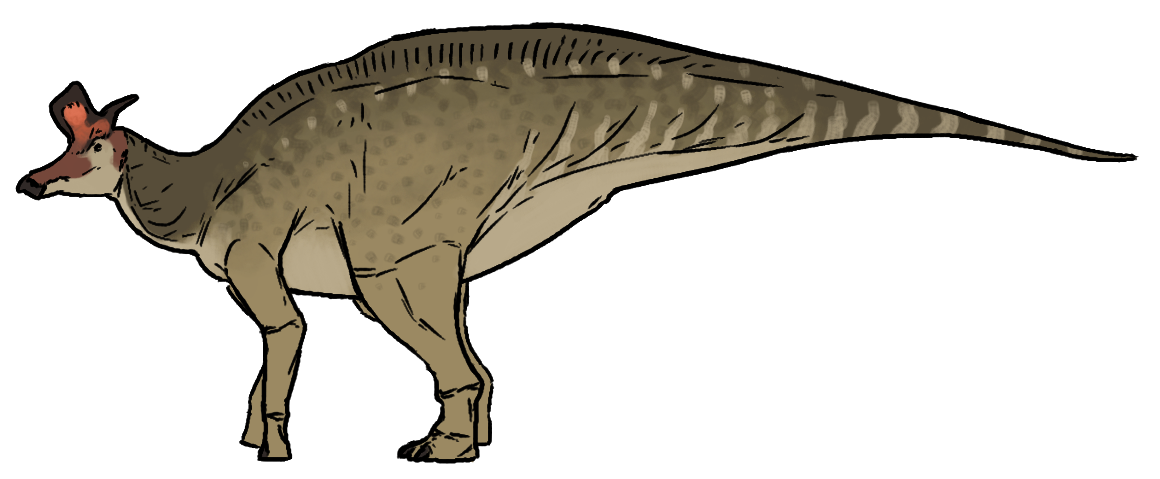
A large Canadian duck-billed dinosaur with a distinctive hollow hatchet-shaped crest containing an intricate looping airway.
Last updated 16 July 2026
Field guide
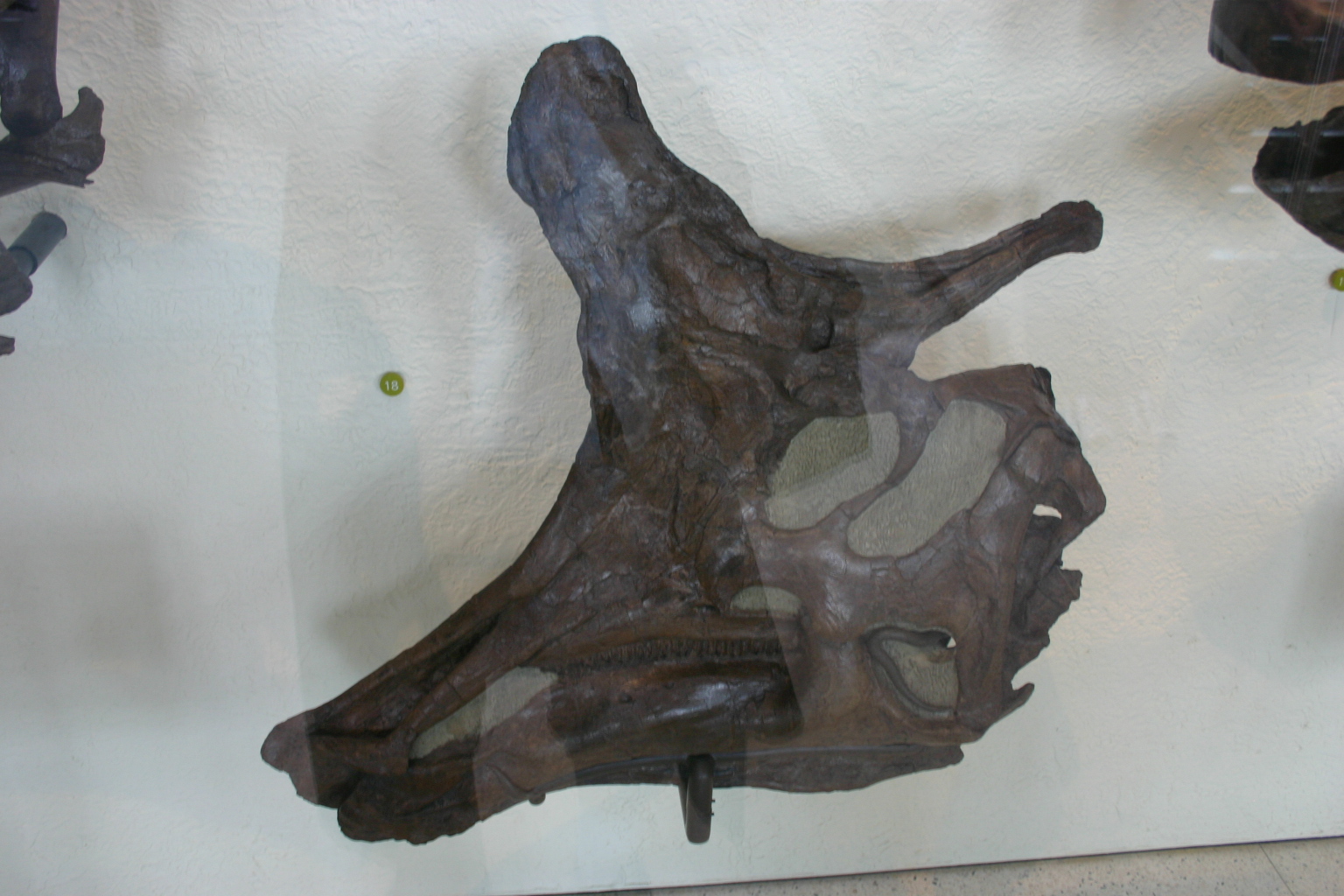
Lambeosaurus lambei was a large plant-eating hadrosaur from Alberta's Dinosaur Park Formation. Its hatchet-shaped crest is built mainly from expanded nasal and premaxillary bones and encloses long, looping air passages. The crest changed dramatically as the animal grew, so small skulls once received separate genus and species names before growth studies united them. The airway could have modified sound and the conspicuous external shape almost certainly carried visual information, but fossils cannot recover a particular call or assign every crest form to a biological sex.
Its fossils occur between approximately 76.5 and 75 million years ago. Values shown here are approximate and reflect the current curated seed dataset.
Form and function
The hollow crest rose above the skull and projected backward, with a forward-pointing bony prong that helped produce the familiar hatchet profile. Air entering the nostrils travelled through convoluted passages inside it before reaching the throat. A broad toothless beak cropped vegetation while stacked dental batteries sliced and ground it. Strong forelimbs supported quadrupedal walking, longer hind limbs allowed bipedal movement, and calcified tendons stiffened the back and tail. Adult crest anatomy was much more elaborate than the low, simple crest of juveniles.
Evolutionary position
This simplified classification path shows one placement from Dinosauria to this species. Each step is clickable, and other analyses may support alternative relationships.
Open interactive positionScale
Simplified length comparison using preferred dataset estimates; body shape and posture are not represented.
Scientific record
Sternberg family expeditions for the Geological Survey of Canada recovered important crested hadrosaur skulls along Alberta's Red Deer River in the 1910s. Lawrence Lambe initially referred them to Stephanosaurus, a name based on much less informative material. William A. Parks created Lambeosaurus lambei in 1923 to honour Lambe, who had died in 1919. Charles Gilmore's 1924 redescription selected the well-preserved skull CMN 2869 as the type and clarified why it could not be securely joined to the original Stephanosaurus bones. Later growth studies showed that several smaller named forms were juvenile lambeosaurines rather than distinct adults.
Discovery credit: Sternberg family field crews, Geological Survey of Canada.
Naming authors: William A. Parks.
Palaeoenvironment
The Dinosaur Park Formation preserves river channels, coastal floodplains, ponds and forested lowlands near the western shore of the Western Interior Seaway. Conifers, flowering plants, ferns and horsetails provided varied browse. Lambeosaurus shared the regional fauna with other hadrosaurs, horned and armoured dinosaurs, small theropods and tyrannosaurids, but the formation's fossil assemblage spans many habitats and hundreds of thousands of years.
Dental batteries and microwear identify Lambeosaurus as a plant eater capable of processing fibrous vegetation. Physical models and airway reconstructions show that the crest could resonate, while its species-specific external shape and growth strongly support a display role. Those findings do not reveal an exact pitch, a spoken language or whether one crest shape belonged to males and another to females. Bonebeds suggest aggregation among hadrosaurs generally, but individual social systems remain uncertain.
Worth knowing
Fossil distribution
Alberta, Canada
Dinosaur Park Formation
regional marker
Markers are deliberately approximate. They identify published fossil areas without exposing sensitive excavation coordinates.
Open interactive mapFossil specimen record
Gatineau, Quebec, Canada
Research repository of the well-preserved original skull and right lower jaw selected as the type of Lambeosaurus lambei. The Natural Heritage Campus collections facility is not open to the public, so this entry does not imply current exhibition.
A research repository is not necessarily a public exhibit. Loan and display status can change, so check with the institution before visiting.
Media record
Evidence
Canadian Museum of Nature
Open sourceWilliam A. Parks · University of Toronto Studies, Geological Series 15 · 1923
Charles W. Gilmore · Canada Department of Mines, Geological Survey Bulletin 43 · 1924
David C. Evans, Robert Ridgely, Lawrence M. Witmer · The Anatomical Record 292 · 2009
Open source