Dinosaur Cove fossil area
Cape Otway coast, Victoria, Australia
Eumeralla Formation
regional marker
Pronunciation: lee-EL-in-ah-SORE-ah ah-mee-kah-GRAF-ih-kah
A small Early Cretaceous ornithischian from polar southeastern Australia, securely known from limited skull material at Dinosaur Cove.
Last updated 23 July 2026
Field guide
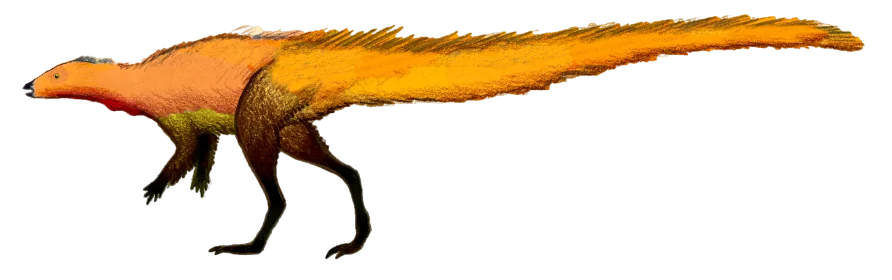
Leaellynasaura amicagraphica was a small plant-eating dinosaur from the Eumeralla Formation of Victoria, which lay within the Antarctic Circle during the Early Cretaceous. Its secure remains are much less complete than many popular reconstructions imply: the name is based on a toothed upper-jaw bone, with closely associated skull-roof and braincase material. Numerous postcranial bones from Dinosaur Cove were historically referred to the species, producing the familiar reconstruction with an exceptionally long tail, but later taphonomic work showed that several animals were mixed at the locality and many of those assignments cannot be demonstrated.
Its fossils occur between approximately 108 and 105 million years ago. Values shown here are approximate and reflect the current curated seed dataset.
Form and function
The holotype is a left maxilla bearing small leaf-shaped cheek teeth suitable for cutting vegetation. A nearby skull roof and natural brain endocast preserve large orbital regions, although claims that enlarged eyes were a special adaptation to polar darkness remain uncertain. Traditionally referred limb and tail bones suggest a lightly built biped with long hind limbs and a very elongated balancing tail, but these postcranial proportions cannot presently be assigned to Leaellynasaura with confidence. No skin or feather-like covering is directly preserved.
Evolutionary position
This simplified classification path shows one placement from Dinosauria to this species. Each step is clickable, and other analyses may support alternative relationships.
Open interactive positionScale
Simplified length comparison using preferred dataset estimates; body shape and posture are not represented.
Scientific record
Volunteer Michelle Colwell found the key fossil in 1987 during a dig led by Thomas Rich and Patricia Vickers-Rich at Dinosaur Cove on the Cape Otway coast. Rich and Vickers-Rich named Leaellynasaura amicagraphica in 1989. The genus honours their daughter Leaellyn, while the species name recognized the Friends of the Museum of Victoria and National Geographic Society. Museums Victoria preserves the holotype maxilla NMV P185991 and associated skull material. A 2016 reappraisal clarified that the fossil bed contains disarticulated remains from multiple small ornithischians.
Discovery credit: Michelle Colwell.
Naming authors: Thomas H. Rich, Patricia Vickers-Rich.
Palaeoenvironment
Dinosaur Cove lay at a high southern palaeolatitude within the Antarctic Circle. The Eumeralla Formation preserves cool-temperate river floodplains with conifers, ferns and other vegetation. Seasonal light varied strongly, but the climate supported diverse dinosaurs, small mammals, turtles, lungfish and other vertebrates. Winter darkness does not imply a permanently frozen landscape.
The cheek teeth indicate herbivory, and a small bipedal body would have allowed agile movement through floodplain vegetation. Seasonal darkness inspired hypotheses about enhanced vision, migration and winter survival, but none is established by direct evidence. No nest, trackway or monospecific bonebed demonstrates herding or parental care. The long-tail balance and display ideas often attached to the animal depend on postcranial fossils whose identity is disputed.
Worth knowing
Fossil distribution
Cape Otway coast, Victoria, Australia
Eumeralla Formation
regional marker
Markers are deliberately approximate. They identify published fossil areas without exposing sensitive excavation coordinates.
Open interactive mapFossil specimen record
Melbourne, Australia
The collection preserves holotype maxilla NMV P185991 and skull-roof and braincase specimen NMV P185990; the catalogued research material is not currently listed as on display.
A research repository is not necessarily a public exhibit. Loan and display status can change, so check with the institution before visiting.
Media record
Evidence
Thomas H. Rich, Patricia Vickers-Rich · National Geographic Research 5(1), 15–53 · 1989
Matthew C. Herne, Alan M. Tait, Steven W. Salisbury · New Mexico Museum of Natural History and Science Bulletin 71, 121–147 · 2016
Open sourceMuseums Victoria Collections
Open sourceAustralian Museum
Open source