Willow Creek Anticline nesting region
Teton County, Montana, United States
Two Medicine Formation
regional marker
Pronunciation: MY-ah-SORE-ah peeb-ul-ZOR-um
A large Montana hadrosaur famous for colonial nesting grounds containing eggs, embryos and young of many ages, providing landmark evidence for prolonged dinosaur nest care.
Last updated 16 July 2026
Field guide
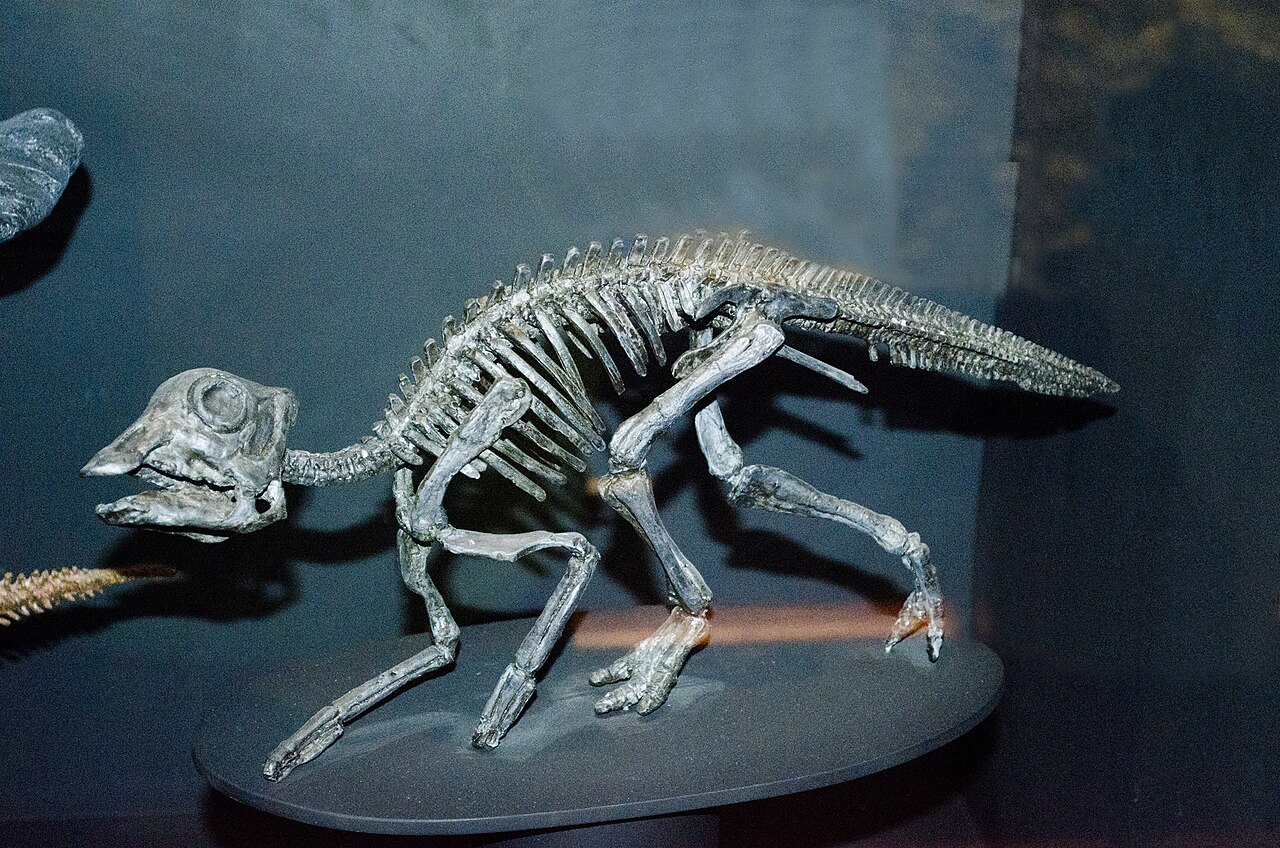
Maiasaura peeblesorum is known from an extraordinary growth series rather than one isolated skeleton. Eggs, embryos, nestlings, juveniles and adults from Montana's Two Medicine Formation allow researchers to follow major changes from hatching to maturity. Closely spaced nests and bonebeds show repeated use of favourable nesting landscapes by many animals. Hatchlings remained in nests while their limb bones were still poorly developed, supporting prolonged attendance or provisioning by adults. The fossils do not preserve an adult actually feeding a chick, so the celebrated good-mother interpretation is strong behavioural evidence rather than a literal snapshot.
Its fossils occur between approximately 76.7 and 74 million years ago. Values shown here are approximate and reflect the current curated seed dataset.
Form and function
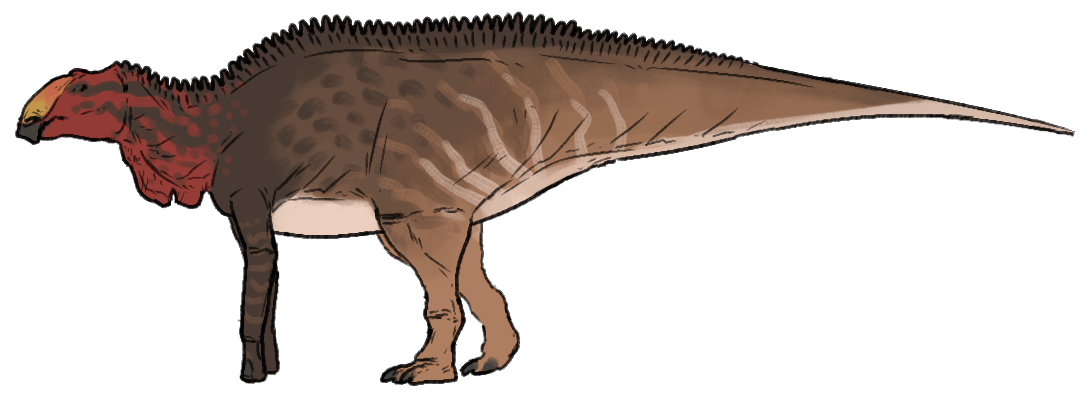
Maiasaura had a broad toothless beak at the front of the jaws and dense dental batteries farther back for slicing and grinding plants. Unlike hollow-crested lambeosaurines, it had a low solid ridge above the eyes. Robust forelimbs could support the body during quadrupedal walking, while longer hind limbs and a stiffened tail also permitted bipedal movement, especially in smaller individuals. Growth-series bones show major changes in limb proportions and tissue as young animals developed into adults approaching nine metres long.
Evolutionary position
This simplified classification path shows one placement from Dinosauria to this species. Each step is clickable, and other analyses may support alternative relationships.
Open interactive positionScale
Simplified length comparison using preferred dataset estimates; body shape and posture are not represented.
Scientific record
In 1978, fossil collector Marion Brandvold showed John Horner and Robert Makela tiny hadrosaur bones from the Willow Creek Anticline near Choteau, Montana. Fieldwork revealed nests, eggs and juveniles at what became famous as the Egg Mountain region. Horner and Makela named Maiasaura peeblesorum in Nature in 1979. The genus name used the feminine Greek form saura, 'lizard', to express 'good mother lizard'; the species honours the Peebles family, on whose land important fossils were found. Continued Museum of the Rockies work uncovered colonies and bonebeds representing hundreds of individuals.
Discovery credit: Marion Brandvold, John R. Horner, Robert Makela.
Naming authors: John R. Horner, Robert Makela.
Palaeoenvironment
Maiasaura lived on seasonal uplands east of the rising Rocky Mountains. The Two Medicine Formation records river channels, floodplains, volcanic ash falls and a climate with pronounced wet and dry seasons. Conifers and flowering plants supplied browse. Ceratopsians, armoured dinosaurs, small theropods and the tyrannosaurid Daspletosaurus inhabited the broader formation, although they were not all preserved in the same moment or exact locality.
Nests occurred in colonies, and some nesting horizons were reused, indicating that many Maiasaura gathered at suitable breeding grounds. Very young animals had immature limb joints and worn nest floors, implying that they remained in the nest for a period after hatching. Plant fragments reported inside nests may represent food brought by adults, but direct feeding and the identity or sex of carers are not preserved. Large bonebeds indicate group living or at least mass aggregation; they do not by themselves reveal a permanent herd structure.
Worth knowing
Fossil distribution
Teton County, Montana, United States
Two Medicine Formation
regional marker
Markers are deliberately approximate. They identify published fossil areas without exposing sensitive excavation coordinates.
Open interactive mapFossil specimen record
Bozeman, Montana, United States
The current Siebel Dinosaur Complex includes a roughly nine-metre mounted Maiasaura tending a nest and interprets the museum's extensive Montana nesting and growth-series research. Individual pieces in the mount may include casts or reconstruction; it should not be read as one complete original skeleton.
A research repository is not necessarily a public exhibit. Loan and display status can change, so check with the institution before visiting.
Media record
Evidence
John R. Horner, Robert Makela · Nature 282 · 1979
Open sourceMuseum of the Rockies
Open source