Berivotra Study Area
Mahajanga Basin, northwestern Madagascar, Madagascar
Maevarano Formation
regional marker
Pronunciation: mah-JUNG-gah-SORE-us kren-ah-TISS-ih-mus
A short-skulled Madagascan abelisaurid known from multiple skulls and skeletons, including bones bearing feeding marks made by its own species.
Last updated 23 July 2026
Field guide
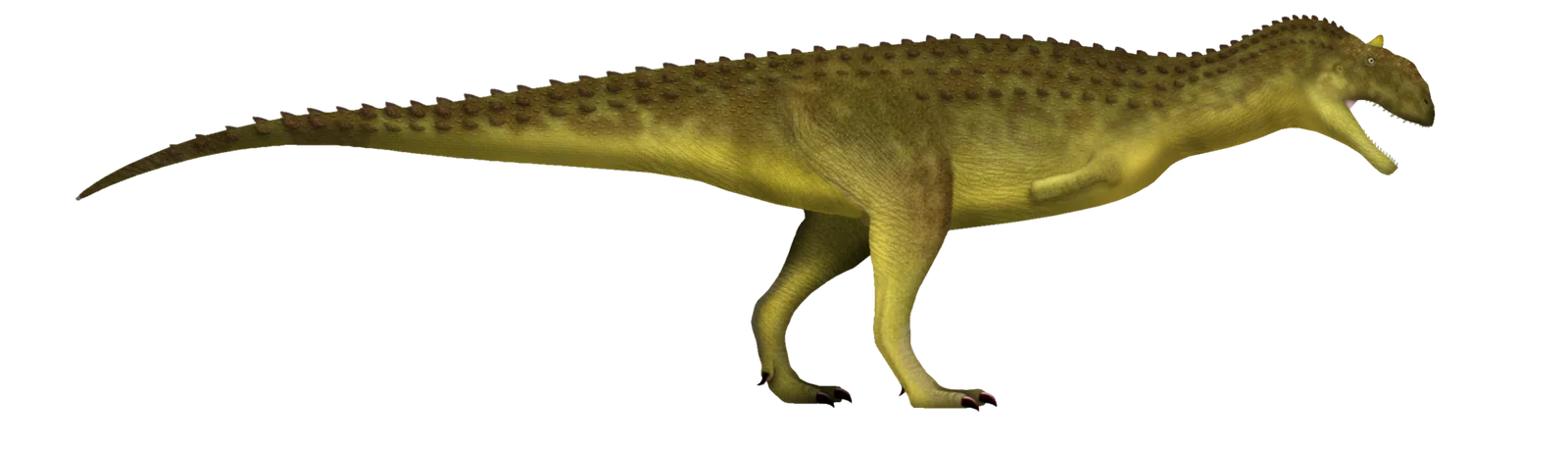
Majungasaurus crenatissimus was the dominant large theropod in the latest Cretaceous Maevarano ecosystem of northwestern Madagascar. An unusually rich sample of skulls and skeletons makes it one of the best-known abelisaurids. Its head was short, deep and broad, with a thickened nasal region, rough facial bone and a low dome-like horn on top of the skull. The neck and hind limbs were powerful, but the forelimbs were drastically reduced. Tooth marks matching Majungasaurus teeth occur on bones of both sauropods and other Majungasaurus individuals, providing direct evidence that at least some members of the species fed on conspecific carcasses.
Its fossils occur between approximately 70 and 66 million years ago. Values shown here are approximate and reflect the current curated seed dataset.
Form and function
The skull was proportionally short and deep, with fused thickened nasals, a broad rear surface for strong neck muscles and a single rounded frontal dome rather than paired brow horns. Short-crowned serrated teeth lined jaws capable of some movement between their constituent bones. The face carried heavily textured bone associated with a tough external covering. Robust neck vertebrae and ribs reinforced the head-neck system. Like other abelisaurids, Majungasaurus had extremely short forelimbs with four reduced digits, while a deep pelvis, muscular tail and stout hind limbs supported bipedal movement.
Evolutionary position
This simplified classification path shows one placement from Dinosauria to this species. Each step is clickable, and other analyses may support alternative relationships.
Open interactive positionScale
Simplified length comparison using preferred dataset estimates; body shape and posture are not represented.
Scientific record
Charles Depéret named isolated teeth from the Mahajanga region Megalosaurus crenatissimus in 1896. René Lavocat erected Majungasaurus in 1955 for additional material, but a domed skull roof was later named Majungatholus atopus and interpreted as a pachycephalosaur. Mahajanga Basin Project expeditions beginning in the 1990s recovered abundant associated remains, including excellent skulls and a nearly complete skeleton. The comprehensive 2007 monograph showed that the dome belonged to the same abelisaurid and restored Majungasaurus crenatissimus as the valid name.
Naming authors: Charles Depéret.
Palaeoenvironment
The Maevarano Formation records seasonally dry river channels and floodplains crossed by episodes of drought and intense flooding. Majungasaurus shared this environment with the titanosaurian sauropods Rapetosaurus and Vahiny, the small theropod Masiakasaurus, giant and small crocodyliforms, turtles, snakes, mammals and the enormous frog Beelzebufo. Madagascar had already been geographically isolated, helping produce a distinctive endemic fauna.
Serrated tooth marks on sauropod bones document carcass feeding, while matching marks on Majungasaurus bones establish conspecific feeding. The evidence cannot distinguish active predation from scavenging or show how frequently cannibalism occurred. Its reinforced skull and neck may have supported a bite-and-hold feeding style, but that remains a biomechanical hypothesis. No trackway or associated group demonstrates pack hunting, and the function of the cranial dome is unknown.
Worth knowing
Fossil distribution
Mahajanga Basin, northwestern Madagascar, Madagascar
Maevarano Formation
regional marker
Markers are deliberately approximate. They identify published fossil areas without exposing sensitive excavation coordinates.
Open interactive mapFossil specimen record
Antananarivo, Madagascar
The university repository preserves original Mahajanga Basin Project material catalogued with UA specimen numbers.
Chicago, United States
Field Museum research collections include original specimens such as the virtually complete skull FMNH PR 2100 and the associated skeleton FMNH PR 2836.
A research repository is not necessarily a public exhibit. Loan and display status can change, so check with the institution before visiting.
Media record
Evidence
David W. Krause, Scott D. Sampson, Matthew T. Carrano, Patrick M. O'Connor · Journal of Vertebrate Paleontology 27, Supplement 2, Memoir 8, 1–20 · 2007
Open sourceScott D. Sampson, Lawrence M. Witmer · Journal of Vertebrate Paleontology 27, Supplement 2, Memoir 8, 32–104 · 2007
Open sourceRaymond R. Rogers, David W. Krause, Kristina Curry Rogers · Nature 422, 515–518 · 2003
Open source