Cañadón del Gato bonebed region
Neuquén Province, Argentina
Huincul Formation
regional marker
Pronunciation: MAP-oo-SORE-us ROH-see-eye
A giant Patagonian carcharodontosaurid represented by a remarkable bonebed containing several individuals of different sizes.
Last updated 26 July 2026
Field guide
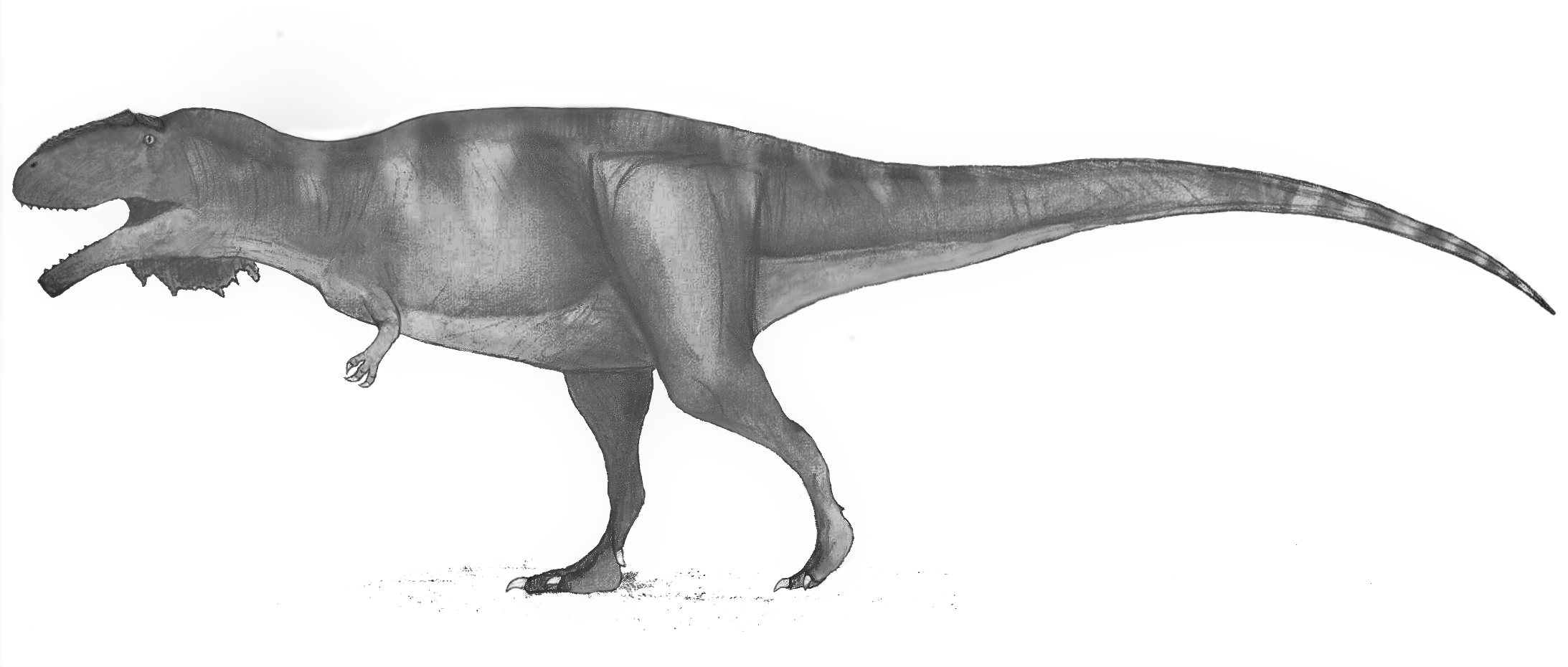
Mapusaurus roseae was one of the largest predatory dinosaurs of South America. Hundreds of disarticulated bones from a single Huincul Formation bonebed represent at least seven individuals, from juveniles to very large adults. Although no complete skeleton is known, their combined remains reveal a deep, narrow skull, blade-like teeth and the long-legged body plan of a giant carcharodontosaurid closely related to Giganotosaurus.
Its fossils occur between approximately 97 and 93.5 million years ago. Values shown here are approximate and reflect the current curated seed dataset.
Form and function
Mapusaurus had a relatively low, narrow skull with heavily textured facial bones and laterally compressed, serrated teeth suited to slicing flesh. The arms were short, while the pelvis and hind limbs were built to support a multi-tonne biped. Its vertebrae contained air spaces that reduced skeletal weight. The known bones come from multiple animals and must be combined cautiously when reconstructing an adult.
Evolutionary position
This simplified classification path shows one placement from Dinosauria to this species. Each step is clickable, and other analyses may support alternative relationships.
Open interactive positionScale
Simplified length comparison using preferred dataset estimates; body shape and posture are not represented.
Scientific record
The Argentine–Canadian Dinosaur Project excavated the Cañadón del Gato bonebed in Neuquén Province between 1997 and 2001. Rodolfo Coria and Philip Currie named Mapusaurus roseae in 2006. The holotype is an isolated right nasal, MCF-PVPH-108.1, accompanied by hundreds of referred bones. Mapu means land or earth in Mapudungun; roseae refers both to the rose-coloured rocks and Rose Letwin, a supporter of the project.
Discovery credit: Argentine–Canadian Dinosaur Project field team.
Naming authors: Rodolfo A. Coria, Philip J. Currie.
Palaeoenvironment
The Huincul Formation preserves river channels, floodplains and seasonally dry woodland in Cretaceous Patagonia. Mapusaurus shared this ecosystem with the enormous sauropod Argentinosaurus and a diverse community of smaller dinosaurs, crocodyliforms and other vertebrates.
The accumulation of several Mapusaurus individuals in one bonebed is unusual, but it does not by itself prove coordinated pack hunting. A drought, flood, predator trap or repeated use of the site could also have produced the assemblage. Its blade-like teeth identify it as a large-prey carnivore, while specific hunting tactics remain unknown.
Worth knowing
Fossil distribution
Neuquén Province, Argentina
Huincul Formation
regional marker
Markers are deliberately approximate. They identify published fossil areas without exposing sensitive excavation coordinates.
Open interactive mapFossil specimen record
Plaza Huincul, Argentina
The museum repository houses the holotype and referred material from the Cañadón del Gato bonebed.
A research repository is not necessarily a public exhibit. Loan and display status can change, so check with the institution before visiting.
Media record
Evidence
Rodolfo A. Coria, Philip J. Currie · Geodiversitas 28(1), 71–118 · 2006
Open sourceNatural History Museum, London
Open source