Dapingfang type region
Chaoyang County, Liaoning Province, China
Jiufotang Formation
regional marker
Pronunciation: MY-kroh-RAP-tor goo-eye
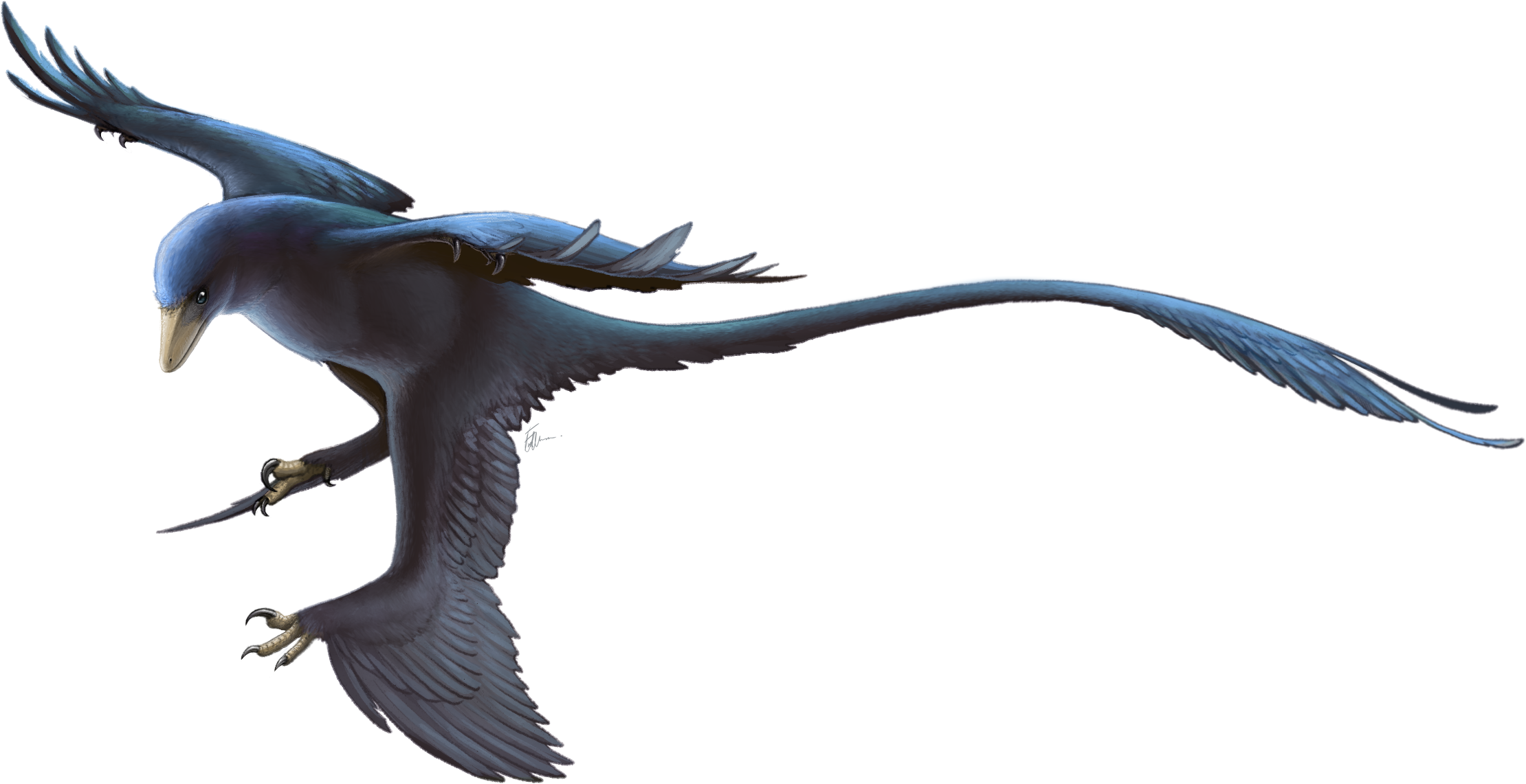
A crow-sized dromaeosaur with long flight feathers on all four limbs, a feathered tail fan and direct fossil evidence for glossy iridescent plumage.
Last updated 16 July 2026
Field guide
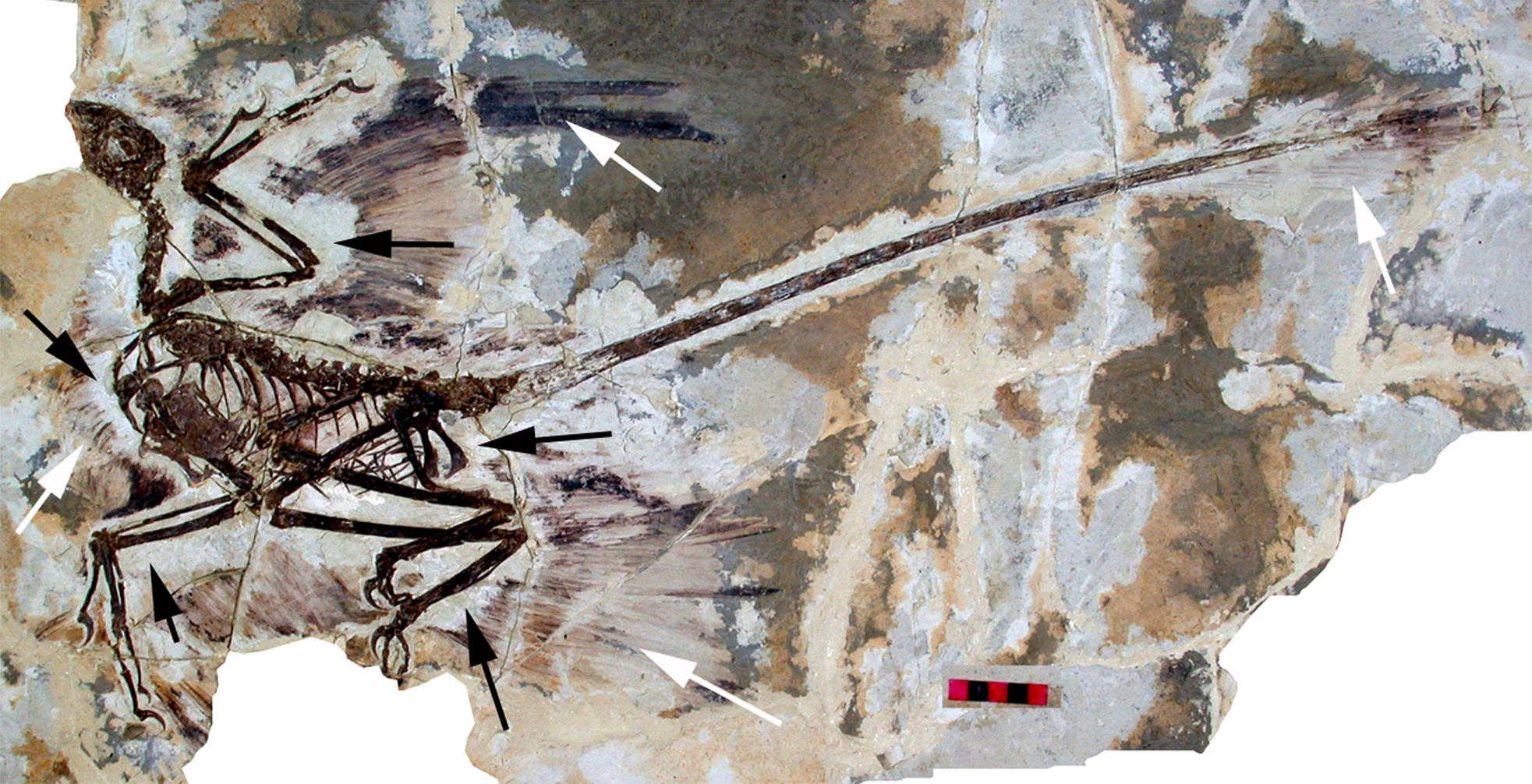
Microraptor gui was a tiny feathered dromaeosaur from the Early Cretaceous forests of northeastern China. Exceptionally preserved fossils show not only a complete body covering but long, asymmetrical flight feathers attached to both the arms and legs. This four-winged arrangement made Microraptor central to debates about how aerial locomotion evolved near the origin of birds. Aerodynamic studies agree that its feathers could generate lift, although proposed launch styles, leg positions and the balance between gliding and powered flapping differ. Microscopic structures in a separate Microraptor specimen indicate predominantly black, glossy and iridescent plumage.
Its fossils occur between approximately 121 and 119 million years ago. Values shown here are approximate and reflect the current curated seed dataset.
Form and function
The holotype is about 77 centimetres long, most of that length coming from a slender bony tail. Its skull carried small recurved teeth, the hands bore curved claws and the second toe had the enlarged sickle claw characteristic of dromaeosaurids. Long pennaceous feathers formed wings on the forelimbs and hind limbs, while elongate tail feathers created an aerodynamic and display surface. Short down-like feathers covered the body. The shoulder, sternum and feather asymmetry support aerial ability, but the exact stroke range and power output remain debated.
Evolutionary position
This simplified classification path shows one placement from Dinosauria to this species. Each step is clickable, and other analyses may support alternative relationships.
Open interactive positionScale
Simplified length comparison using preferred dataset estimates; body shape and posture are not represented.
Scientific record
Xing Xu and colleagues described Microraptor gui in 2003 from almost complete specimens collected near Dapingfang in Liaoning Province. The holotype, IVPP V13352, and referred specimen IVPP V13320 came from the Jiufotang Formation. Computed tomography and examination of matching fracture surfaces showed that most of the holotype was associated correctly while identifying a few questionable or misplaced pieces—a necessary safeguard for fossils that had passed through commercial preparation. The species name honours Chinese palaeontologist Gu Zhiwei. Later ultraviolet imaging revealed feather traces that are difficult to see under normal light.
Discovery credit: Xing Xu and the IVPP research team.
Naming authors: Xing Xu, Zhonghe Zhou, Xiaolin Wang and 3 coauthors.
Palaeoenvironment
The Jiufotang Formation preserves lakes, forests and volcanically influenced landscapes within the Jehol Biota. Fine sediment buried animals quickly enough to retain feather outlines, stomach contents and other delicate structures. Microraptor shared these habitats with early birds, mammals, lizards, fish, pterosaurs and numerous feathered dinosaurs. Its curved claws and preserved prey are compatible with movement through trees, but the formation also included open ground and lake margins.
Different Microraptor specimens preserve remains of birds, fish, mammals and a lizard in or near the digestive tract, demonstrating a flexible carnivorous diet rather than one specialised food source. Four feathered limbs could generate lift and control during descent, but models disagree over whether the hind wings spread sideways, hung lower or changed position during a glide. The iridescent plumage and tail fan could have served visual display as well as aerodynamics. Fossils do not establish flocking, courtship routines or how often it launched from trees.
Worth knowing
Fossil distribution
Chaoyang County, Liaoning Province, China
Jiufotang Formation
regional marker
Markers are deliberately approximate. They identify published fossil areas without exposing sensitive excavation coordinates.
Open interactive mapFossil specimen record
Beijing, China
Repository of the original Microraptor gui holotype and associated research material. IVPP's Collection House is primarily a scientific repository, so this entry does not imply continuous public exhibition.
A research repository is not necessarily a public exhibit. Loan and display status can change, so check with the institution before visiting.
Media record
Evidence
Xing Xu, Zhonghe Zhou, Xiaolin Wang and 3 coauthors · Nature 421 · 2003
Open sourceDavid W. E. Hone, Helmut Tischlinger, Xing Xu, Fucheng Zhang · PLOS ONE 5(2), e9223 · 2010
Open sourceQuanguo Li, Ke-Qin Gao, Qingjin Meng and 7 coauthors · Science 335(6073) · 2012
Open sourceInstitute of Vertebrate Paleontology and Paleoanthropology, Chinese Academy of Sciences
Open sourceJingmai K. O'Connor, Zhonghe Zhou, Xing Xu · Proceedings of the National Academy of Sciences 108(49) · 2011
Open sourceLida Xing, W. Scott Persons IV, Phil R. Bell and 5 coauthors · Evolution 67(8) · 2013
Open source