Miragaia–Sobral fossil region
Lourinhã, Lisbon District, Portugal
Lourinhã Formation
regional marker
Pronunciation: meer-ah-GUY-ah lon-jee-KOL-um
A Portuguese stegosaur with at least seventeen neck vertebrae—more than most sauropods and far more than its short-necked relatives.
Last updated 23 July 2026
Field guide
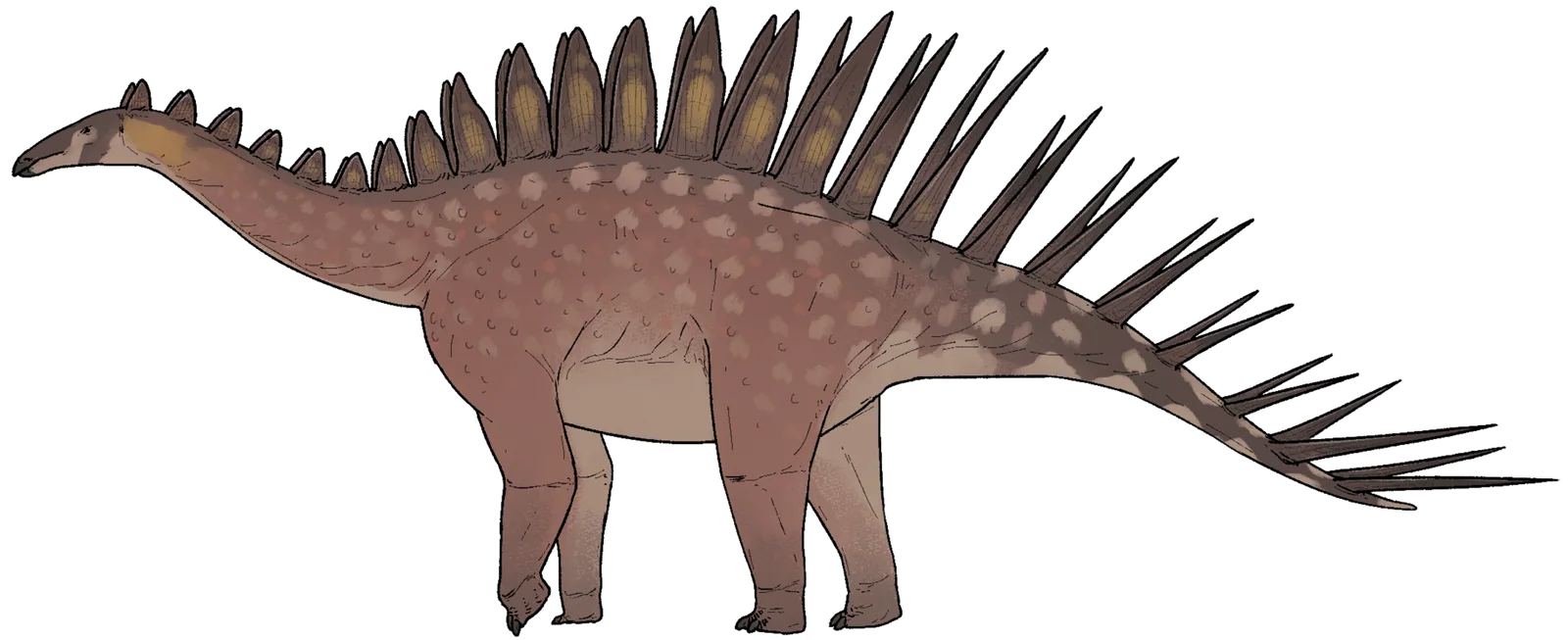
Miragaia longicollum was a Late Jurassic stegosaur from Portugal whose dramatically elongated neck expanded the known body plans of plated dinosaurs. The holotype preserves much of the front half of the skeleton, including rare stegosaur skull material, an articulated series of cervical vertebrae, forelimbs and plates. At least seventeen vertebrae formed the neck, eight more than the ancestral ornithischian count. Miragaia achieved this through adding vertebrae and incorporating back vertebrae into the neck, a pattern convergent with the neck evolution of sauropods. Later discoveries confirmed that Miragaia was anatomically distinct and closely related to Dacentrurus.
Its fossils occur between approximately 152 and 145 million years ago. Values shown here are approximate and reflect the current curated seed dataset.
Form and function
The neck contained at least seventeen cervical vertebrae and was both proportionally and numerically longer than in any other known stegosaur. Long cervical ribs overlapped adjacent vertebrae and helped stiffen the neck. The head remained small, with a toothless beak at the front and small leaf-shaped teeth farther back. Paired plates ran along the neck and back, changing into long narrow spines around the hips and tail. Because the holotype ends around the front of the pelvis, the exact arrangement of its rear armour is reconstructed partly from referred material and close relatives.
Evolutionary position
This simplified classification path shows one placement from Dinosauria to this species. Each step is clickable, and other analyses may support alternative relationships.
Open interactive positionScale
Simplified length comparison using preferred dataset estimates; body shape and posture are not represented.
Scientific record
Road construction near the villages of Miragaia and Sobral exposed fossil bone, leading Museu da Lourinhã teams to excavate the site in 1999 and 2001. Octávio Mateus, Susannah Maidment and Nicolai Christiansen named Miragaia longicollum in 2009 from the nearly complete anterior skeleton ML 433 and juvenile material ML 433-A. Miragaia refers to the locality and can also be read as 'wonderful goddess of the Earth'; longicollum combines Latin words for long and neck. A second partial skeleton described in 2019 helped confirm the genus and preserve more of its armour.
Naming authors: Octávio Mateus, Susannah C. R. Maidment, Nicolai A. Christiansen.
Palaeoenvironment
The Lourinhã Formation accumulated on a seasonally dry coastal plain crossed by rivers and flood channels. Its dinosaur fauna included the theropods Lourinhanosaurus, Ceratosaurus and Allosaurus, sauropods such as Lourinhasaurus, and other ornithischians. Miragaia's long neck could have expanded its feeding envelope above or around the body, but the plants it selected are not preserved with the skeleton.
Miragaia was a quadrupedal herbivore. Its unusually long neck probably gave it access to vegetation unavailable without moving the heavy body, and may have reduced direct feeding competition with shorter-necked stegosaurs. Display and mate competition have also been proposed as influences on neck evolution. Neither explanation can currently be isolated as the sole cause. The plates may have contributed to display or recognition, while tail spines could have served in defence.
Worth knowing
Fossil distribution
Lourinhã, Lisbon District, Portugal
Lourinhã Formation
regional marker
Markers are deliberately approximate. They identify published fossil areas without exposing sensitive excavation coordinates.
Open interactive mapFossil specimen record
Lourinhã, Portugal
The museum preserves the holotype ML 433 and associated juvenile material excavated near Miragaia and Sobral.
A research repository is not necessarily a public exhibit. Loan and display status can change, so check with the institution before visiting.
Media record
Evidence
Octávio Mateus, Susannah C. R. Maidment, Nicolai A. Christiansen · Proceedings of the Royal Society B 276(1663), 1815–1821 · 2009
Open sourceFrancisco Costa, Octávio Mateus · PLOS ONE 14(11), e0224263 · 2019
Open sourceMuseu da Lourinhã
Open source