Wucaiwan fossil area
Junggar Basin, Xinjiang, China
Shishugou Formation
regional marker
Pronunciation: MON-oh-LOF-oh-SORE-us jee-ANG-eye
A remarkably complete Middle Jurassic theropod from China with a single hollow crest running along the middle of its skull.
Last updated 23 July 2026
Field guide
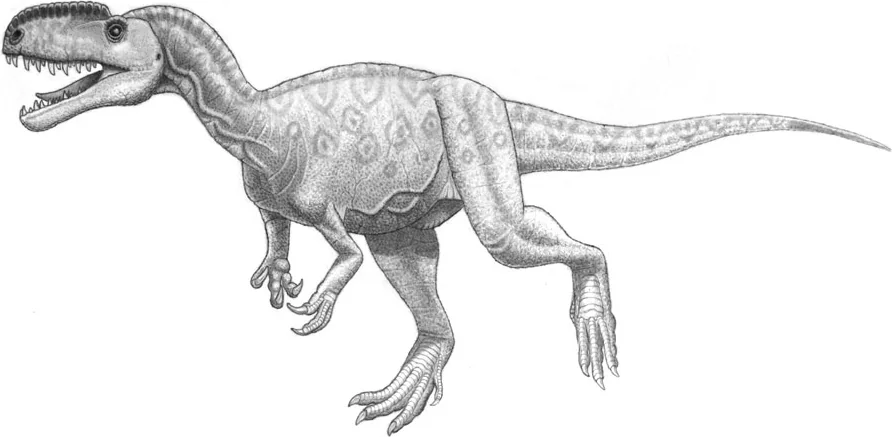
Monolophosaurus jiangi was a medium-sized predatory theropod from the Shishugou Formation of Xinjiang. It is known from one unusually informative skeleton that preserves an almost complete skull, much of the vertebral column, the pelvis and hind limbs. A tall median crest rises from the snout and continues over the skull roof. Internal openings connected parts of this crest to the antorbital air spaces, but it was not an inflatable structure. Monolophosaurus was originally interpreted as an allosauroid; later studies generally place it near the base of Tetanurae, making it important for understanding the early evolution of the group.
Its fossils occur between approximately 165 and 160 million years ago. Values shown here are approximate and reflect the current curated seed dataset.
Form and function
The skull was roughly eighty centimetres long and carried a single crest built mainly from the nasal and lacrimal bones. Grooves, ridges and openings gave the crest a complex surface and hollow interior. The jaws contained recurved, serrated teeth for cutting flesh. The neck and torso were strongly built, while the pelvis combined primitive features with traits seen in later tetanurans. Long hind limbs supported bipedal locomotion. The forelimbs are not preserved, so their proportions and hand anatomy must be inferred from related theropods.
Evolutionary position
This simplified classification path shows one placement from Dinosauria to this species. Each step is clickable, and other analyses may support alternative relationships.
Open interactive positionScale
Simplified length comparison using preferred dataset estimates; body shape and posture are not represented.
Scientific record
A Sino-Canadian expedition discovered the holotype IVPP 84019 in the Junggar Basin in 1981. Zhao Xijin and Philip Currie formally named Monolophosaurus jiangi in 1993. The genus refers to the single crest along the skull midline, while the species name honours Jiangjunmiao, the historical place-name associated with the fossil area. Detailed redescriptions of the skull and postcranial skeleton in 2010 clarified its anatomy and showed that it was a comparatively early-branching tetanuran rather than a specialized allosauroid.
Naming authors: Zhao Xijin, Philip J. Currie.
Palaeoenvironment
The Shishugou Formation records river channels, floodplains, wetlands and seasonally dry landscapes affected by volcanic activity. Monolophosaurus shared this ecosystem with the smaller crested tyrannosauroid Guanlong, sauropods, stegosaurs, crocodyliforms and mammals. Fossil-rich mud-filled depressions in the formation trapped some animals, although the Monolophosaurus holotype was not evidence of a social group.
Monolophosaurus was a bipedal predator whose serrated teeth were suited to cutting flesh. Its crest was too thin and air-filled to function as a heavy impact weapon. Visual species recognition or display is a plausible interpretation, but colour, sex differences and display behaviour are not preserved. The single known individual provides no evidence for pack hunting or sociality.
Worth knowing
Fossil distribution
Junggar Basin, Xinjiang, China
Shishugou Formation
regional marker
Markers are deliberately approximate. They identify published fossil areas without exposing sensitive excavation coordinates.
Open interactive mapFossil specimen record
Beijing, China
IVPP 84019 is the unique holotype skeleton and preserves the skull, axial column, pelvis and hind limbs.
A research repository is not necessarily a public exhibit. Loan and display status can change, so check with the institution before visiting.
Media record
Evidence
Zhao Xijin, Philip J. Currie · Canadian Journal of Earth Sciences 30(10–11), 2027–2036 · 1993
Open sourceStephen L. Brusatte, Roger B. J. Benson, Philip J. Currie, Zhao Xijin · Zoological Journal of the Linnean Society 158(3), 573–607 · 2010
Open sourceZhao Xijin, Roger B. J. Benson, Stephen L. Brusatte, Philip J. Currie · Geological Magazine 147(1), 13–27 · 2010
Open sourceNatural History Museum, London
Open source