Rosebery Downs type region near Muttaburra
Thomson River, central Queensland, Australia
Mackunda Formation
regional marker
Pronunciation: MUT-ah-BUR-ah-SORE-us LANG-don-eye
An iconic Australian ornithopod with an inflated muzzle, a remarkably complete type skeleton and a newly reconstructed skull shaped by CT scanning and fresh quarry finds.
Last updated 16 July 2026
Field guide
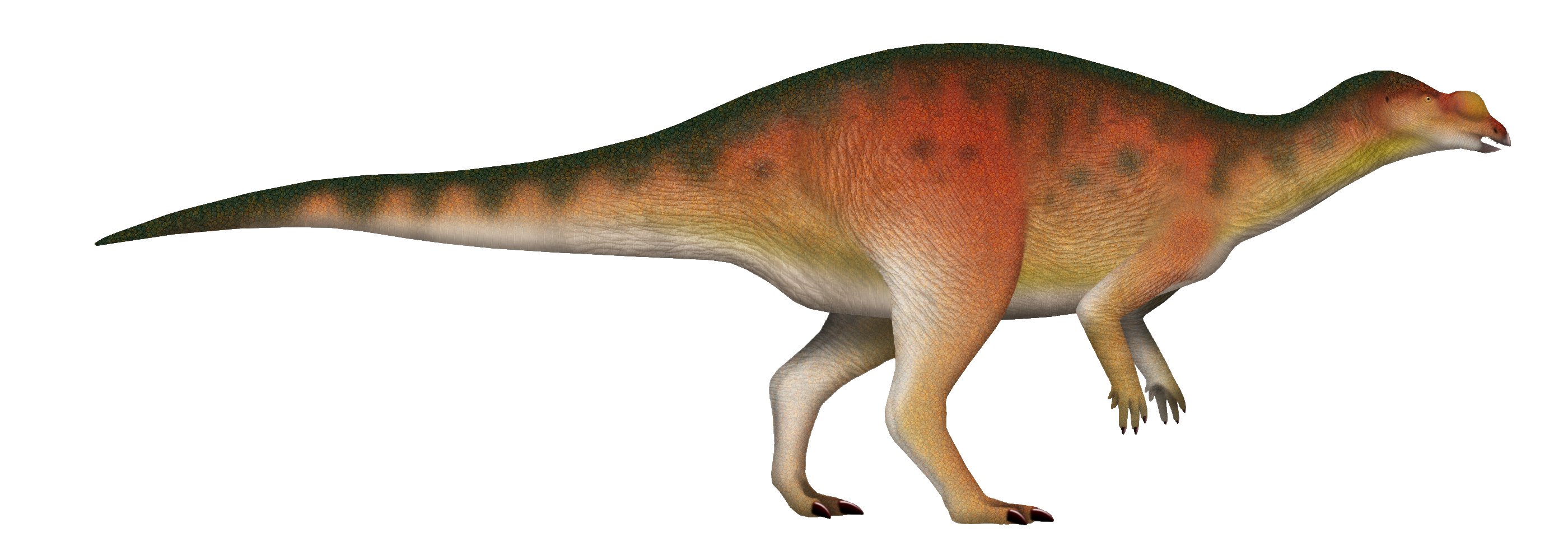
Muttaburrasaurus langdoni was a large mid-Cretaceous ornithopod from Queensland. The holotype preserves an almost complete skull and much of the skeleton, making it one of Australia's most informative dinosaurs. A major 2026 revision combined newly recovered bones from the original quarry with CT scans and digital reconstruction. It showed that the famous swollen muzzle was assembled differently from older restorations and that the front of the upper jaw retained five small teeth on each side. Its exact family position remains unresolved: the safest broad placement is Ornithopoda, while traditional iguanodontian and newer elasmarian interpretations require further testing.
Its fossils occur between approximately 96.3 and 93.5 million years ago. Values shown here are approximate and reflect the current curated seed dataset.
Form and function
The skull had a deep rounded muzzle formed by expanded bones around the nostrils, strong jaw-closing musculature and large shearing cheek teeth. Newly identified premaxillary teeth show that the front of the mouth was not completely toothless. CT-based reconstructions indicate large olfactory bulbs, broad sideways visual fields and hearing best suited to relatively low frequencies. Its powerful hind limbs and shorter but robust forelimbs support facultative bipedalism: it could move and feed on all fours while retaining the ability to stand or travel on two legs.
Evolutionary position
This simplified classification path shows one placement from Dinosauria to this species. Each step is clickable, and other analyses may support alternative relationships.
Open interactive positionScale
Simplified length comparison using preferred dataset estimates; body shape and posture are not represented.
Scientific record
Grazier Doug Langdon noticed fossil bones at Rosebery Downs near Muttaburra in 1963. Queensland Museum staff recovered the scattered skeleton from the bank of the Thomson River, and Alan Bartholomai and Ralph Molnar named Muttaburrasaurus langdoni in 1981. The holotype is QM F6140. A second skull from Dunluce Station near Hughenden and other isolated remains expanded the record. Newly recognised fragments associated with the holotype, CT imaging and renewed study of the type locality helped complete the 2026 reconstruction.
Discovery credit: Doug Langdon, Queensland Museum field team.
Naming authors: Alan Bartholomai, Ralph E. Molnar.
Palaeoenvironment
The type skeleton was buried in marine mud of the Mackunda Formation after the carcass probably washed from a nearby coastal plain into the Eromanga Sea. On land, Muttaburrasaurus would have inhabited conifer, cycad and fern vegetation along rivers and low coastal terrain. The fossil's marine burial environment is therefore not the same as the habitat in which the animal spent most of its life.
The revised jaws support selective browsing on resistant vegetation rather than the older idea of a simple cropping beak. Small front teeth may have helped strip cones or other tough food, and occasional invertebrate feeding is possible, but direct gut contents are unknown. Digital brain and inner-ear models suggest strong smell, limited binocular overlap and sensitivity to lower-frequency sounds. None of these features establishes herd structure or a specific call.
Worth knowing
Fossil distribution
Thomson River, central Queensland, Australia
Mackunda Formation
regional marker
Near Hughenden, Queensland, Australia
Allaru Mudstone
regional marker
Markers are deliberately approximate. They identify published fossil areas without exposing sensitive excavation coordinates.
Open interactive mapFossil specimen record
Brisbane, Queensland, Australia
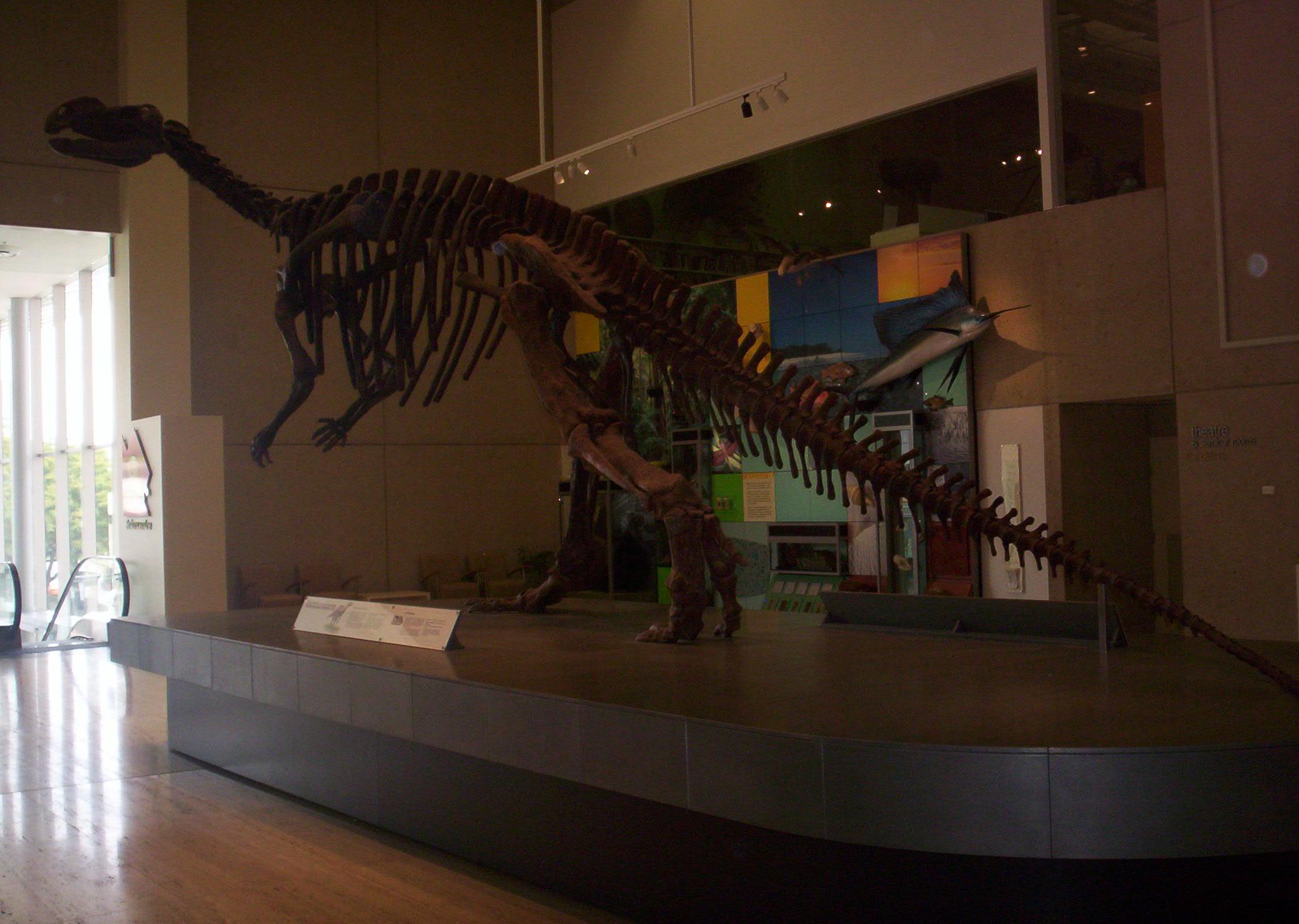
Repository of the original Muttaburrasaurus langdoni holotype and additional Queensland material. A skeletal cast has long been mounted for display, but gallery arrangements can change.
Sydney, New South Wales, Australia
Displays a cast of the famous Queensland skeleton and holds possible related opalised material from Lightning Ridge. The cast is not the name-bearing original.
A research repository is not necessarily a public exhibit. Loan and display status can change, so check with the institution before visiting.
Media record
Evidence
Alan Bartholomai, Ralph E. Molnar · Memoirs of the Queensland Museum 20 · 1981
Open sourceMatthew C. Herne, Joseph J. Bevitt, Luke Milan and 7 coauthors · PeerJ 14, e20794 · 2026
Open sourceAustralian Museum
Open sourceQueensland Museum
Open source