Grange Chine fossil region
Southwest coast of the Isle of Wight, United Kingdom
Wessex Formation
regional marker
Pronunciation: NEE-oh-ven-AY-tor sah-LAIR-ee-eye
A large Early Cretaceous allosauroid from the Isle of Wight, represented by much of the skeleton and a remarkably complex sensory network inside its snout.
Last updated 2 August 2026
Field guide
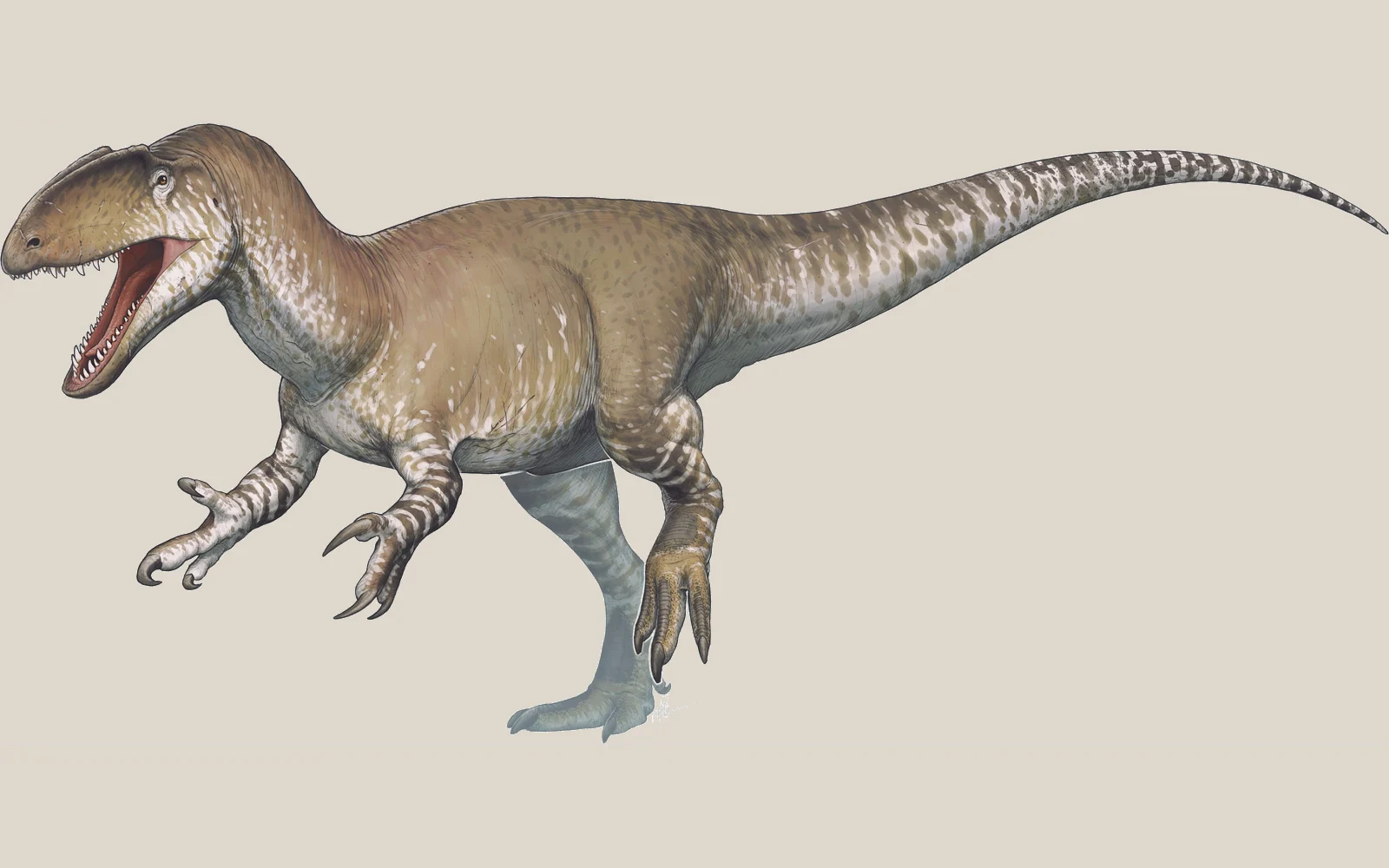
Neovenator salerii was a large, lightly built predatory theropod from the Early Cretaceous Wessex Formation of the Isle of Wight. The holotype and referred material together represent about 70 percent of the skeleton, making it the most complete large theropod known from Europe. It had a deep, narrow skull with serrated blade-like teeth, powerful three-fingered arms, long hind limbs and a stiff balancing tail. CT scans revealed an extensive network of nerve and blood-vessel canals inside the snout, suggesting enhanced facial sensitivity. Neovenator was an allosauroid, although analyses differ over whether it belongs in a distinct Neovenatoridae or close to the base of Carcharodontosauridae.
Its fossils occur between approximately 130 and 125 million years ago. Values shown here are approximate and reflect the current curated seed dataset.
Form and function
The skull was deep and laterally compressed, with a large nasal opening and recurved, serrated teeth. Numerous small openings peppered the face and connected to branching internal canals carrying parts of the trigeminal nerve and blood vessels. The neck and trunk vertebrae contained extensive air spaces, while robust shoulder and arm bones supported three-clawed hands. Long hind limbs, narrow feet and a muscular tail produced the balanced bipedal build typical of large allosauroids.
Evolutionary position
This simplified classification path shows one placement from Dinosauria to this species. Each step is clickable, and other analyses may support alternative relationships.
Open interactive positionScale
Simplified length comparison using preferred dataset estimates; body shape and posture are not represented.
Scientific record
The first remains were exposed after part of Grange Chine collapsed during a storm in 1978. A long programme of collecting recovered pieces of a large theropod from the Wessex Formation, alongside bones later recognized as the ornithopod Brighstoneus. Steve Hutt, David Martill and Michael Barker named Neovenator salerii in 1996. The genus means new hunter and the species honours the Salero family, owners of the land. A detailed 2008 monograph united the holotype and referred material into an anatomical description covering about 70 percent of the skeleton.
Naming authors: Steve Hutt, David M. Martill, Michael J. Barker.
Palaeoenvironment
Neovenator lived on the warm, seasonally wet floodplains of the Wessex Formation. Rivers crossed a landscape of conifers, cycads, ferns and flowering plants, while wildfires and floods regularly disturbed the environment. Potential prey included Iguanodon, Mantellisaurus, Hypsilophodon and young sauropods. The Grange Chine marker is deliberately generalized along the eroding southwest Isle of Wight coast.
Its teeth and allosauroid skull identify Neovenator as a terrestrial predator of vertebrate prey and carrion. The sensitive snout may have helped it control bites, strip flesh, manipulate objects or communicate through facial contact, but no single behaviour can be demonstrated. Tooth wear has been interpreted as consistent with avoiding hard bone. Hunting style, sociality and parental care remain unknown.
Worth knowing
Fossil distribution
Southwest coast of the Isle of Wight, United Kingdom
Wessex Formation
regional marker
Markers are deliberately approximate. They identify published fossil areas without exposing sensitive excavation coordinates.
Open interactive mapFossil specimen record
Sandown, Isle of Wight, United Kingdom
Dinosaur Isle cares for the original Isle of Wight collection that includes the holotype MIWG 6348 and associated Neovenator material; the museum presents the island's large predator in its galleries.
A research repository is not necessarily a public exhibit. Loan and display status can change, so check with the institution before visiting.
Media record
Evidence
Steve Hutt, David M. Martill, Michael J. Barker · Neues Jahrbuch für Geologie und Paläontologie, Monatshefte 1996, 635-644 · 1996
Open sourceStephen L. Brusatte, Roger B. J. Benson, Steve Hutt · Palaeontographical Society Monograph 162 · 2008
Open sourceChris Tijani Barker, Darren Naish, Elis Newham and 2 coauthors · Scientific Reports 7, 3749 · 2017
Open sourceGB3D Type Fossils
Open sourceDinosaur Isle Museum
Open source