Haystack Butte fossil region
Southern Zuni Basin, Catron County, New Mexico, United States
Moreno Hill Formation
regional marker
Pronunciation: noh-THRON-ih-kus muh-KIN-lee-eye
North America's first definitively recognized therizinosaur, a broad-bodied theropod with leaf-shaped teeth, four-toed feet and enormous curved hand claws.
Last updated 7 August 2026
Field guide
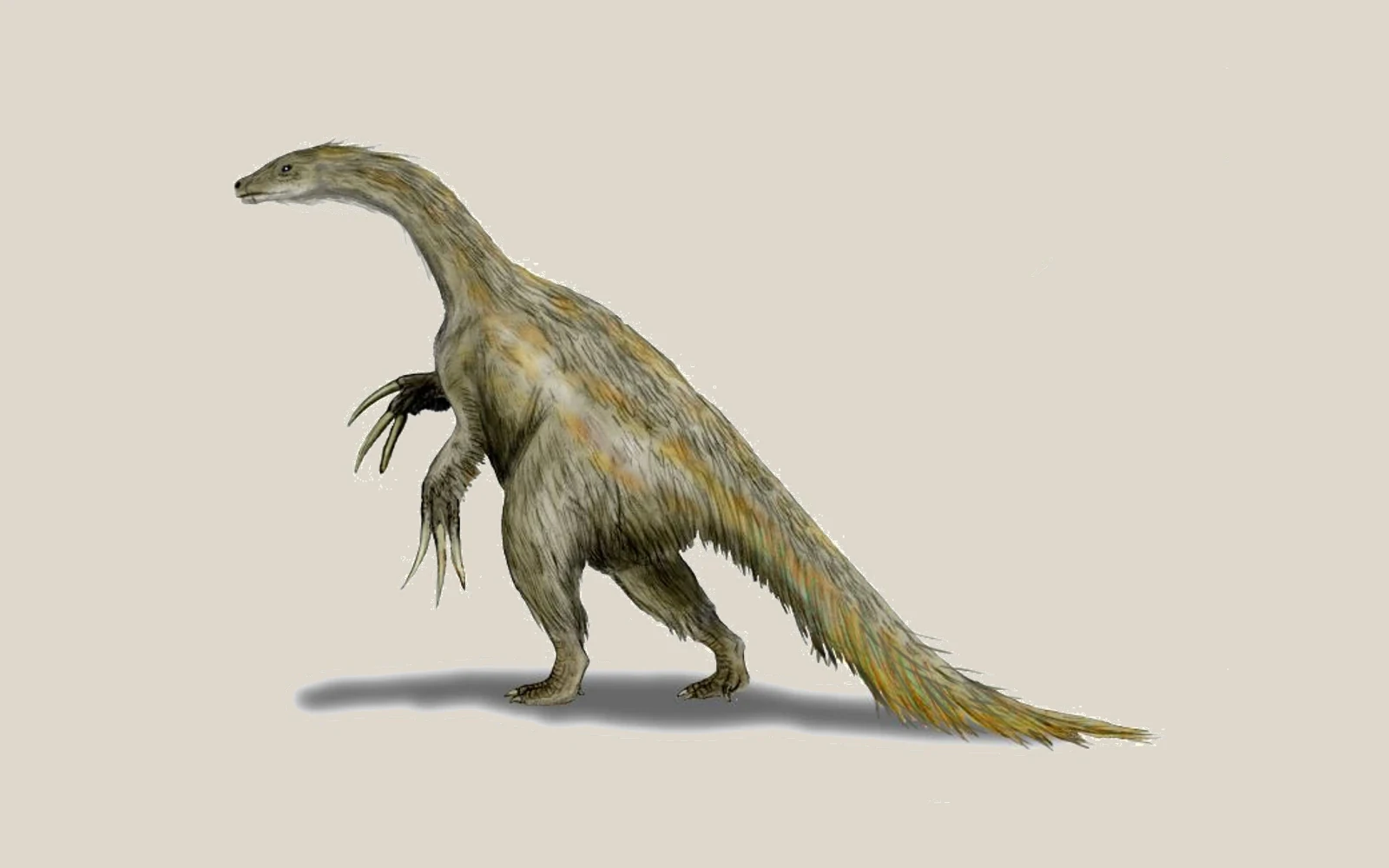
Nothronychus mckinleyi was a specialized therizinosaurid from the middle Turonian Moreno Hill Formation of New Mexico. Although descended from predatory theropods, it combined a small head, long neck, broad gut, backward-directed pubis and coarse leaf-shaped teeth suited to a strongly plant-based or omnivorous diet. Its holotype, MSM P2117, is a partially disarticulated skeleton preserving teeth, a partial braincase, vertebrae and substantial parts of all four limbs and the pelvis. It became the first definitive therizinosaur recognized in North America and demonstrated that this predominantly Asian lineage had crossed into western North America by about 92 million years ago.
Its fossils occur between approximately 92 and 91 million years ago. Values shown here are approximate and reflect the current curated seed dataset.
Form and function
Nothronychus had a small head on a long neck, a wide torso and a shortened tail. The preserved teeth are tall, narrow, leaf-shaped and coarsely serrated. Long arms ended in three strongly curved claws, while expanded hips and a backward-pointing pubis created room for a large digestive system. Both feet carried four functional forward-facing toes rather than the three-toed weight-bearing pattern of most theropods. The partial braincase is heavily air-filled and preserves canals for cranial nerves and the inner ear. A shaggy feather covering is plausible from related therizinosaurs but is not directly preserved with MSM P2117.
Evolutionary position
This simplified classification path shows one placement from Dinosauria to this species. Each step is clickable, and other analyses may support alternative relationships.
Open interactive positionScale
Simplified length comparison using preferred dataset estimates; body shape and posture are not represented.
Scientific record
A field team led by James Kirkland and Douglas Wolfe excavated the specimen during the early to mid-1990s at Haystack Butte in the southern Zuni Basin. One unusual ischium was initially mistaken for a skull bone of Zuniceratops from the same bonebed; additional discoveries revealed a giant-clawed theropod instead. Kirkland and Wolfe named Nothronychus mckinleyi in 2001. The genus combines Greek words for slothful and claw, referring to its sloth-like appearance, and the species honours rancher Bobby McKinley. A detailed 2015 study redescribed the skeleton and showed that river currents had transported, sorted and concentrated its bones with logs and other animals.
Discovery credit: James I. Kirkland, Douglas G. Wolfe and field team.
Naming authors: James I. Kirkland, Douglas G. Wolfe.
Palaeoenvironment
Nothronychus lived on the humid river floodplains of the Moreno Hill Formation near the western shore of the Western Interior Seaway. Conifers, ferns and early flowering plants supported large herbivores, including the horned dinosaur Zuniceratops, while tyrannosauroids and other predators shared the ecosystem. The holotype accumulated in a current-sorted bonebed containing plant debris and bones from several animals. The map marker represents the generalized Haystack Butte region rather than a protected quarry coordinate.
Its broad torso, retroverted pubis and leaf-shaped teeth are consistent with a large fermentation chamber and a mainly plant-based diet, although small animals or insects may also have been eaten. The long claws could have drawn branches inward, defended the animal or served in display, but no preserved trace identifies one exclusive use. The inner ear and braincase have prompted hypotheses about posture and hearing; claims of specialized low-frequency communication remain tentative. There is no direct evidence for herding, nesting or social care.
Worth knowing
Fossil distribution
Southern Zuni Basin, Catron County, New Mexico, United States
Moreno Hill Formation
regional marker
Markers are deliberately approximate. They identify published fossil areas without exposing sensitive excavation coordinates.
Open interactive mapFossil specimen record
Mesa, Arizona, United States
The museum cares for the original holotype MSM P2117, including the partial braincase, teeth, vertebrae and limb and pelvic bones examined in the detailed osteological studies. Public display of the original material is not guaranteed, so visitors should check current galleries before travelling.
A research repository is not necessarily a public exhibit. Loan and display status can change, so check with the institution before visiting.
Media record
Evidence
James I. Kirkland, Douglas G. Wolfe · Journal of Vertebrate Paleontology 21(3), 410-414 · 2001
Open sourceBrandon P. Hedrick, Lindsay E. Zanno, Douglas G. Wolfe, Peter Dodson · PLOS ONE 10(6):e0129449 · 2015
Open sourceDavid K. Smith, R. Kent Sanders, Douglas G. Wolfe · PLOS ONE 13(7):e0198155 · 2018
Open sourceNatural History Museum, London
Open sourceArizona Museum of Natural History
Open source